
I used to carry so much junk into the woods that my pack weighed damn near forty pounds. Fire starter. Backup fire starter. Backup backup fire starter. A hatchet I never used. Three knives because “you never know.” A folding shovel. A full first aid kit that could have serviced a small clinic. Emergency blankets. Emergency calories. An entire camp kitchen stuffed into a stuff sack. I was prepared for the apocalypse and I was hunting whitetails two miles from a road.
It took me about six years to figure out that every ounce in your pack is an ounce you have to carry up a ridge at 5:00 AM in the dark. By year three my lower back was sending me memos I couldn’t ignore. By year five I had a knee that clicked when I walked downhill. By year six I finally started throwing things out of my pack like I was bailing water from a sinking boat.
The 87-Cent Multitool That Almost Killed Me
The low point was a gas station multitool I bought on the drive up to camp because I’d forgotten my Leatherman. It cost $12.99. The pliers folded under moderate pressure — the kind of pressure you apply to, say, a tent stake — and the screwdriver bent on the first screw it met. The “knife” blade was stamped from metal so soft you could probably sharpen it with a fingernail. I threw it into the fire on the last night. It didn’t deserve to be packed out.
That’s when I started paying attention to what I actually used. Not what looked cool on a gear list. Not what Instagram hunters were shilling. What I reached for. What stayed in the pack trip after trip without ever being touched. The difference between what you think you’ll need and what you actually need is the weight of a small dog, and carrying a small dog for eight miles will humble any man.

The Stuff I Actually Use Now
After a decade of trial and error — mostly error — here’s what survived the purge. This isn’t a buying guide. It’s a list of things that didn’t break, didn’t weigh me down, and actually earned their spot in the pack.
Binoculars. Not a scope. Not a spotting scope unless you’re hunting open country out west. An 8×42 or 10×42 set of binoculars gets more use than anything else in my kit. I’ve used a $200 pair. I’ve used a $1,000 pair. The difference is real at dawn and dusk, but what matters most is that you actually have them around your neck, not buried in your pack. If they’re in the pack, you won’t use them. If you won’t use them, you don’t need them. Get a harness. Wear them. They’ll save your legs more than any piece of gear you own.
One good knife. I used to carry three. Now I carry one — a fixed-blade with a four-inch drop point. It guts, skins, trims branches, opens packages, spreads peanut butter. You don’t need a survival knife with a sawback spine and a hollow handle full of matches. That’s movie gear. Get one knife that holds an edge and keep it sharp. If you want a backup, put a Swiss Army Classic on your keychain. It weighs an ounce. Done.
A headlamp with a red mode. The red mode matters because white light at 4:30 AM announces your presence to every deer within half a mile. Some people will argue this. Those people hunt from heated box blinds and don’t care. If you’re walking in, walking out, or field dressing in the dark, a headlamp with red mode costs maybe thirty bucks and you’ll use it every single time. Petzl and Black Diamond both make reliable ones. Replace the batteries before every season, even if the old ones “still work.”
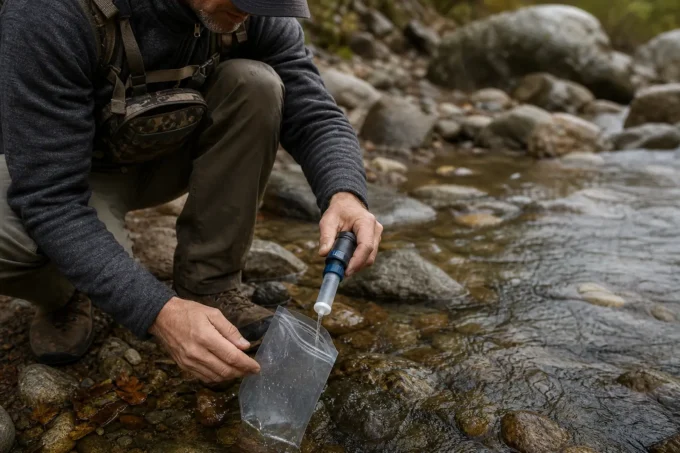
A water filter, not water bottles. I used to carry two liters of water into the woods. That’s about four and a half pounds. Now I carry a Sawyer Squeeze — three ounces — and drink from wherever I find water. This only works if you’re hunting near water, but most of the good spots are. The filter costs thirty dollars and saves you more weight than anything else on this list. If you’re going somewhere without reliable water, carry a single liter and know where your next fill is.
Rain gear that actually works. I’ve owned three sets of rain gear in my life. The first was a $40 set that soaked through in forty minutes. The second was a $150 set that soaked through in two hours. The third was a Gore-Tex shell I bought used on a forum for about the same price as the second. It turns water for eight hours straight. Buy used high-end rain gear instead of new budget rain gear. The budget stuff fails at exactly the moment you need it most, and being wet and cold in the backcountry is how bad decisions get made.
What Got Cut
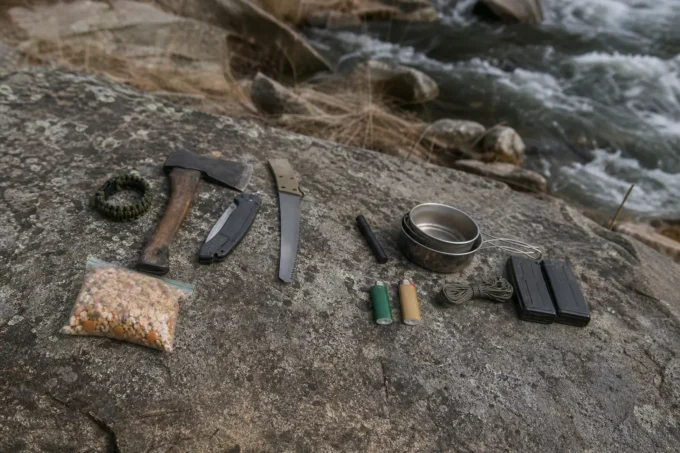
The hatchet. The backup knife. The camp kitchen. The folding saw that I used exactly once to cut a branch I could have broken with my boot. The extra magazines I never fired. The emergency rations that expired in 2017. The paracord bracelet I wore for three years and never unraveled. The ferro rod that I loved in theory and absolutely hated whenever I actually needed fire. Two lighters weigh less and work better. I’ll argue with anyone about this.
My day pack now weighs about fourteen pounds fully loaded, including water and a thin layer. My overnight pack adds a sleeping bag, a bivy sack, and a stove — maybe twenty-two pounds total. I can walk all day with that. My knees don’t hurt. I don’t dread the hike in. And I still have everything I actually need.
The Real Lesson
Good gear isn’t about brands or price tags. It’s about whether the thing works when you need it, every single time, without making your life harder. Most of the fancy stuff you see at outdoor retailers is designed to look good on a shelf, not perform well in a downpour. The companies that win are the ones that make simple things that don’t break. Sawyer. Petzl. Leatherman. Vortex. Companies that have been making the same basic product for twenty years because the design was right the first time.
If you’re new to this and trying to figure out what to buy, here’s the only rule that matters: buy the lightest version of the thing that doesn’t break. If the lightest version breaks, go up one weight class. Keep doing that until you find the version that survives. Everything else is marketing.
And for god’s sake, leave the hatchet at home.