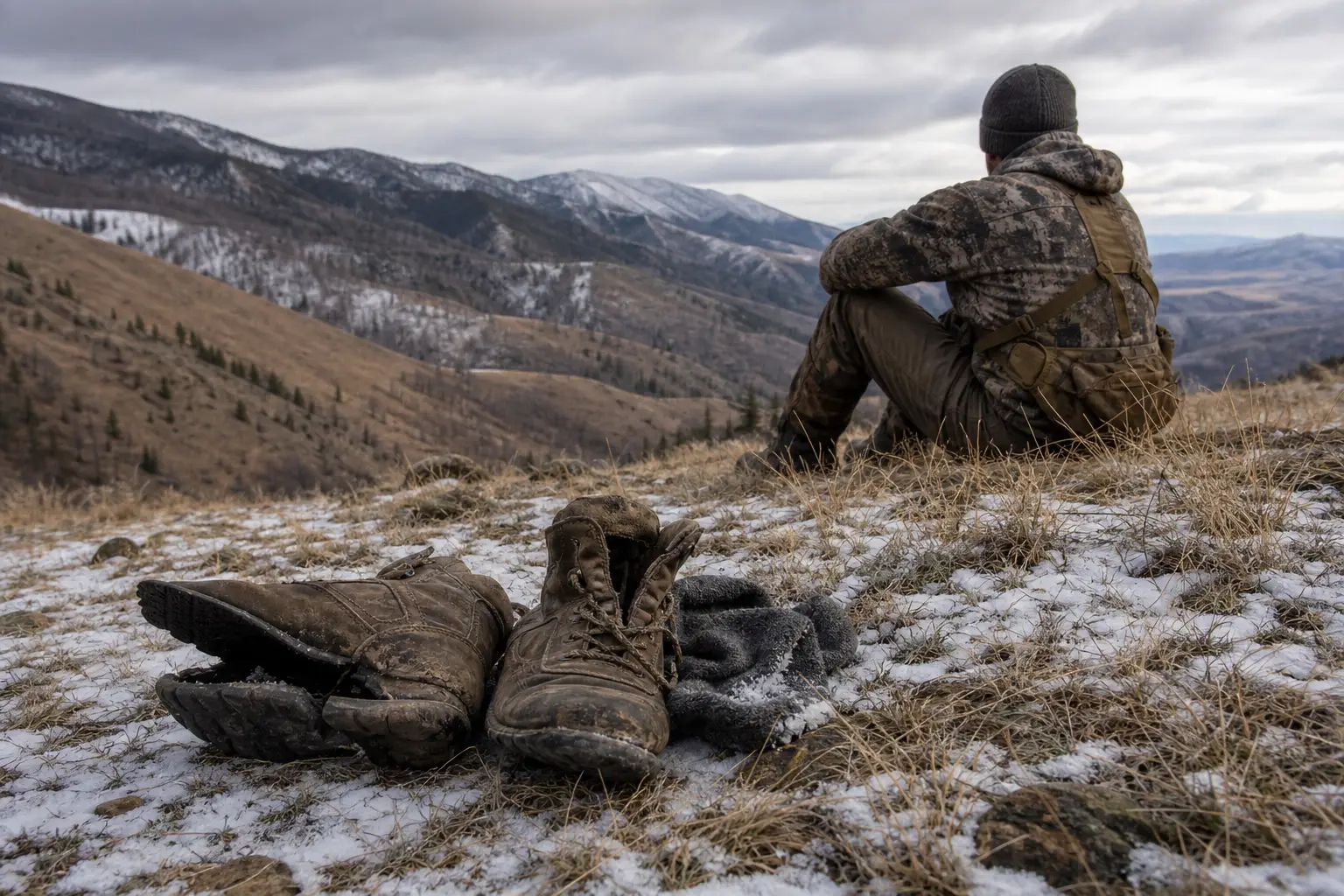
I paid forty-three dollars for my first pair of hunting boots. That should tell you everything right there.
I was twenty-two, had just moved to Montana for a seasonal job, and had exactly enough money for rent, gas, and a six-pack of something cheap. Hunting season was three weeks away. I needed boots, and I needed them now. So I drove to the Walmart in Missoula, walked past the aisle with the actual hunting gear, and grabbed a pair of brown work boots from the clearance rack. Forty-three dollars. Waterproof — said so right on the tag. Insulated — some kind of felt liner that felt warm when I tried them on in the air-conditioned store. I figured I’d outsmarted the system.
Reader, I had not outsmarted the system.
The First Year Went Fine (Kind Of)
Actually, the first season wasn’t terrible. I hunted mostly flat ground within a mile of the road. The boots held up. My feet got damp a couple times, but nothing a second pair of socks couldn’t fix. I told myself I’d made a smart purchase. Told my buddy Dave, who’d spent two hundred and sixty bucks on some Crispis, that he was a sucker.
Dave just looked at me the way a mechanic looks at a guy driving on a donut spare for three months. Like he knew something I was about to learn.
The Year They Died
Second season. Late October. I’d drawn a general deer tag for a unit about two hours east of town. It was the kind of country where you park at the end of a gravel road and walk in before first light, up a drainage that gets steeper the farther you go. I’d scouted it on Google Earth like a pro. What I hadn’t scouted was my footwear.
The morning started perfect. Twenty-eight degrees, light wind, fresh snow on the north slopes. I hiked in about an hour before shooting light, found a knoll with a good view of three drainages, and sat down to glass. Saw a couple does. Nothing with antlers. Around ten I decided to push farther up the ridge, farther than I’d ever gone in that unit.
That’s when the sole of my left boot started talking to me.
Flap. Flap. Flap. The front three inches of the sole had separated from the upper. Every step sounded like a pancake hitting a countertop. I stopped, looked at it, cursed, and kept going. I was four miles from the truck. Turning back felt like quitting, and I wasn’t a quitter. I was an idiot, but not a quitter.
The Mud Section
Around noon I crossed a small creek. The boots were supposedly waterproof. Dry feet guaranteed, said the tag. I stepped in, ankle deep, and felt water immediately. Cold water. The kind of cold that makes your foot cramp. I scrambled out the other side, sat on a log, and pulled the boot off. The felt liner was soaked. The “waterproof membrane” — I put that in quotes because I’m pretty sure it was just a plastic bag glued to the inside — had torn somewhere between the creek and my last step.
I wrung out my sock. It was eleven thirty in the morning. I had at least five hours of daylight left. My left foot was already going numb.
I should have turned around right there. That’s what any normal person would do. But I’d seen a decent buck track crossing the mud about a hundred yards up the drainage, and my brain — still twenty-two years old and allergic to good decisions — decided that a warm sleeping bag and dry socks were less important than finding that deer.
The Walk Out
I never found the buck. I followed those tracks for another hour and a half, up and over a saddle, and lost them in a patch of blowdown. By then my left boot was basically a sandal. The right one was starting to go too — the heel had cracked clean across, and every downhill step made a grinding sound like chewing gravel.
At two in the afternoon, with dark coming by six and a storm front moving in, I finally admitted defeat. I turned around and started walking.
What followed was the longest four miles of my life.
The left boot gave up completely about half a mile in. The sole peeled off like a banana skin and I left it lying in the mud somewhere. I don’t remember exactly where. I remember looking at it and thinking it wasn’t worth the effort to bend down and pick it up. So I walked the last three and a half miles with one boot and one sock. The sock was a wool blend — decent, not great — and it lasted about a mile before it had holes in the heel and toe. After that it was bare foot on frozen ground.
Let me tell you something about walking barefoot on frozen ground for three miles. It’s not the cold that gets you first. It’s the rocks. Every sharp little chunk of gravel feels like stepping on a LEGO. Then the cold kicks in, and your foot goes past numb into something worse — that deep ache in the bones that makes you think about frostbite, which you’ve read about but never actually worried about, because you always assumed you were smart enough not to be in this situation.
I was not smart.
The Truck
I got back to the truck at five forty. The sun was already behind the ridge. My right boot was held together by two strips of duct tape I’d found in the glove box — I’d stopped twice to re-wrap it, kneeling in the dirt, hands shaking because I couldn’t feel my fingers either. My left foot was a mess. Blisters on the heel and both toes. The pad was raw, like I’d been walking on sandpaper. The skin between my toes had split from the moisture and cold.
I sat in the driver’s seat with the heat on full blast for twenty minutes before I could feel my feet again. Then I drove home, took a shower, and threw both boots in the dumpster behind my apartment building. The dumpster made a hollow clang. Felt appropriate.
What I Learned (The Hard Way)
Here’s the thing about cheap gear. It’s not about the money. The boots cost forty-three dollars, which sounds like a steal until you realize I spent almost that much on gas to get to the trailhead and back. The real cost was the hunt itself. I blew an entire day, walked away with nothing, and put myself in a situation that could’ve been serious if the weather had turned worse or if I’d been farther from the road.
I’m not saying you need to spend four hundred dollars on boots. I’m saying the gap between forty-three dollars and a hundred and fifty is the biggest jump in quality you’ll ever make. Forty-three-dollar boots are made for walking from the parking lot to the office. A hundred and fifty gets you actual leather, an actual waterproof membrane, and an actual sole that was attached by someone who gave a damn.
The boots I wear now cost two hundred and ten dollars. I bought them five years ago. They’ve been through three elk seasons, more deer hunts than I can count, and one very unfortunate encounter with a bog that I’d rather not talk about. The sole is still attached. The waterproofing still works. I can still feel my toes after a ten-mile day.
Dave still reminds me about the forty-three-dollar boots every time we hunt together. He’ll look down at his Crispis, look at mine, and say something like, “You paying attention now?” I don’t have a good comeback. He was right. He was right in year one, year two, and he’s still right.
If you’re new to hunting and you’re looking at the price of real boots and thinking you can get away with something cheaper — I get it. I was you. Budget is real, and the entry cost of this sport is stupid high. But if you’re going to cheap out on something, let it be your camo. Let it be your hat. Hell, let it be your knife. Just don’t let it be the thing between your feet and twenty square miles of frozen Montana dirt.
Because walking out of the woods in socks sounds funny until you’re doing it.