The Four Hundred Dollar Feather Pillow
I spent four hundred dollars on a down jacket the way a nervous man buys flood insurance. I read the fill power number like it was scripture. I held the thing in the store and squeezed it until my knuckles went white, the way you squeeze a handshake from somebody you are about to trust with your life in February. Eight hundred fill power. Goose down. Baffled construction. I said the words out loud to my wife, who does not care about any of this, and she nodded the way you nod at a man describing a dream he had about a ladder.
The jacket was the warmest object I had ever owned. I wore it everywhere the first week, the way you wear a new relationship. I wore it to get the mail in July. I stood in the backyard in August and let it insulate me against nothing, just to feel it do its job. A down jacket does not keep you warm the way a heater keeps a room warm. It traps the heat your own body already made, the way a friend keeps a secret you told them. You are the source. The jacket just refuses to let it leak away. That was the whole point, and I understood none of it, because I had never actually read past the fill power number on the tag.
The Stupid Thing a Stubborn Man Does First
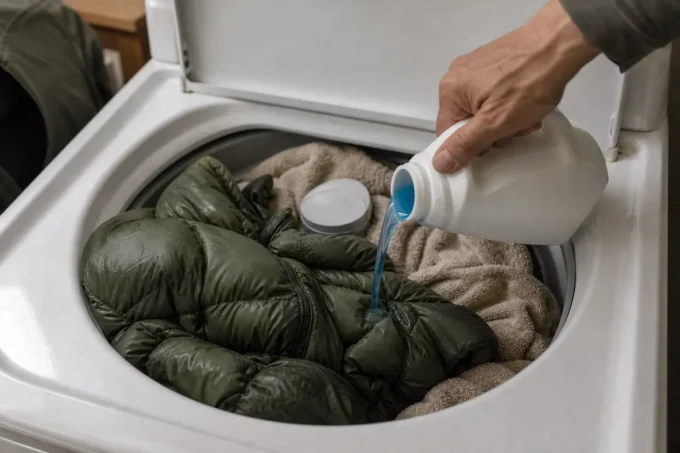
Nobody wrecks a down jacket on purpose. I wrecked mine out of love, which is the same way a child drowns a goldfish by changing its water too often. The jacket got dirty. That was it. A season of campfire smoke and spilled coffee and one memorable incident with a pine tree that decided to bleed sap on my shoulder. So I did what any adult man does when a four hundred dollar jacket gets a spot on it. I threw it in the washing machine with a regular load of towels and poured in the same detergent I use on my socks.
Let me slow down for the younger men in the room, because I was once where you are. A down jacket is not a hoodie. Inside that nylon shell are thousands of tiny feathers, and each one is shaped like a tiny claw that hooks into its neighbor. That claw is what makes the jacket puff up. That puff is what makes it warm. Warmth is not in the feather. Warmth is in the space between feathers, the little pockets of dead air the jacket holds still. When you wash it with regular soap and throw it in a machine that spins and agitates, the soap strips the natural oil off every feather, and the agitation beats the little claws flat, and the pockets of air collapse into a soggy mat that looks like a dead pigeon inside a sandwich bag.
The Moment You Realize You Killed It
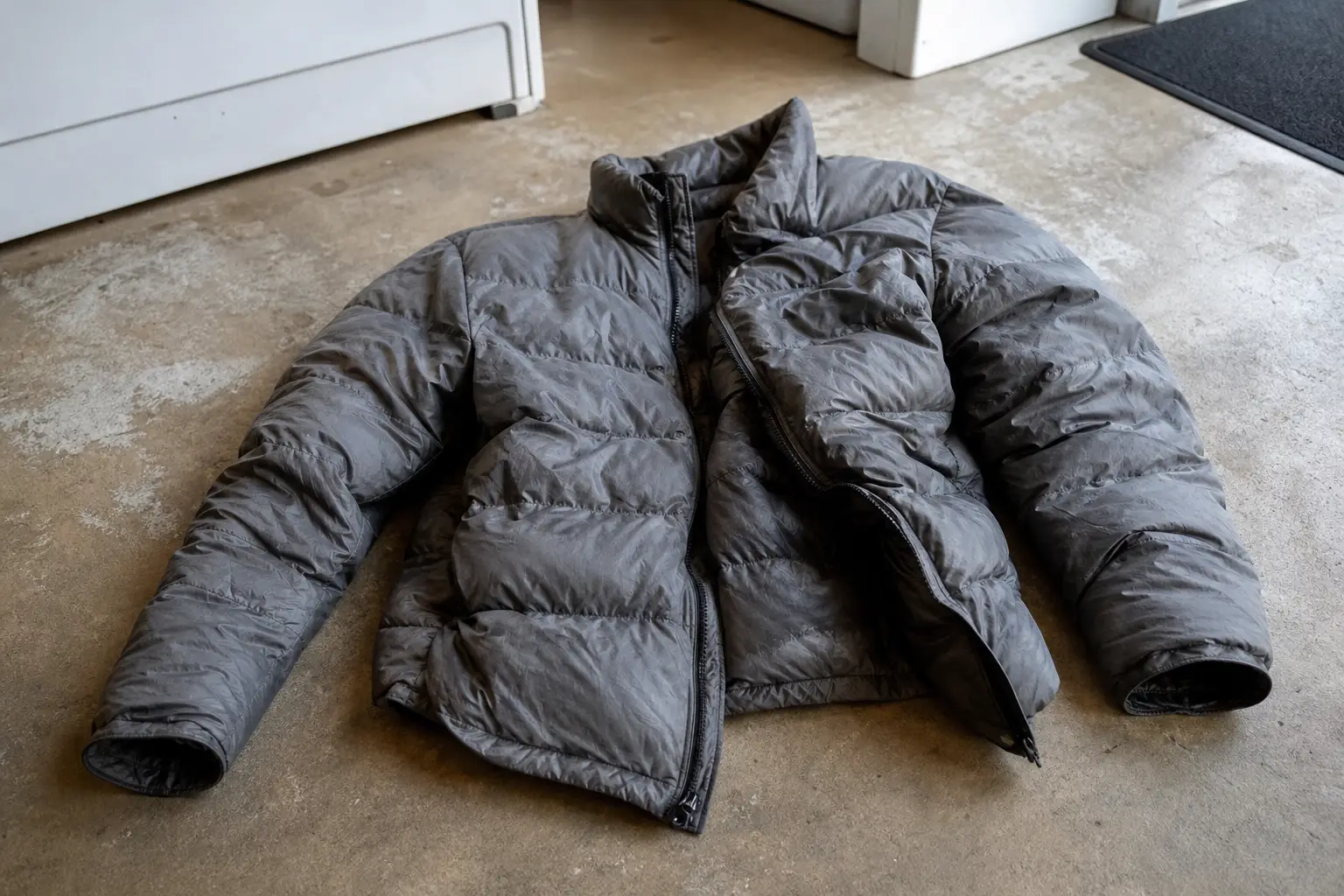
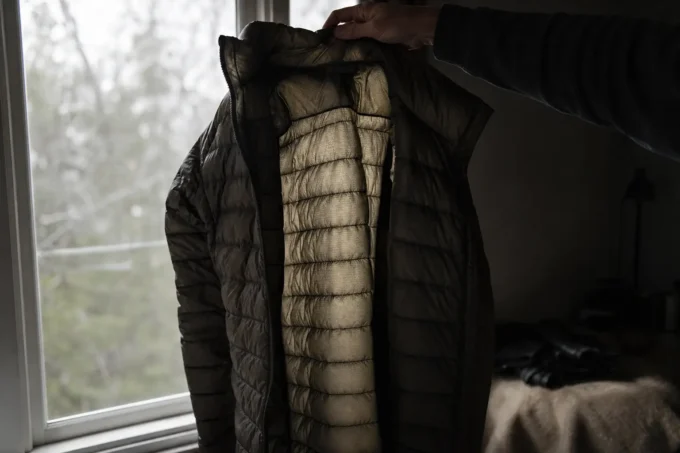
I pulled the jacket out of the dryer and knew before I touched it. It was heavy in a way a down jacket should never be heavy. The baffles hung flat like deflated balloons the morning after a birthday party. I held it up to the window and the light went straight through where it used to be stopped. The jacket was not a jacket anymore. It was forty dollars worth of fabric and about three hundred and sixty dollars worth of ruined feathers, all sewn together into a monument to my own shortcut.
Here is the part where I tell you I panicked. I did the thing every panicked man does. I Googled it. How to fix a down jacket after washing it wrong, I typed, as if the internet had been holding a secret the tag on the collar had refused to share. The internet, which has never once let me down when I needed to feel worse about myself, told me the truth in one cruel sentence. You cannot un-clump down. Once the feathers mat together, they do not un-mat. You can fluff them a little in the dryer with tennis balls, but the jacket will never be what it was. The loft is gone. The warmth has left the building and it is not coming back on a retainer.
The Tennis Ball Ritual of a Desperate Man
I did not accept this. A four hundred dollar mistake is the kind of number that makes a man argue with physics. I found some tennis balls. I read a comment from a man on a forum who swore by dryer balls, and another who said use more, always more, and a third who said the secret was drying it on no heat for two hours while you pace the laundry room like the father of a sick child. I did all of it. I threw the jacket back in the dryer with four tennis balls and set it on air fluff and stood there listening to it thump against the drum like a sneaker in an empty hallway.
It helped a little. The tennis balls beat the clumps apart at the edges. Some of the loft came back the way a mattress reinflates a little when you stop sitting on the same corner. But the jacket never puffed back to what it was. It was warm still, in the way a moderately thick sweater is warm. It was a thing that used to be a down jacket, and now it was a thing that used to be a down jacket, and there is a real difference between those two sentences that I had spent four hundred dollars to learn.
The Rule a Man Only Learns After the Invoice
The proper way to clean a down jacket is boring, which is why almost nobody does it. You wash it alone, in cold water, with a detergent made specifically for down. You rinse it twice. Then you dry it low and slow, for three or four hours, with three or four dryer balls or clean tennis balls in there with it, stopping every thirty minutes to take it out and break apart the clumps with your fingers while the feathers are still damp. The drying takes longer than the washing. The drying is the part that matters. Down only lofts when it dries slow and gets fluffed while it dries, and if you rush any of it, you get exactly what I got. A cold, flat, heavy apology with a zipper on it.
I want to be clear about the lesson here, because it is not a lesson about laundry. It is a lesson about shortcuts. I paid four hundred dollars for the jacket and I would not spend two extra dollars on the right soap or one extra hour on the right dryer. I treated the most expensive piece of clothing I owned with less care than I give a rental car. That is not an accident. That is a man who respects the purchase more than the thing itself, who thinks spending money is the same as doing the job, who believes a big number on the price tag buys him out of having to read the fine print. The fine print is where the warmth lives. I skipped it, and I got April in the middle of January.
What the Second Jacket Taught Me
I bought the same jacket again the next fall. Not because I am rich. Because I am stubborn, and because there was a version of me who wanted to prove he had learned the lesson and another version who wanted to prove the first jacket had been defective, and they both signed off on the charge in the end. This time I read the tag. I washed it alone in cold water with down soap. I dried it for four hours with dryer balls, stopping to break the clumps apart with my fingers like a man kneading bread he is terrified of ruining. The jacket came out puffier than the first one ever was, because a thing cared for properly is always better than a thing that got lucky.
The second jacket is hanging in my closet right now. It is warm in a way that no longer feels like a magic trick, because I know exactly what it is doing. It is trapping the heat I already carry, and holding it still in the dead air between ten thousand tiny hooked feathers, and refusing to let any of it leak away into the cold that is always waiting outside the nylon. I do not stand in the backyard in August anymore. I do not need to. The jacket does not have anything left to prove to me, and I stopped needing it to prove anything, which I think might be the first time in my life a piece of gear and I finally understood each other.