The Cheap Climbing Stick
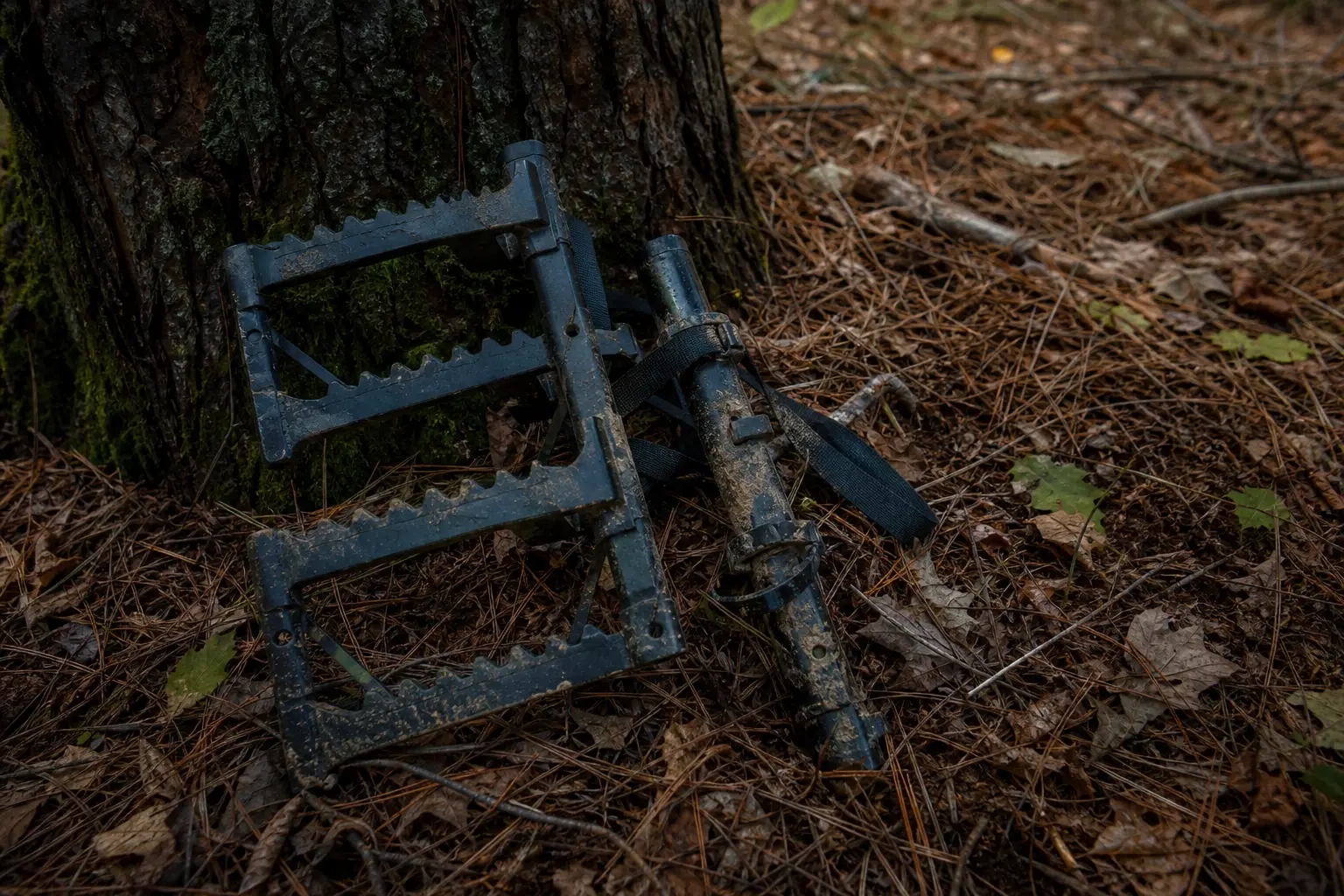
I bought my first set of climbing sticks the way a lot of men buy their first set of climbing sticks. I found the cheapest ones in the store, held them up like I knew what I was looking at, and told myself the expensive ones were for guides with sponsorships and YouTube channels. Four years later the cheap sticks were still in my closet and my hands still hurt when I think about them, which is the only honest review a piece of safety gear ever deserves.
The sticks were fine on level ground. Everything is fine on level ground. I would set them against a tree in the driveway, cinch the straps down, and rock them with my whole weight, and they held. In the driveway a climbing stick never has to hold you twenty feet up in the dark while your knees shake and your bow hangs off one shoulder and the wind does what wind does to tall skinny things. The driveway is where cheap gear goes to look trustworthy. The tree is where it goes to tell you the truth.
The Habit of Trusting What Has Not Hurt You Yet
Here is the thing nobody warns you about with climbing sticks, because the warning would sound like nagging and men do not listen to nagging. A stick that has not dropped you yet is not a stick that will not drop you. It is a stick that has not dropped you yet. I climbed those cheap sticks for two full seasons because they had not dropped me yet, and I treated every clean climb as proof that they were good sticks. That is the exact logic of a man who refuses to admit he was cheap, and it is the exact logic that put me on them the Friday they finally let go.
It was the last weekend of October. I had shot a buck and a doe over the course of the evening and I was climbing down to drag them out. My headlamp was dying, my hands were cold, and I was in a hurry to get the drag started before midnight. All of that is context, and none of it is an excuse. The stick did not kick out because I was tired. The stick kicked out because I had been treating a twenty-dollar piece of aluminum as if it had made me a promise.

Four Feet of Falling That Cost More Than the Sticks
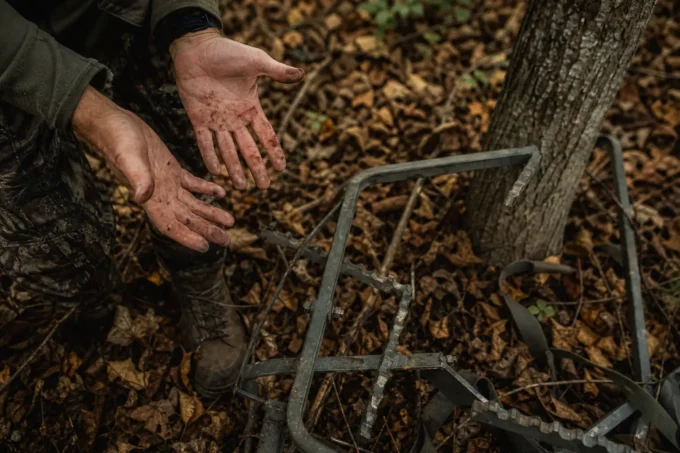
The bottom stick kicked out on my last step down. I was too low for the fall to be a catastrophe, and too high for it to be nothing. The step slid out from under my boot and I dropped three or four feet, and on the way down the edges of the higher steps shredded both my hands. I hit the ground standing up, because my linesman belt had enough slack in it that close to the dirt, and I stood there in the dark looking at my own palms and bleeding into the leaves.
That is the part I keep coming back to. I was standing flat on the ground. The belt caught just enough, the ground was close enough, and the whole thing cost me a set of hands that took weeks to heal and one very long walk back to the truck with two deer. If the stick that kicked out had been the one I was standing on twenty feet up, there is no version of this story where I am writing it down. The only reason this is a funny camping story instead of a funeral is a number I had nothing to do with deciding.
What the Strap Was Actually Doing
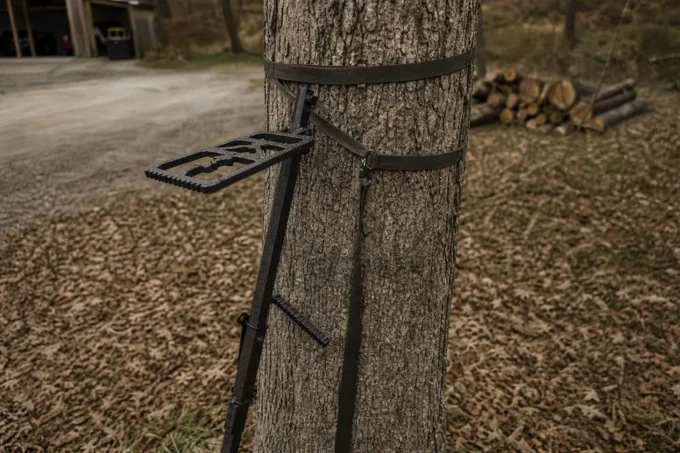
After my hands stopped shaking enough to hold a phone, I looked at why it happened. The answer was boring and specific and it made me angry because it had always been true. The strap on that stick was angled too high against the tree. When you set a climbing stick, the strap needs to run in line with the anchor point and be tightened down hard, and if it pulls up at an angle the bottom of the stick can swing out the second it meets a little damage in the bark. There was a small gouge low on that tree, exactly the kind of thing I had always stepped on without looking. The stick caught it, slid just enough, and the angle did the rest.
I had always told myself I set the sticks right. I was maniacal about it, is what I told people. But being maniacal about a thing you do not actually understand is just being loud, and the tree does not grade on effort. It grades on whether the strap holds, and the strap did not hold, and everything I would have said about my own carefulness turned out to be the same driveway logic all over again.
The Belt That Is Not What You Think It Is
There is another piece of gear in this story that deserves its own confession, because I leaned on it for years and it was never the thing I told myself it was. A linesman belt is not a safety harness. It does not lock you to the tree. At best it is a positioning device. If it is not choked tight against the trunk with no slack, a kick out or a slip goes straight through whatever slack you left in it, and you learn the difference between being held and being slowed down.
I stood on the ground that night because my fall ran out of slack, which is not the same thing as being kept safe. I had been calling that belt my harness for two seasons and talking to other new hunters like I understood the equipment, and the only reason it did not kill me is that the ground was closer than I deserved it to be. A man who thinks his positioning belt is a harness is a man one mild gust away from finding out in the worst place.
The Money I Did Not Spend
I want to be clear about what the cheap sticks cost, because the price tag lied the whole time. The sticks were forty dollars. The hands took more than two weeks to close up, and I could not shoot, could not work a deer the way I wanted to, and spent the walk back to the truck fumbling the flashlight with mangled fingers because every grip was a small event. Then I went and bought a real set of sticks, the kind I used to tell myself were a waste of money, and the entire time I was paying for them I was doing the math on a number that had almost been decided for me.
Cheap gear is not cheap. Cheap gear is a loan, and the interest gets collected on the tree, in the dark, at the exact moment you are least ready to pay. The sticks that dropped me are in the bottom of a closet now, or maybe the trash, and I do not regret a single dollar I spent replacing them. What I regret is that I had to be standing over my own bleeding hands before I believed what the expensive crowd had been saying the whole time.
What I Would Tell a Man Holding His First Set
If you are standing in the store right now holding a cheap set of climbing sticks and doing the same math I did, put them back. Buy the good ones. Spend the extra forty or eighty or a hundred dollars, and do not let yourself call it a luxury, because it is not a luxury, it is the price of every future climb you plan to walk away from. A climbing stick is the thing that holds your whole body between one dirty trick of physics and the ground, and that is not the place to save money.
And when you set them, set them like the strap is the only thing in the whole world doing any work, because it is. Run it in line with the anchor, tighten it down until it cannot think about moving, and check the tree for the little damage that turns a good stick into a bad one. Then do not trust any of it. Trust nothing that has not dropped you yet, because that is the only way the first drop also becomes the last one.