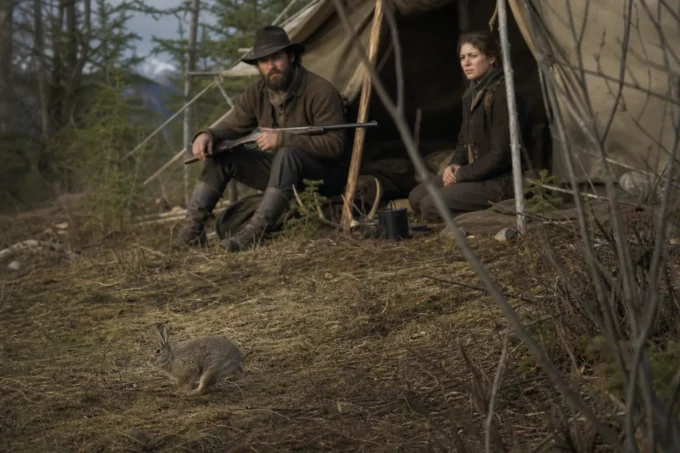
You wake because the rifle is leaning against you and the boy has put a dead squirrel on your chest. It is early November, 1845, three days west of Fort Laramie, and the wind has dropped. The squirrel is still warm under its fur. The boy, Thomas, stands over you with a proud, hungry face, and behind him Sam the brother-in-law is already folding the rabbit snares into a wet roll of rawhide.
“That your last ball,” Sam says. He is not asking. He saw you miss the buck yesterday, saw the lead splash into the dirt of the bluff, saw you walk back empty handed with nothing but a dirty patch. Now he is doing the arithmetic out loud the way he does, quietly, so nobody else has to say it. You have four rifle balls left in the pouch, three caps, and about a third of a horn of powder. The trading post is two hundred miles behind you and Fort Hall is farther still. Nobody here is going to hand you more lead.
Four balls. That is four chances for a deer, or one bad afternoon spent missing a rabbit that is not worth an ounce of it. A rabbit has maybe two pounds of meat on him. A ball of lead costs you more than the rabbit does, and you can eat a rabbit in a day and stay just as hungry as you were before. This is the arithmetic of a man who shoots his food instead of buying it. Every trigger pull spends money you are carrying on your hip, and when the pouch is empty the rifle is a heavy, honest club.
Why the Rifle Stays Loaded
You start keeping it loaded and do not fire it. A loaded rifle is a promise you do not have to keep until you see a deer or a buffalo, something with enough meat on it to justify the charge. Hannah, your wife, has already learned the new rule by watching you. She does not ask you to shoot the grouse that walks through camp. She just looks at it and lets it go, because a grouse is a pound of meat and the ball that kills it is a deer you will not get.
The trick on the trail is that small game does not cost you a ball if you do not use the rifle. You use a snare. You use a deadfall. You use a rock and a handful of patience. You shoot what is too big to catch, and you catch what is too small to shoot. Sam knows this better than you do, because Sam has been poor longer. When you reach for the rifle at the sight of a rabbit, he shakes his head once, the way a man might turn down a card he knows is bad.
Setting a Snare When You Have Nothing But String
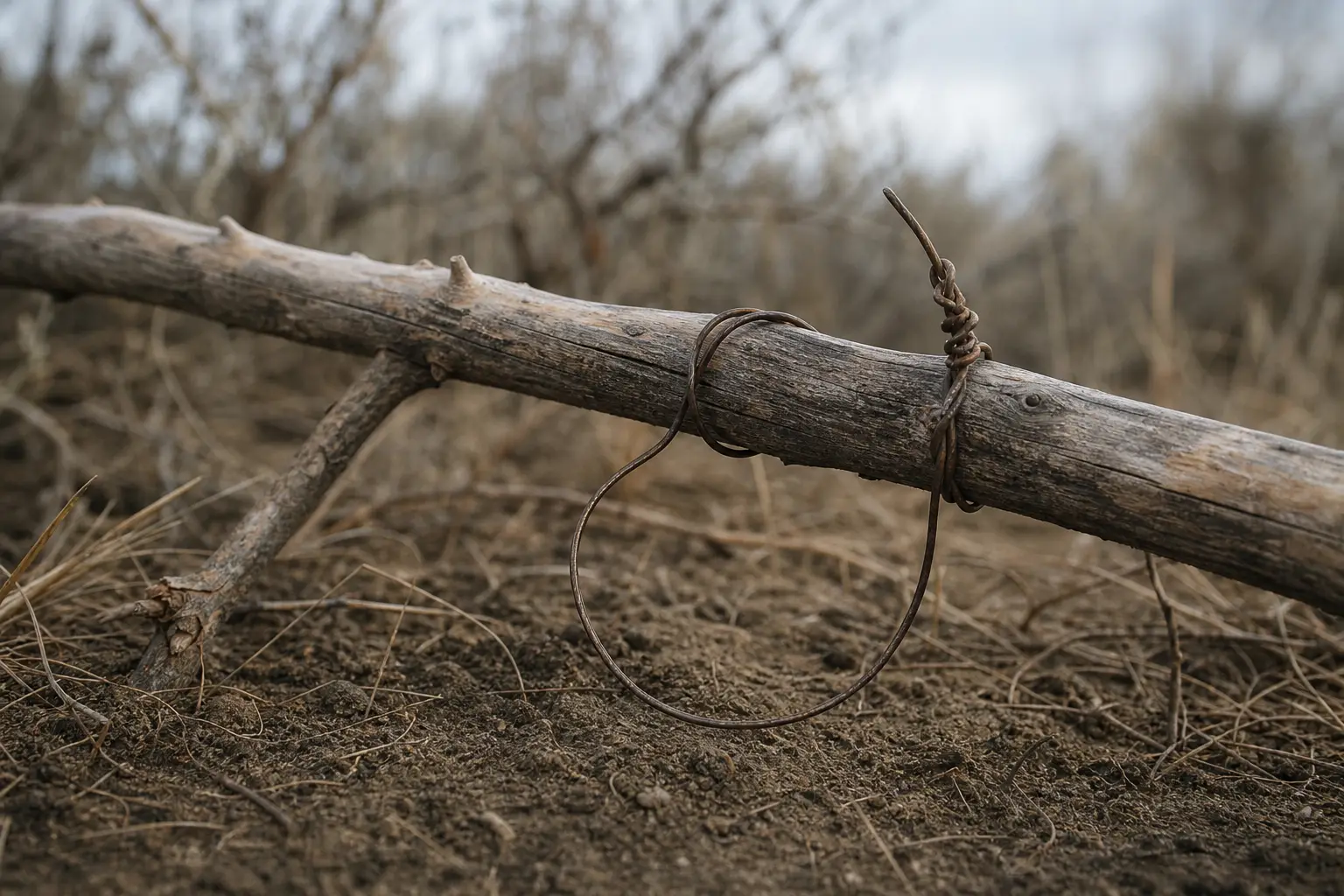
You make the snare from the inside of a leather strap, cut thin and soaked in water until it is soft, or from horsehair twisted until it does not slip. Sam carries a pocket of brass snare wire he bought at Fort Laramie for a pinch of powder and a needle, and he treats that wire like a man treats money. You learn to set it in a rabbit run, that narrow pressed-down trail the rabbits keep through the sage, with the noose a fist wide and the height of it just enough to catch a rabbit by the neck as it runs, never high enough to let it walk under, never low enough to trip it. You peg the free end to a sage root with a stick shoved into the ground.
You set it at dusk, because rabbits move at night and a snare set in the morning sits all day giving you nothing. You set a dozen if you can, spread wide, and you check them before the sun is up, because a dead rabbit left in a snare past midmorning is stolen by a coyote or souring in the sun. The first morning you check them and find four empty and one sprung, the noose pulled tight around nothing because you set it too big. Sam does not scold you. He just shortens the loop a finger’s width and shows you the angle of the run you did not read right.
Then he shows you the deadfall, because a snare catches neck and windpipe but a deadfall catches anything that walks under a propped slab with bait. You take a flat piece of rock, bigger than a skillet, and you balance one end of it on a trigger stick shaped like a three. Under it goes a piece of dried plum or a bit of the squirrel the boy brought in. The bait is not food, it is an expense you will get back. A rabbit nudges the bait, the stick rolls, the rock drops, and you have a rabbit that never heard a shot and cost you nothing but the bait.

The Boy Learns the Other Way to Hunt
Thomas watches all of this with the patience of a child who has decided he will be useful. He wants to shoot. He has wanted to shoot since he saw the rifle lean against a wagon wheel. You give him the throwing stick instead, and the two of you walk the sage at the low edge of the day, and you teach him to read the ground like a man reads all the old signs. Here is where a squirrel has been burying pine nuts. Here is the scrape where a rabbit sat in the cold. You teach him to stop and wait instead of stalking, because a boy walking loud scares every small thing within three hundred feet.
For birds you show him a trick Sam showed you. You make a noose of fine horsehair and set it over a line of grain you have scattered where the grouse dust themselves, and you wait, and when a grouse puts its head through the loop to peck, you draw it tight and you have a grouse that cost you one pinch of ground corn and an afternoon of sitting very still. It is the slowest hunting you have ever done. It is also the only hunting that does not spend a ball, and after a week of it you start to understand that a man who cannot afford lead learns to earn his meat with his hands.

The Sour Morning and the Missing Snare
On the sixth morning everything turns against you. The wind comes up in the night and turns cold and wet, and when you go out to check the snares in the dark the ground is soft and the smell of the coming rain is thick as wool. You find the first snare still holding a rabbit, but the rabbit is half eaten. Something has been at it in the night, a coyote by the look of the long dragging marks, and it has pulled the peg free and carried the snare and the wire with it. You find the wire fifty feet off, kinked and useless, and the rabbit gone except for fur and one hind foot still caught in what is left of the loop.
Two more snares are gone, one sprung empty and one simply missing, and the boy’s squirrel run is washed out by a little stream you did not notice the night before because it had no water in it. You lose the wire, and you lose the bait you had buried for the deadfalls, and you stand there in the cold and the half light feeling the old want to reach for the rifle and end the morning with something you can carry back. Sam is there, and he reads your hand on the rifle and says the one thing that has been true all along. “You are shooting your food ahead of you,” he says. “Save the lead for the thing that fills the pot.”
You go back to camp with one hind foot and a handful of wet wire and no meat at all, and you spend the rest of the day cutting new twine from the rawhide and soaking it and setting the snares again, smaller this time, and you do not fire the rifle once. By nightfall you are cold and hungry and the pot has nothing in it but water and a few wild onions Thomas dug up where the ground had thawed. It is not a good day. It is just the kind of day a man has when he is learning how to eat without spending his future.
What Was Real
Small game was the everyday food of the Oregon Trail, and the rifle was almost never the tool that took it. Emigrant families did not waste scarce powder and lead on rabbits and squirrels when a snare or a deadfall would do the same work for free. Lead for a rifle ball cost real money at the trading posts, and powder was carried in limited amounts because it was heavy and already half used by the time a wagon reached the plains. Every ball spent on a cottontail was a ball that could not be spent on the antelope, deer, or buffalo that actually fed a family.
The snare was the poor man’s hunter. A noose made of brass wire, horsehair, or soaked leather, set across a rabbit run or a game trail at the right height, caught small game by the neck or the foot while the trapper slept. The deadfall, a flat rock or a log propped on a trigger stick with bait beneath it, was older than the trade rifle and worked without any ammunition at all. The historian Francis Parkman, who traveled the plains in 1846, wrote that the emigrants and mountain men he met caught more small game with snares and deadfalls than they ever shot, because a man a thousand miles from a trading post learns fast that a ball is money.
The arithmetic was unforgiving. A pound of lead produced roughly twenty to twenty four round balls of the size a Kentucky or Hawken rifle used, and a pound of powder fired about forty to sixty charges depending on the rifle and the load. A rabbit carried two to three pounds of meat, a squirrel a little under a pound, and a grouse perhaps a pound and a half. Spend a ball and a charge on a rabbit and you had traded a twentieth of your lead and a sixtieth of your powder for one day of thin eating. Spend it on a deer and you had fifty pounds of meat to dry, smoke, or salt. Anyone who had crossed the Missouri had already learned to reach for the snare first.
The year 1845 sits at the front edge of the Oregon Trail’s big years, before the 1849 gold rush drove the numbers up, and in that year the traffic was still thin enough that game near the forts was not yet shot out. Families carried their rifles loaded, kept the hammers at half cock, and saved the shot for the meat that would keep. The boy with the throwing stick and the horsehair noose was not a detail of one family. He was the standard, ordinary way a frontier family fed itself when the pot was empty and the nearest store was two or three hundred miles of grass and wind behind them.