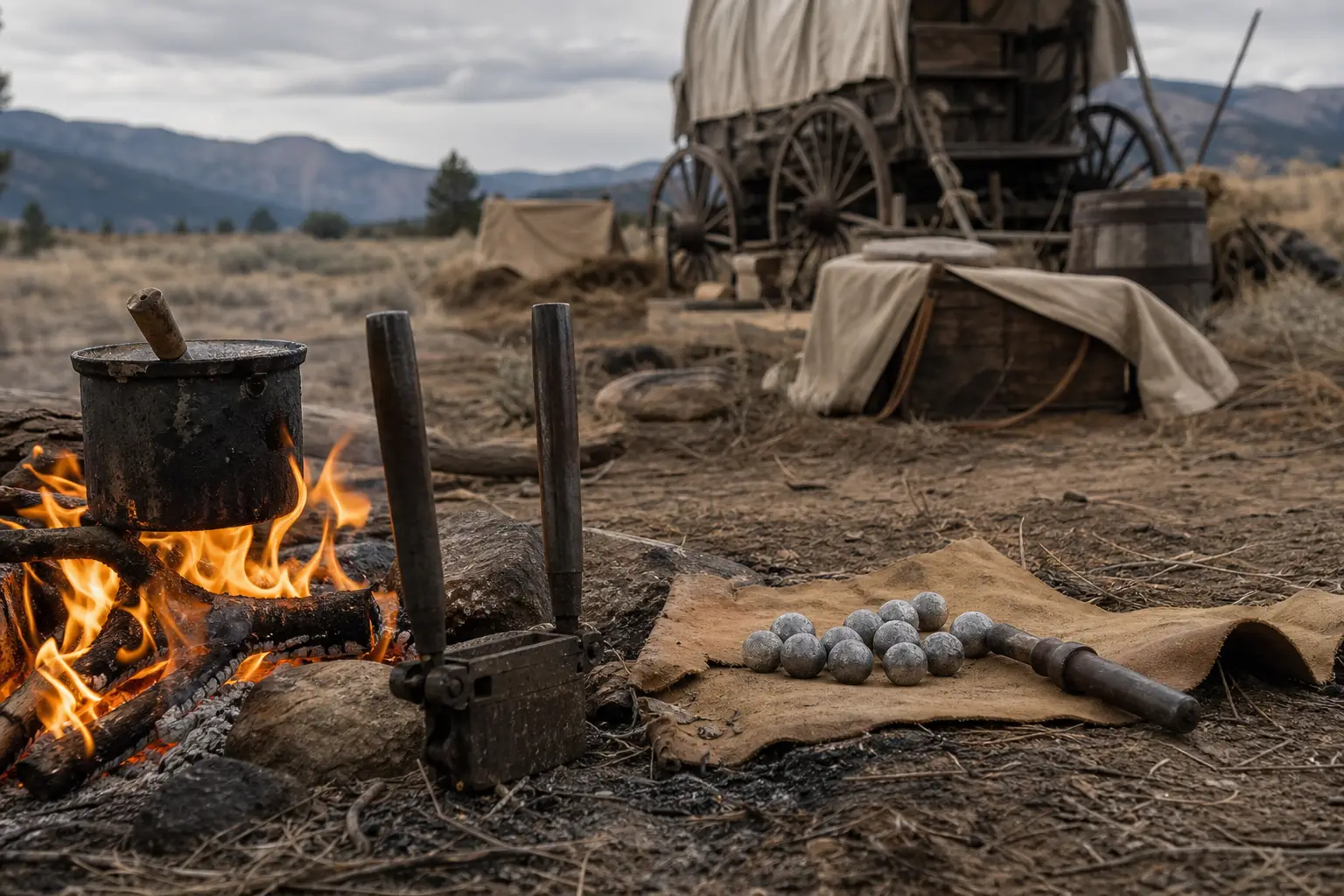
You wake because the mold is lying empty between your boots, and the morning is cold enough that the last ball of lead you cast last night has a dull skin of frost on it. September 3, 1849. Somewhere east of South Pass, on the dry side of the Wind River range, where the sagebrush is gray and the nearest trading post is Fort Bridger, still a week behind you over the mountains. Your brother-in-law Sam is already up, feeding chips from last night’s pile onto a low fire, and he does not look at you because he knows what you are both about to count.
You kneel and tip the bullet mold open with a fingernail. Eleven balls roll out into your palm, cold and heavy, and you count them again. Eleven. Between the two of you there is a little over a pound of powder left in the horn, maybe two, and the deer you have not seen in nine days. Your wife Hannah sits mending a seam by the wagon with her back to you, and she has not asked in two days whether there is meat, which is how you know she is starting to ration the flour instead.
Eleven Balls Left
This is the arithmetic of the frontier. It is not about sport. It is about whether the three of you eat in October.
The problem is simple and it is not simple. A ball of lead is worthless on its own. It needs a charge of black powder at the exact right weight, a cap or a flint that will spark when the hammer falls, and a dry pan and a dry barrel and a dry nipple. You have all of that, just barely, but every shot you take now is one you cannot take later. A deer at seventy yards is a temptation, and a deer that jumps the string of white smoke is a wasted charge and a wasted ball and a morning of walking after a bloodline that peters out in the sage. You think briefly about the men back east who shoot pigeons for fun from a boat, and the thought tastes like ash.
So you learn to make every round count, and you learn it the hard way.
Lead, Powder, and Dry Caps
First, the casting. You set the pot over the fire before the wind picks up, because lead pours best into a hot, dry mold, and a cold mold leaves a wrinkled ball that flies crooked. You melt the last of your sheet lead and the two worn musket balls Sam dug out of a tree back near the Sweetwater, and you skimm the gray scum off the top with a chip of wood. The smoke off the pot is sweet and heavy and it settles in your throat. You keep the mold closed tight and pour until the sprue overflows, then you wait until the metal flashes solid before you strike the sprue off with the handle. A good ball comes out with a faint seam you file off with the edge of a knife. A bad one, the ones with the hollow in them from pouring too fast, you throw back in the pot. Lead is too dear to waste.
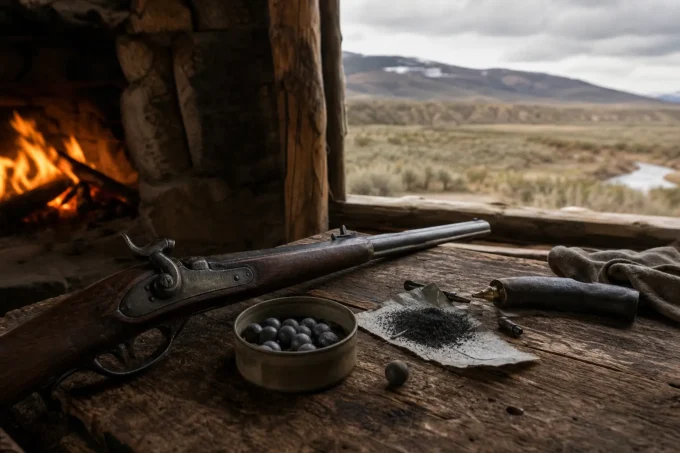
Second, the charge. Every ball needs the same measure, and you do not guess. You keep your powder in the horn and you throw your charges with a small tin measure you have not lost yet because it is looped to your belt by a string. Too little powder and the ball drops at forty yards into the dirt in front of a deer’s chest. Too much and the barrel kicks and the ball flies high and you flinch, which is worse than missing because flinching teaches you to miss every time. You learn the measure by feel, by the weight of it in your palm before you tip it down the barrel.
Third, the cap and the dry. This is where it goes wrong. The plains are not dry just because the ground is cracked. The morning dew gets into everything, and a damp charge in the barrel fires late or not at all, a phut and a curl of smoke and the deer gone before the bullet ever leaves the muzzle. You start carrying the rifle wrapped in a scrap of oiled cloth and you keep the caps in a tin inside your shirt, against your chest, where your own heat keeps them from fouling. Sam laughs at you for it once, and then one frost morning his rifle will not fire on a standing doe at sixty yards and he stops laughing.
The Shot That Costs You
You go out at dusk because that is when the mule deer come down off the ridge to drink, and you find a little seep in a draw where the tracks cross. You sit in the sage and you do not move, and a buck comes, and you raise the barrel slow, and you settle the front sight just behind the shoulder, and you shoot.
The shot goes high. The ball sails over his back by a hand’s width and the buck is gone in one long leap, white tail flagging, and the smoke drifts away and leaves you kneeling on a cold spot with one less ball and one less charge and nothing to show for it but the ringing in your ears.
You know why you missed. You have not shot in two weeks, because shooting cost you lead and powder you could not spare, and so when the time came you held the sight too long and the barrel wandered and you yanked the trigger instead of squeezing it. Practice is a luxury you cannot afford, so you are not sharp, and on the frontier being not sharp is the same as being hungry.
Ten Balls Left
Hannah sees you come back with the empty hands. She does not say anything. She puts the lid back on the flour barrel and sets a little pot of water on the fire, and Sam skins out the single rabbit a boy from another wagon traded you for two balls, and you sit by the fire and eat a stringy mouthful and count the ten balls you have left and think about what a ball is actually worth out here now.
A ball is worth a lot more than you paid for the lead. Out east you could buy a pound of lead for a few cents and cast twenty balls and go shoot a target off a fencepost for the fun of it. Out here, two hundred miles from the next place that will sell you a single round, that same lead is the difference between a family that eats and a family that walks.
In the morning you will walk back out to that draw. There will be a doe this time, closer, and you will load at the wagon where your hands are still steady and your breath is not clouding the lock, and you will squeeze instead of yank, and if the ball flies true you will carry the meat back and be the one who feeds them for a week. And if it does not fly true, you will have nine left.
That is the whole of it. You do not think about the men back east anymore. You just count.
What Was Real
Black powder, lead, and caps were the currency of survival on the Oregon-California Trail, and settlers carried far more of them than they carried food they could not replenish. The standard was the .50 or .54 caliber plains rifle or trade musket, and a pound of lead cast roughly twenty to twenty-four balls depending on caliber. Powder came in kegs of twenty-five pounds for a party, or in individual horns holding one to two pounds, enough for a modest number of charges in a pinch.
Casting balls over a campfire was common, and the technique mattered. A cold mold produced wrinkled, undersized balls that flew inaccurately, and casters skimmed dross from the surface of molten lead, struck the sprue once the metal flashed, and returned flawed balls to the pot. Lead was never thrown away on the trail.
Black powder is hygroscopic, meaning it absorbs moisture from the air, and a damp charge was a constant failure point. A flintlock or caplock that fired reliably one morning could fail the next after a night of dew, which is why rifles were wrapped in cloth and caps and priming powder were kept against the body or in airtight tins. A misfire on game, the “flash in the pan” or the “phut” of a damp main charge, was a common and costly occurrence.
The math of ammunition on the frontier was cold. Every shot was an expenditure that could not easily be replaced, and this is why trapping, snaring, and using a single animal to its full use were preferred over shooting at every opportunity. A settler did not shoot a pigeon for fun. He shot because his family had to eat, and he counted every ball and every charge because the next trading post selling lead and powder might be two hundred miles away.
The famous guidebooks estimated a family needed a rifle, a powder horn, a bullet mold, and a supply of lead and caps as part of their basic outfitting, alongside the salt, flour, and bacon. Powder and lead were among the heaviest and most carefully rationed items in any emigrant wagon, and they were subject to the same enemy as everything else on the trail: water, which could ruin a horn of powder or a keg of flour with equal indifference.