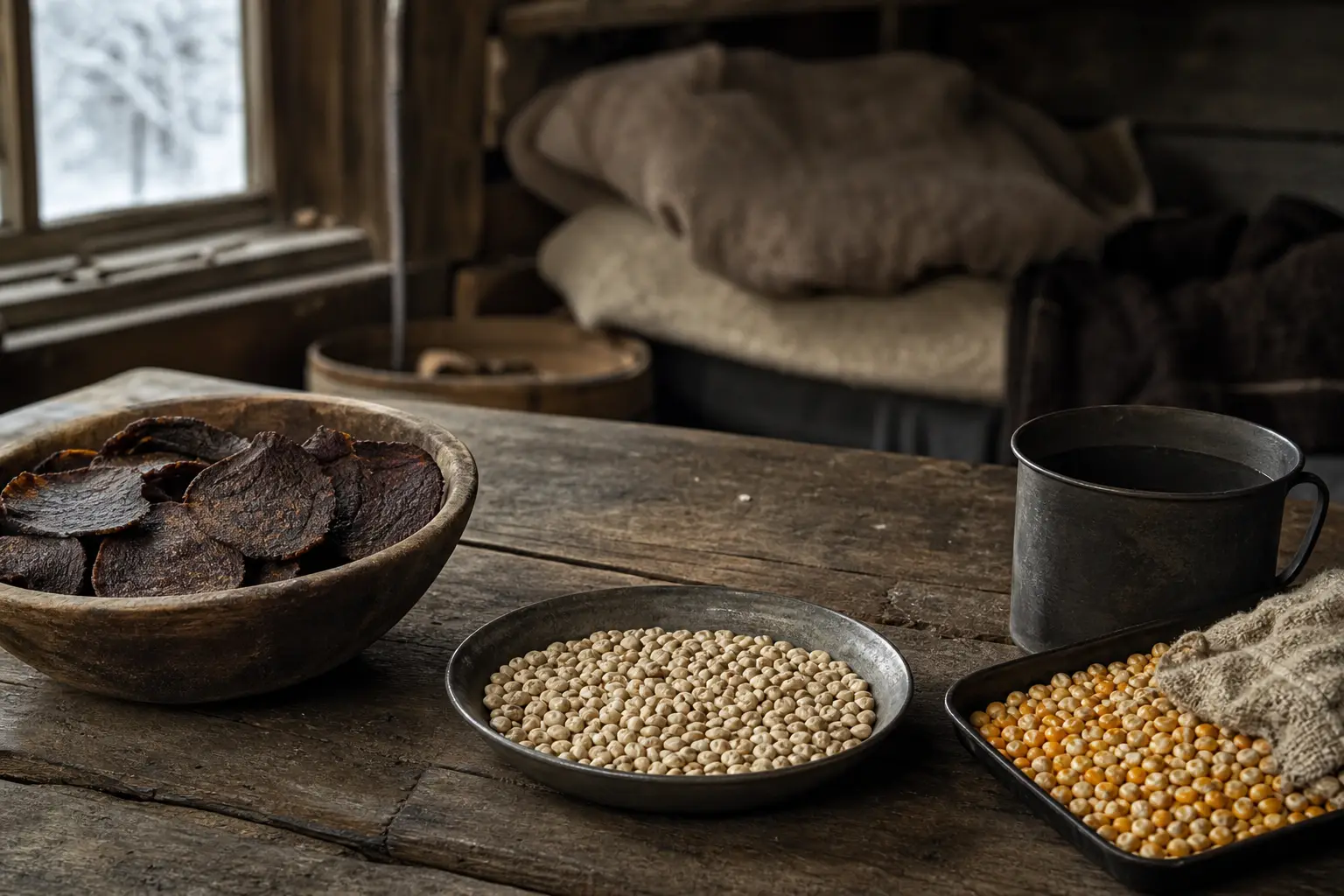
You Wake Because the Cold Has Found Your Spine
Late November, 1846. Somewhere in what people will one day call the Black Hills, nine days behind schedule.
You wake because the cold has found your spine through three layers of blanket and one layer of axle grease. The wagon box groans once, a long low sound like a cow stepping on ice, and you know before you move that the water barrel has frozen through. Your breath hangs in the dark in front of your face and does not leave. Sam, your wife’s brother, is already up, crouched at the fire with his hands inside his coat like a man hiding something from God. Hannah is still asleep with the two boys, and for a second you are grateful for that quiet, because the quiet means they are warm, and warmth right now is the only arithmetic that matters.
Three nights ago the temperature dropped and did not come back. The oxen stand shoulder to shoulder in the dark, their breath pluming in the still air, and you count them once, twice, the way you count your own fingers after a frostbite scare. Morrison is gone, dead of the flux back at the Sweetwater, but his voice is still in your head, the thing he said the last morning he could stand: freeze to death and the wolves find you sitting up, not lying down. You have been thinking about that sentence for three days.
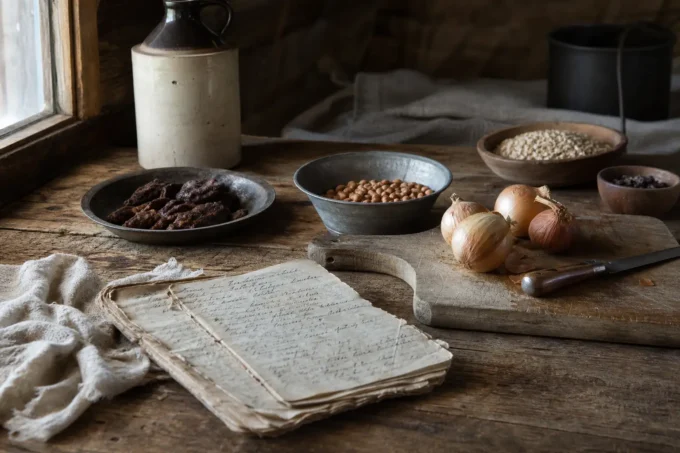
Cold Is Not Weather. Cold Is an Arithmetic Problem
Here is what the cold wants. Your body is a stove burning food. It wants to keep the core at a certain heat, and it will spend fingers, toes, ears and nose to do it. When the core drops a little, you shiver and that burns fuel. When it drops more, the shivering stops and that is the worst sign there is, because the stove has started rationing. You have seen it in the boys. The shiver is the machine fighting. The stillness is the machine quitting.
The numbers are honest and they are against you. A wagon box is a wooden box with a canvas over it and the wind comes through the gaps where the bows meet the bed. You lose heat from the ground first, because the ground is a hole you are sleeping on top of. Then the wind, because wind is just cold with an opinion. Then your own wet clothes, because cold that gets near your skin through sweat or snow is cold that never leaves.
You do not want to end up the way you nearly ended up that first bad night, when you thought one more blanket would fix it and you let the fire die down to save chips. You woke with your hands too stiff to strike a light, and you sat there in the black, listening to your own teeth, understanding that a man can be killed by a thing he was already holding.
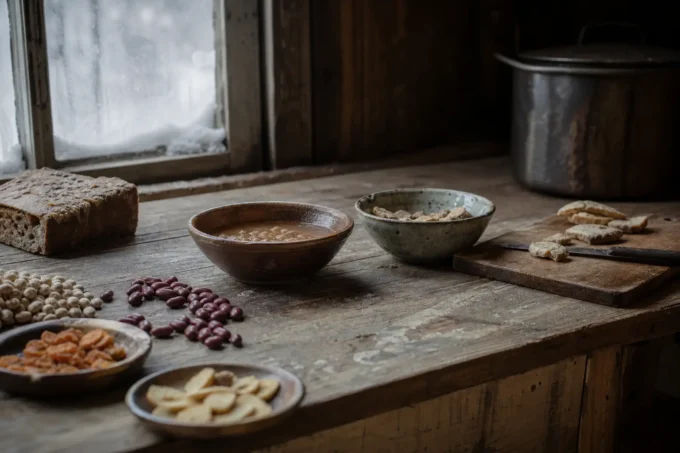
Step One: Get the Fire Right, Then Stop Losing Heat
You work in the present tense, because the future is a fire you are not allowed to stop feeding.
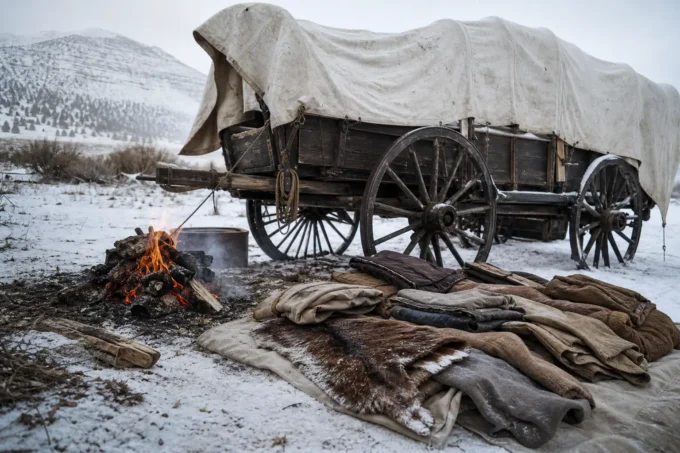
First the fire. You do not build it high, you build it close and you build it low. A big fire eats wood you do not have and throws heat up into the sky where nobody sleeps. A low fire of built-up coals throws heat sideways and long. You bank it with the last of the buffalo chips and you set the wagon so the canvas catches that sideways heat and holds it, the way a hand holds a cup of something hot.
Then the ground, because that is where the heat runs. You lay the wagon’s spare canvas down first, then a folded buffalo robe, then every coat that is not on a body. You lift the bed off the wagon floor on two chests and a plank, so the cold wood is not drinking heat out of your back. You have learned this the hard way: a man can wear fifteen pounds of blanket on top of him and freeze because the one inch of wood under him was never warmed at all.
Then the bodies. You put Hannah and the two boys in the middle, because children and a nursing woman lose heat fastest and because the middle is the warmest two feet in the entire northern plain. You and Sam take the edges, and you pull the robe over all of them and then over yourselves. You do not sleep pressed against them because it is tender. You sleep pressed against them because shared heat is the only fuel that runs all night without being fed.
Then the detail that feels silly and saves lives: you take off the day’s wet shirt and boots before you climb in. Wet cotton is a wick pulling heat out of you all night. You swap for dry wool, and you rub the boys’ feet until the blood comes back, and you do not let anyone, not even Sam, crawl in with snow still in his hair.
The Human Part You Notice Anyway
Hannah does not say thank you. She never does for this. She takes the smallest boy against her chest and the older one at her back and she closes her eyes the way a person closes a door on a thing that can still come in. The older boy, Thomas, asks in a whisper if the fire will still be lit when he wakes, and you say yes the way you have been saying yes to questions you cannot honestly answer, and his breathing goes slow and even.
Sam does not sleep. He sits up with his rifle across his knees and watches the fire and the darkness past it, and every hour or so he adds a chip and a twig with the economy of a man spending his last coin. You watch him for a while and you understand he is not keeping watch for Indians or wolves. He is keeping watch over the one warm thing that still belongs to all of you.
You think, briefly, about the people back east, sleeping in houses with iron stoves and walls that hold the heat, eating bread without worrying whether the flour barrel has frozen and split. The thought does not feel like envy. It feels like looking at a photograph of a man who has never once had to choose between keeping his family warm and keeping them fed, and it is a strange, distant, private thing.
The Complication: The Fire Dies and the Snow Comes Through
It happens the fourth night. The wind swings around from the north at full dark and the snow comes in horizontally, fine as salt and just as determined. It finds the one gap in the canvas bow that you patched with a scrap of old blanket and it builds a small white drift on the tail of the wagon while you sleep. Sometime after midnight the fire simply goes out. You do not know why. Too much wind, a chip spent, a moment when everyone was listening to their own breathing instead of the flames.
You wake to the cold coming off the ground like a hand pressed flat against your back, and the inside of the wagon is no warmer than the inside of a grave. The boys are still, too still, and for a long second you cannot find Thomas’s pulse through the dark and the panic. Then he stirs and coughs, and the cough is the sweetest sound you have ever heard, and you set to work blind.
You do not let anyone move. Movement loses body heat faster than lying still, and the floor is now a cold sink. You and Sam crawl out into the storm together, and you get the fire lit off a coal you kept banked in a small iron pot just for this, a trick Morrison taught you and mocked you for learning. The fire comes back low and mean, and you feed it the broken tailgate that you have been saving, because wood you will burn tonight is cheaper than the wood you will burn as a coffin. The snow keeps coming. In the morning a third of the buffalo chips are soaked through and useless, and the water barrel is frozen solid all the way to the bung.
Nothing is catastrophic. Nobody dies. But you sit against the wagon wheel at dawn with your hands wrapped around a tin cup of half-melted snow water, too tired to feel the victory people will later tell you you had, and you understand that survival out here is just losing slowly enough to reach the next warm place. Somewhere ahead of you, past the next soft ridge, the snow is already falling on a party that started a month later than you did. You do not know their names yet. The mountain will remember them, and the winter will write their story in a language of hunger and cold.
What Was Real
The Oregon and California trails ran from roughly 1841 to 1869, and an estimated 400,000 people crossed them. The popular image of prairie heat and alkali dust is only half the picture. Parties that left too late in the season ran head-on into the same winter that made the mountains impassable, and cold killed in ways the diaries recorded quietly: frozen feet, frozen hands, pneumonia after a wet crossing, and entire families found sitting upright in drifted camps.
Hypothermia works exactly as described in the narrative. The body shunts blood away from the extremities to protect the core, which is why fingers, toes, ears and nose freeze first. Shivering is a heat-generating reflex that burns large amounts of energy. When shivering stops in a person still cold enough, it is a sign of dangerous core cooling, not recovery. The three dominant heat-loss paths are conduction to cold ground, convection from wind, and the effect of wet clothing, which conducts heat away many times faster than dry clothing. The advice to insulate a person from the ground, block the wind, and replace wet clothing with dry wool is all grounded in the real physics of surviving a cold night.
The most famous example is the Donner Party, which left for California in 1846 and became snowbound in the Sierra Nevada during the brutal winter of 1846 to 1847. Of the roughly 87 members who attempted the crossing, only about 45 survived, and the survivors resorted to what the diaries and later accounts described. It remains the standard warning handed to every emigrant party about what a late start and an early winter could cost. The party in this story is a fictional one, but the shape of their danger is not.
Buffalo chips, dried bison dung, were a genuine and essential fuel on the treeless plains, burned low and hot and carefully banked. The practice of banking coals overnight, keeping a live ember under ash or in a covered pot, was universal, because starting a fire from scratch with flint, steel and wet tinder in a storm was a gamble nobody could afford. Wood was so scarce west of the Missouri that broken wagon parts were routinely burned as fuel, which is why a spare axle or a cracked sideboard was as much firewood as it was repair stock.
The word “frostbite” has been in English since the early 1600s, formed directly from frost and bite, and it does exactly the work the word suggests. The cold was never a dramatic villain in the emigrant record. It was a long, patient counter of mistakes, and it kept the same arithmetic the entire way: heat lost always, heat made occasionally, and heat borrowed from the bodies of other people when everything else ran out.