Late August, 1846. Somewhere west of the Sweetwater, three days of empty skillet behind you, and your stomach has stopped asking for food and started eating you. You wake before dawn because your legs are cramping again, the way a man cramps when the salt is gone from his blood and his belly is full of air and water that tastes like the bottom of a barrel.
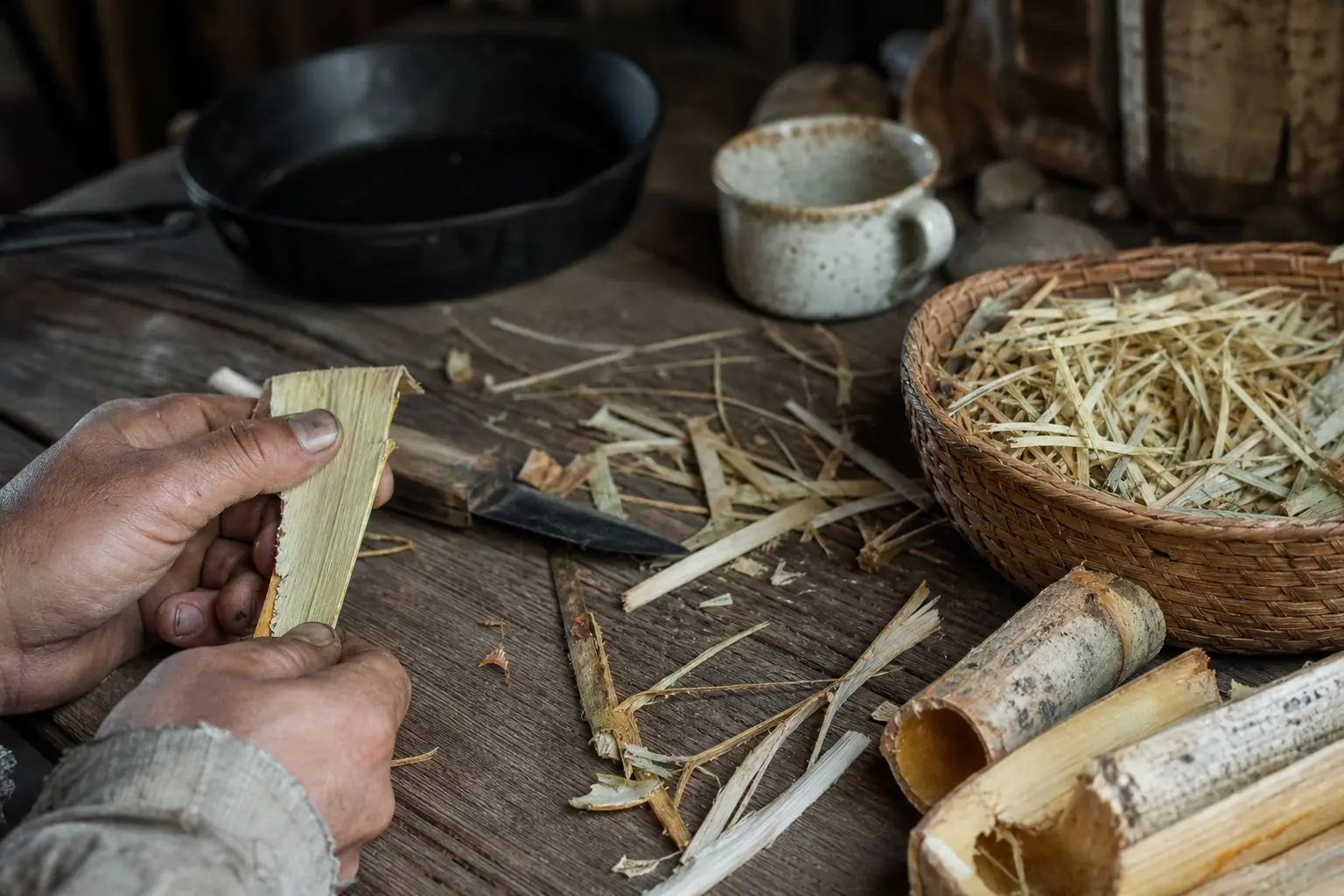
Sam, your brother-in-law, is already up, kneeling at the cold ashes and shaving thin curls of bark off a willow with a dull knife. The curls are not for the fire. They are breakfast. He has been stripping the inner bark of the cottonwood for two days now, chewing it until it turns soft and stringy in his mouth, and you have watched his gums go gray from it.
Hannah sits with the two youngest at the wagon tongue, feeding them little bits of boiled purslane she found under the rock ledges. Morrison is gone three weeks now, dead of the flux, and the only thing he left behind that still feeds you is a scrap of paper in his Bible that says, in a hand you can barely read, that a starving man on the Platte can eat the meat under the bark of a cottonwood if it comes to it. It has come to it.
The Cart Goes Empty First
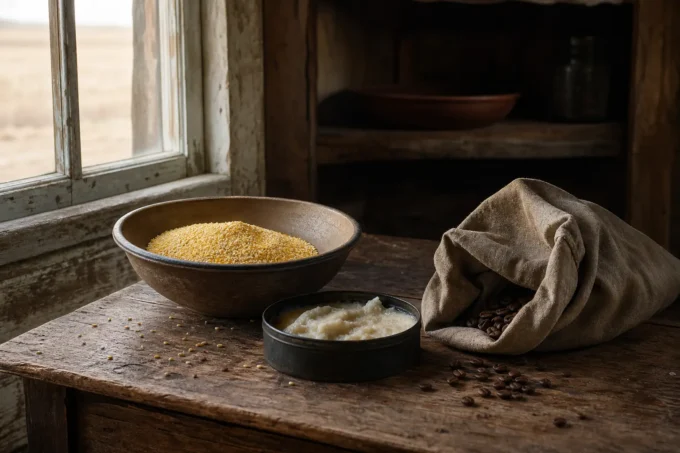
The flour was gone before the Sweetwater. The salt pork turned in the barrel ten days back. The last of the dried buffalo from the spring hunt went into a thin broth four mornings ago, and you drained it so slow that the boys started to cry. Now the cart holds a half dozen cups of old cornmeal with weevils walking through it, a tin of grease, and a shrinking sack of coffee that you are saving because a man with coffee still feels like he has not lost everything yet.
You do the arithmetic in your head the way you always do now. A man your size needs a place to stand every day and more than two thousand dollars would buy at Fort Laramie in flour, and you have none of it. What you have is a country full of things that grow, and you do not know half their names. That ignorance is the difference between walking out of these flats and leaving a mound of dirt beside the trail like the last one you passed, the one with the name scratched on a board so green the lettering was still bleeding sap.
What the Barren Country Gives Up
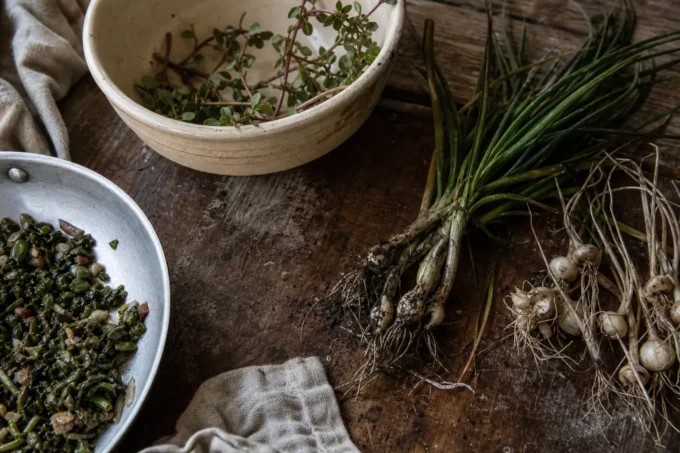
You start with what you can see, because seeing is free. The season is high summer, and the flats are not empty, they are just stingy. You learn to spot purslane by its red stems and fat leaves, creeping in the shade of the same rocks where a rattler likes to lie. You pull it up by the root, shake the dust off, and Hannah boils it with a little of the bacon grease, and it goes down green and mild and almost tastes like food.
Wild onion grows in the draws where the water runs in spring, and you dig it with a stick because your fingers have stopped caring about the cold dirt. The bulbs are small, smaller than a boy’s fist, and you string them on a length of rawhide and hang them from the wagon to dry. Lambsquarter grows tall along the creek edges, and you strip the young leaves. You have begun to eat things you would have walked past with your nose turned up a month ago, and it shames you a little how long it took to see that the country was feeding you the whole time and you were too proud to bend down.
Then there are the things that fight back. You try chokeberries and your whole mouth seizes up dry like you swallowed a handful of chalk. You dig what you think is an edible root and it burns your tongue numb for an afternoon. Hannah spits it out and will not let the children near it. You mark these lessons in the dirt with a stick and move on, because a mistake you survive is the only kind of field guide a man gets out here.
Bark, Bugs, and What a Starving Body Does
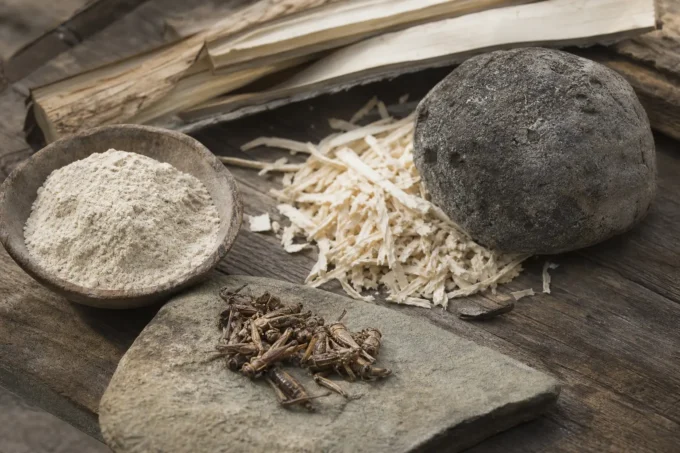
When the greens run thin, you fall back on the cottonwood. You peel away the rough outer bark and shave the white inner layer, the cambium that carries the sap, and you dry it in the sun and pound it into a coarse flour with a rock. It tastes like nothing, like chewing wet paper, but it fills the hole for a few hours and the children do not know enough to complain anymore. Sam stirs it into the last of the cornmeal and calls it bread, and you let him call it that because the word costs nothing.
You learn the insects next because the boys bring them to you on a flat stone like a gift. Grasshoppers, thick on the sage in the late afternoon, and you gather them by the handful, roast them over a low fire until they turn brittle, and eat them without looking too hard at what you are doing. A body that has not seen meat in a fortnight stops being particular. The first day your stomach aches from emptiness. The fourth day the ache dulls into a kind of gray fog, and your thoughts slow down like a wagon in deep sand. By the tenth day your gums bleed when you chew the bark, and you can feel your own ribs through your shirt without touching them, and your joints hurt from nothing at all. That is what it is to starve: it does not scream, it just turns the volume of the world down a little every day.
The Human Smallness of It
You think, at night while the children sleep with their bellies touching their spines, about people back east who are eating bread without weevils in it this very minute, who will throw away a crust because it is two days old. The thought does not make you angry. It just sits there, foreign, like a memory from a life that belongs to somebody else now. Hannah catches you staring into the fire and does not say anything, only hands you a cup of the weak coffee, and you both drink it like it is medicine.
Sam has begun to talk less, and when he does it is about flour. He describes bread the way a man describes a woman he has not touched in a year, and you let him, because talking about it is the closest either of you will get tonight. The youngest boy, Thomas, asks you if the grasshoppers will be there tomorrow too, and you tell him yes, and he nods like that settles the question of whether he will eat before he sleeps.
The Complication You Knew Was Coming
On the morning you decide you can walk to the Sweetwater and back with the last of your strength, it rains. A hard, cold front rolls over the flats and the wind slaps the wagon cloth like a loose sail, and by the time you get the oilcloth over the children the ground is running with water and the willow fire is drowned to a black hiss. You lose most of what you had gathered, the roots washed out of their hole, the dried bark flour turned to glue, the grasshoppers scattered into the wet sage and gone.
It is not the end. It is only a hard step backward, the way everything on this trail is a hard step backward before it is two steps forward. You sit under the wagon with the water dripping through and eat a cold handful of raw purslane and think, for the thousandth time, that you would trade the whole of tomorrow for a bucket of beans and a dry place to cook them. Then Hannah touches your arm and points, and you follow her finger to where the rain has bloomed the flats green overnight, and you both know without saying it that the country will feed you again in the morning, if you can keep bending down long enough to take it.
What Was Real
The Oregon Trail route ran roughly two thousand miles from Missouri to the Willamette Valley, and between 1841 and 1869 an estimated four hundred thousand emigrants traveled it. Supplies ran short constantly, and the fear of starvation was not a literary flourish but a daily calculation. Flour, bacon, coffee, and sugar were the standard staples, and a common loading guide called for around two hundred pounds of flour and seventy-five pounds of bacon per adult for the six month crossing. When the cart ran empty between trading posts, emigrants genuinely fell back on whatever the landscape offered.
Many of the wild greens they ate are still foraged in the American West today. Purslane (Portulaca oleracea) grows as a low, sprawling weed with thick reddish stems and fat, fleshy leaves, and it was eaten raw or boiled. Lambsquarters (Chenopodium album) is a close relative of quinoa with edible young leaves and was called wild spinach. Wild onion grew in moist draws and its small bulbs could be eaten raw, boiled, or dried and strung. Chokecherries were abundant but astringent, and the inner bark of the cottonwood and other deciduous trees, the layer called the cambium, was stripped, dried, and pounded into a flour as a starvation food. The practice was known across the continent and predates the emigrant era by centuries among Indigenous peoples, for whom cambium was a spring food and a famine fallback.
Insects were a real part of survival eating where nothing else remained. Grasshoppers, in particular, were collected and roasted, and they appear in frontier accounts as both a pest that could destroy a crop and, in hard seasons, a food. The word “purslane” traces through Middle English and Old French back to the Latin portulaca. “Lambsquarters” is likewise an old English folk name for the goosefoot plant. The frontier body under genuine starvation followed a predictable course: early emptiness and hunger, then a dulling of sensation and thought, bleeding gums and a susceptibility to bruising as scurvy approached, and a slow wasting that emigrants knew all too well and recorded in diaries with a flatness that reads as exhaustion rather than drama.
The episode of eating bark and bugs and greens is not a legend of the trail. It is the plain arithmetic the Oregon Trail ran on: four hundred thousand people, two thousand miles, and a lot of mornings where the only thing on the plate was whatever a person was willing to bend down and learn how to eat.