The Shot Felt Perfect
The arrow left clean at ten past five in the evening, and for one whole second I was a great hunter. The buck quartered away at twenty-eight yards, the broadhead vanished behind the shoulder exactly where I had practiced it a thousand times into a foam block taped to a tree in the backyard. He kicked, swapped ends, and crashed into the brush like a truck hitting a wet canvas. I lowered the bow like a man who had done this his whole life.
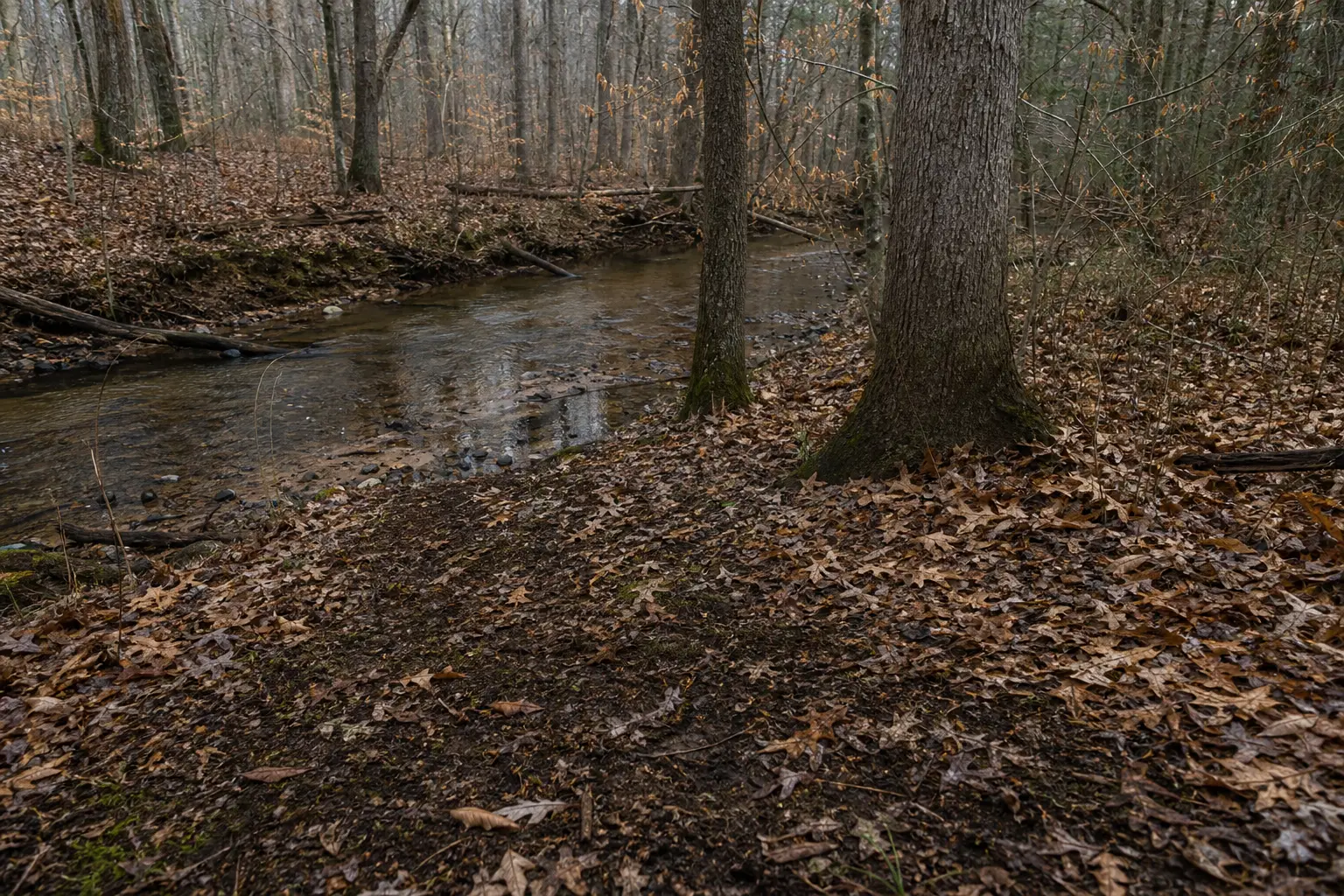
I had done this exactly once, five years earlier, and that one had fallen over in sight. So I climbed down, walked over to the spot, and stared at the ground expecting a highway of red running straight to a dead deer. What I found was four flecks of blood the size of dime drops, then nothing. Just September leaves and the deep hush of a woods that was not going to hand me anything.
Where the Trail Refused to Start
This is the moment every field skill is really learned, the one where you stop being the man in the magazine photo and start being the guy alone in the dark with a dying animal somewhere out there and no idea what you are doing. I did the first thing every overconfident hunter does. I started walking in a straight line in the direction the buck ran.
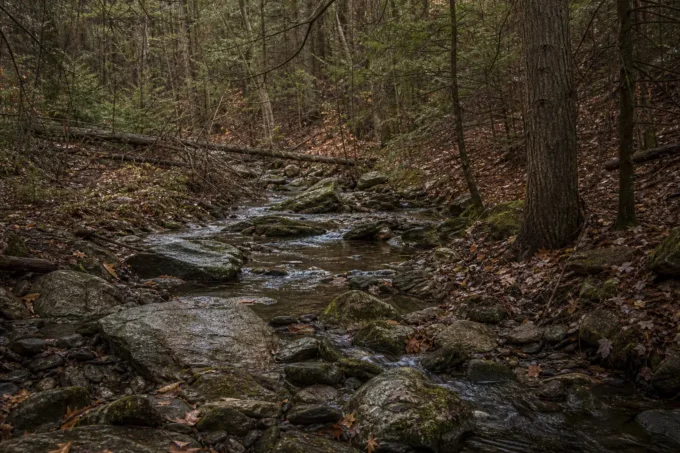
Straight lines are how you lose a blood trail. A wounded whitetail does not run straight for long. He turns downhill, he turns toward cover, he turns to double back across his own line to watch the trail behind him. I walked two hundred yards in a proud straight line and found not one drop. Then I did the second stupid thing, which was to walk back to the four flecks and start over, this time walking in a wider, angrier zigzag, kicking leaves with my boots, mashing the ground flat, and destroying what little sign might have been there while I muttered at the deer for being uncooperative.
An hour of that, and it was getting dark. I had not marked the last blood. I had not marked the first blood. I had not counted steps or tied a single flag or taken a single photograph. I was just a man thrashing in a fifty-yard box, and the light was going.
The Creek Where It All Died
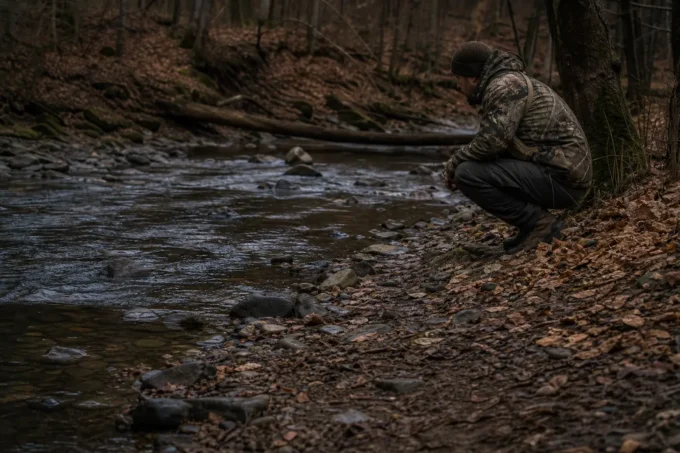
The trail, such as it was, ended at a shallow creek that ran east toward a cedar bottom. A wounded deer heads for water maybe one time in ten, but that night I had convinced myself it was nine times out of nine, because standing at a creek is a lovely place to declare something true that lets you stop crawling. I crossed over and beat the far bank for another forty minutes with a dead headlamp and a live, growing certainty that I had lost my first real trophy.
It was almost fully dark when I leaned a hand on a sycamore and said out loud, to no one, what I had been too proud to admit since the arrow left. I do not know how to do this. All that backyard practice, all those foam blocks and range charts, all that time I spent on the easy half. The killing had been the part I prepared for. The finding, which is what separates a hunter from a guy who wounds things, I had not prepared for at all.
What My Uncle Had Tried to Tell Me
My uncle Ray had told me once, years before, the winter he finally hung up his rifle for good. He said a man with a knife can kill a deer, and a man with luck can find a deer, but only a man with a system can find a deer every time. I had nodded and heard none of it, because I was twenty-six and assumed that wanting it bad enough was a form of skill.
Standing at that creek with a headlamp that flickered every third second, I rebuilt his system from scraps of memory and shame. Read the height of the blood. High sprays on brush mean a high hit, low flecks and smears near the ground mean a low hit or a leg. Read the color. Bright, foamy blood means lungs, and a lung-shot deer rarely goes far. Dark, thick blood means liver or muscle, and that deer beds and waits. Read the gaps. The deer that stops bleeding has either clotted or bedded, and the spacing between drops is a clock telling you whether he is trotting, walking, or slowing down.
I read none of this earlier because I had been walking with my head up, looking for a rack in a brush pile, which is the hunter’s version of trying to find your car keys by staring at the sky.
Learning to Be the Slowest Thing in the Woods
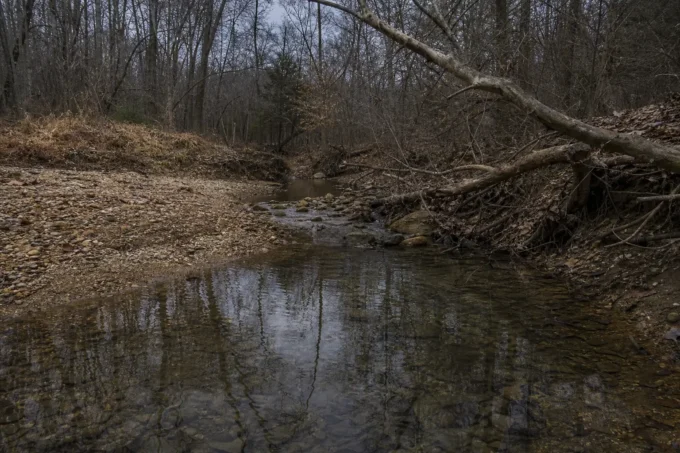
I walked back to the last drop I could remember, which took fifteen minutes and four more mistakes, and I started over the way Ray would have. I dropped a flag at that drop. I got down on my knees with the light, not to look for a deer but to look for one more dot. When I found it, I moved one step at a time, flag in hand, eyes on the ground, and I marked every single drop I found with a twist of survey tape before I moved to the next.
It felt excruciating, and excruciating was exactly right. Trailing is a field skill because it is a discipline, and discipline is just the slowness you refused to learn until you had no other choice. Ten feet at a time. Backtrack when the line vanishes. Circle the last mark in a tight grid, one boot length per pass, trusting that a deer on three legs will leave a print, a tuft of hair, a turned leaf, a smear you would have trampled an hour ago.
I do not know how long I crawled. Long enough for my knees to go numb and my pride to leak out into the leaf litter. And then, forty yards beyond the creek on the far side, not back toward the water at all but cutting along a low ridge I had walked past twice, I found him. He had circled, exactly like they do, and he had bedded within sight of his own back trail, and he was dead.
The Sixty Yards That Owed Me Nothing
The shot had been better than I deserved. The deer had traveled maybe sixty yards total before lying down. He had been within sixty yards of my bow the entire time I was stomping a straight line in the wrong direction, and I want that to be the embarrassing part, but it is only half of it.
The embarrassing part is that I found him not because I was skilled but because I finally admitted I was not, and an admission is not a skill, it is the door you have to walk through to get one. Ray’s system was not magic. It was just attention, applied one drop at a time, and I had skipped it because attention is the least glamorous thing a man can be asked to spend.
I sat with that buck until the woods went fully black, hand on his side longer than I needed to, and I did the work in the dark with the little headlamp that chose that night, of all nights, to finally die for good. I got lost walking the drag out. I left a flag in a tree that I never went back for, and somewhere in that cedar bottom there is still a length of orange survey tape tied to a branch, marking a turn I only sort of remember taking.
That tape is still out there, and I hope it is. Every field skill you learn the hard way leaves something behind, a flag you tied on the wrong side, a boot print pointing the way you already went, a little marker of the version of yourself that did not know. I keep my trail kit ready now, and I wait the full hour before I take one step, and I read the drops before I ever look for the rack. But the thing that changed was smaller than all of that. I learned to be the slowest thing in the woods, because the slowest thing in the woods is the only thing that ever actually finds anything.