The doe came out of the treeline at about 60 yards, quartering away. I had my .308, a soft-point load I’d used for years. Off a shooting stick, solid rest. I held behind the shoulder, squeezed. The rifle barked, the doe jumped — all four legs splayed out like some cartoon deer — and she staggered off into the brush.
I heard the whomp of the bullet hitting meat. That sound is unmistakable once you’ve heard it a few times. I figured she’d pile up inside 50 yards. Took my time packing up, had a drink of water, waited about forty minutes because that’s what the books say. Then I walked over to where she’d been standing.
Not a single drop of blood.
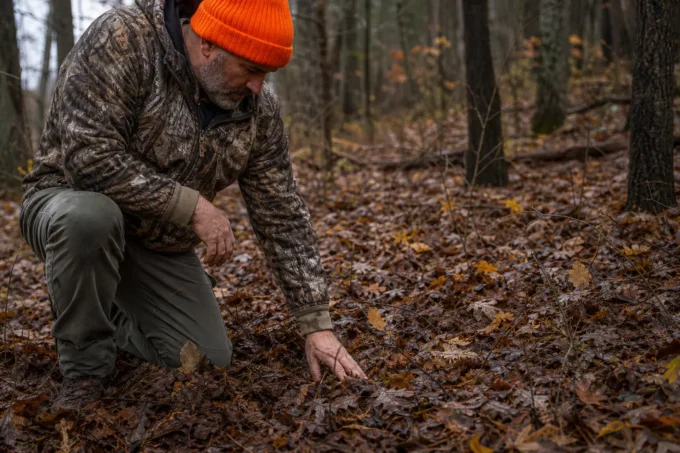
Not one. Not a speck. I knew exactly where I’d hit her — there was a patch of kicked-up leaves where she’d launched into that weird jump. I got down on my hands and knees. Scanned every leaf, every blade of grass, every twig for twenty yards in every direction. Nothing.
The Thing About Zero Blood
Here’s what they don’t tell you in hunting videos: sometimes a perfectly fatal hit produces zero external blood. The bullet goes in, the hide seals up behind it, and all the bleeding happens inside the body cavity. The deer runs. The deer dies. But the blood stays inside, and you’re standing there looking at clean leaves like an idiot.
I was that idiot that morning. I stomped around for twenty minutes in expanding circles, growing more confused and then more pissed off. I knew I’d heard the hit. I knew she was dead somewhere. But dead and found are two different things, and the second one was not cooperating.
I called my buddy Dan. Dan has a little Jack Russell terrier that he uses for blood tracking. I used to think that was kind of silly — a dog for deer recovery? Just follow the blood trail, man. How hard can it be?
Turns out, pretty hard when there is no blood trail.
80 Yards, Then a Kilometer
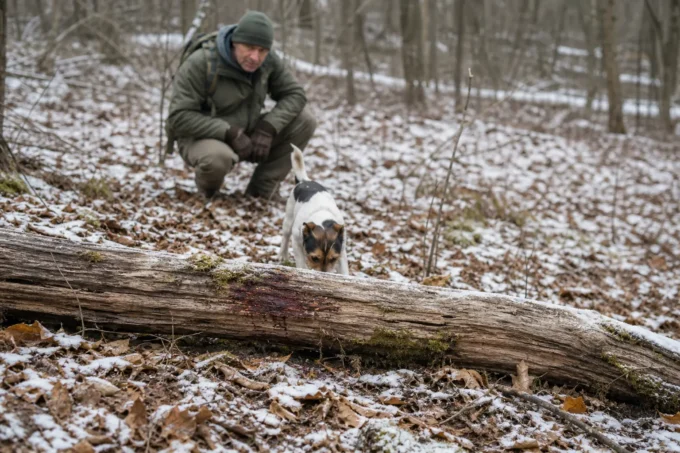
Dan showed up an hour later with the terrier. I explained where the doe had been standing, which direction she’d run. The dog sniffed around the impact site and then took off. Eighty yards in, we found the first blood. A decent-sized patch on a fallen log, dark red, the kind that says lung hit.
I felt like a moron. I’d given up my search maybe thirty yards from where she’d actually bled.
We followed the dog. Another hundred yards. Two hundred. Three hundred. The blood trail went from patches to drops to spotting, the kind where you’d find one tiny speck every ten feet if you were lucky. The terrier kept working, nose down, tail up.
We were about a kilometer in when the dog’s body language changed. She got tight, tense. Then the doe burst out of a patch of thick brush thirty yards ahead of us and bolted. I couldn’t believe it. The dog gave chase, and we followed, crashing through brambles and cursing.
Long story short: we had to call in another hunter with a bigger dog. We tracked that doe for four more kilometers through nasty terrain — steep ridges, creeks, blackberry thickets that tore my sleeves to shreds. She ran up a 150-foot hill that had me bent over gasping for air. We finally caught up to her just before dark and finished the job.
When I field-dressed her, I saw what happened. The bullet had hit the shoulder bone and stopped. Soft-point .308 at 60 yards, and it just lodged in the bone without penetrating the chest cavity. No lung damage, no heart hit. She’d been running on adrenaline and instinct for hours. I’d made what should have been a killing shot and turned it into a six-hour death march for a wounded animal.
What I Got Wrong
I went home that night exhausted, scratched up, and frankly pretty disgusted with myself. Couldn’t sleep. Kept replaying the shot in my head. The doe had been quartering toward me, not away. I’d held where I’d hold on a broadside deer — behind the shoulder — but on a quartering-toward animal, that puts the bullet into the front shoulder instead of slipping behind it into the vitals.
Angle matters. I knew that. I just didn’t process the angle in the moment because I was excited and the deer was right there and my brain skipped the checklist and went straight to squeeze.
Second thing: I didn’t wait long enough. Forty minutes after a shot with no blood? I should have waited two hours minimum. A deer that isn’t leaking blood externally is probably still alive unless you dropped it on the spot. Pushing a wounded deer is the fastest way to turn a 200-yard recovery into a four-kilometer nightmare. She bedded down at some point — we found her first resting spot — and I probably bumped her out of it because sixty minutes earlier I’d been crashing around the impact site like a bear looking for picnic scraps.
Third: I had no tracking dog of my own, no tracking kit, no flagging tape, no backup plan for “what if there’s no blood.” My entire post-shot plan was “walk up to dead deer.” That plan works great right up until it doesn’t.
What I Changed After That Day
First, I bought flagging tape and a real tracking kit. Bright orange tape, hydrogen peroxide in a spray bottle (it foams on blood even when you can’t see it), a good flashlight, extra batteries. The spray bottle has saved my ass at least three times since then.
Second, I started paying actual attention to shot angle. Not just “broadside good, quartering bad” — I mean I started visualizing where the bullet would exit before I pulled the trigger. If I can’t picture the exit hole in my head, I don’t shoot. I’ve passed on deer since then because the angle wasn’t right. That’s a hard thing to do in the moment, but it’s less hard than tracking a wounded animal for six hours.
Third, I got the phone numbers of three guys with tracking dogs and saved them in my contacts. I called every one of them that week and introduced myself. These are the guys you want on speed dial before you need them, not after.
Fourth, I started carrying a notebook. Not for poetry. For marking the last place I saw the animal, the direction it ran, landmarks, time of shot, angle, everything. When you’re stressed and racing against daylight, your memory is worse than you think. Write it down.
The Part That Stuck With Me
That doe fed my family for most of that winter. I didn’t waste the meat. But I also didn’t forget how much she suffered because I got sloppy. Good shot on paper, bad shot on the ground. I think about it every time I glass a deer and feel my heart rate climb. That extra heartbeat of excitement is enough to make you skip the checklist. The checklist is there for a reason.
If you’re out there and you make a shot and find no blood — first of all, it happens. Don’t panic. Mark the spot. Back out quietly. Wait. Call someone with a dog if you can. Trust your ears — you heard the hit, you know the direction. Start wider than you think you need to. The first blood might be a lot farther than you expect.
And if you’ve never lost a deer, you will someday. It’s part of hunting. That doesn’t mean you’re a bad hunter. It means you’re a hunter, period. What matters is what you do next — whether you give up or you learn, and whether you do better the next time you’re staring at clean leaves and a kicked-up patch of dirt.