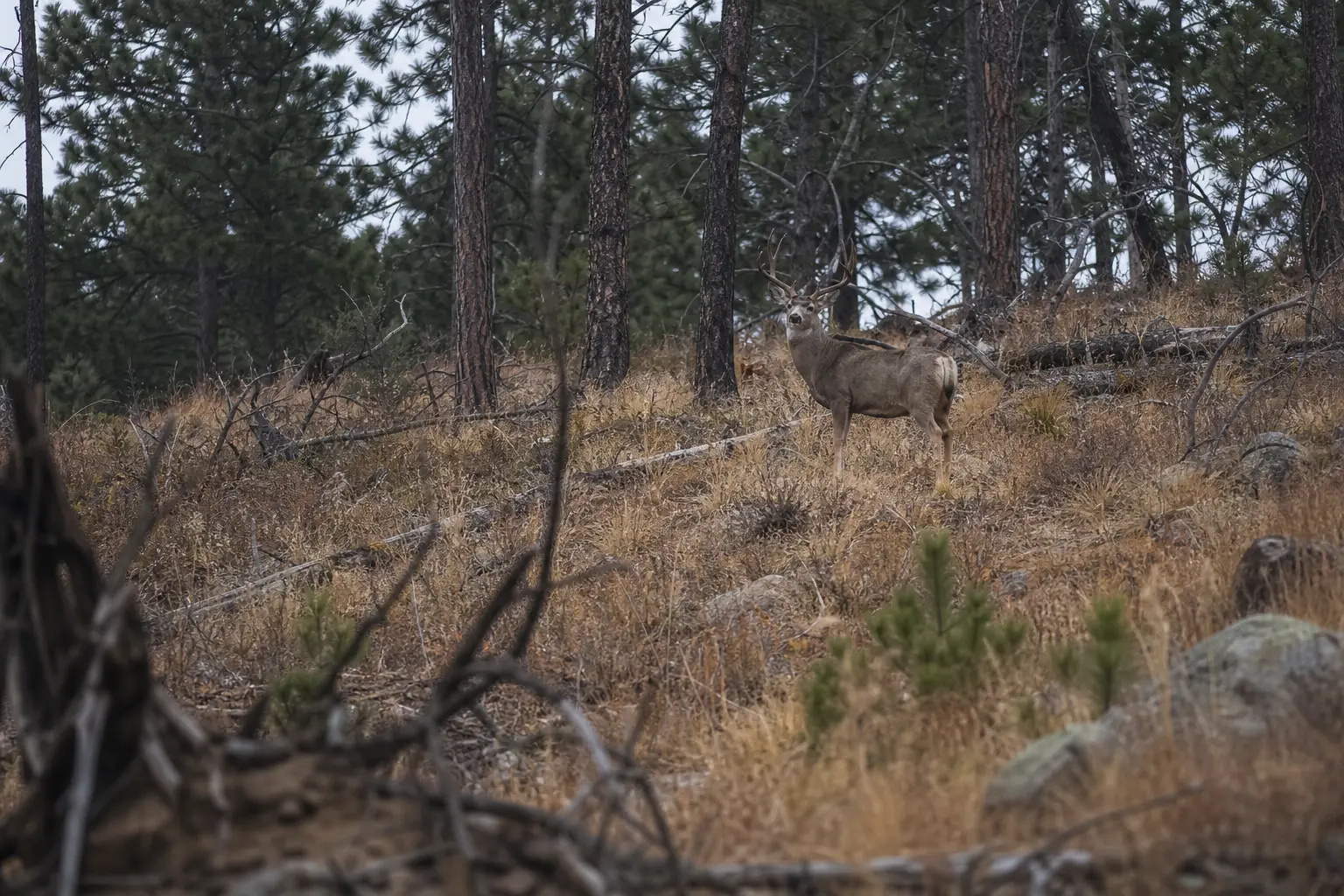
I dialed that buck at 45 yards and watched my arrow sail clean under his chest. Clean under, the way a ball rolls off a pool table you didn’t mean to shoot. Four inches low. He didn’t even bolt hard, just tipped his head down at where the arrow stuck in the dirt, looked back up the hill at me like a man checking his watch, and walked off. He was 45 yards all right. The problem is I shot him at what I thought was 45 the whole time, and I was aiming at the wrong number the whole way up that hill.
The rangefinder was in my pack. Not dead, not lost, not broken. In my pack, sitting at the top where I’d tossed it that morning because I told myself I wouldn’t need it, because I’d hunted that draw a hundred times and I knew it like my own driveway. That draw is steep. Not a little steep. Steep enough that you plant your boot sideways and a rock rolls out from under your heel every third step, and your calves start in on you about halfway up. And I knew a long time ago, the way everybody says they know, that steep ground plays tricks on your eye. Looking up a slope, a buck looks closer than he is. Looking down, he looks farther. I’d read it. Somebody told me. I nodded and said yeah, I know.
Then I stood on the bench with my bow at full draw and let my eye do exactly what my eye does, which is lie to me by eight or ten yards when there’s elevation under it. I didn’t range him. I didn’t even reach for it. I was sure. That’s the word I’d use in the police report of my own head. I was sure, and I shot a number that my eyes made up, and the arrow went under a buck I’d have killed clean if I’d spent four seconds squeezing a button.
The Number Was Real, the Angle Was the Lie
Here’s the thing I want to be honest about, because it took me embarrassing years to get it straight. My rangefinder doesn’t fail me. I fail the rangefinder, by leaving it in the pack, by not trusting what it says, and worst of all by not understanding what the number it spits out is even for. A flat grounder like me spends his whole life on fields and creeks and food plots where the ground runs flat enough that your eye and the gadget agree. You range a tree line at a hundred and ten and the tree line is a hundred and ten, more or less, and everything works and you think you’re a marksman. Then you go up into broken country and the gadget says one thing and your eyeball says another, and instead of believing the machine you argued with it. I’d stand there looking from the buck to the little red readout and back, and somewhere in my head I’d average them out, like the truth was in the middle. Like my eye got a vote.
It doesn’t. That’s the whole lesson, and I write it out plain because nobody said it plain to me. On steep ground the actual horizontal distance, the one your arrow or your bullet travels in the air, is shorter than the straight line you measure up the slope. The gadget that has the little angle thing built in is working it out for you. My eyes were not working it out. My eyes were reading the slope itself, the long diagonal of it, and handing me a number that belonged to a different shot entirely. I wanted the gadget to be wrong because the readout made me feel less sure, and a man will throw away a correct number if it makes him feel less sure. That’s not a rangefinder problem. That’s a me problem wearing a rangefinder like a coat.
I went back the next morning and stood exactly where I’d shot from and ranged the spot where the buck had stood. Flat read it too, walked it with a tape the best I could between the rocks. The straight shot up that grade was eight yards longer than the level distance. My bow was set for the number I sighted. I aimed at the long one. The arrow had no business going anywhere but under him, and that’s exactly where it went. I didn’t flinch. I didn’t string-jump. I shot a perfectly good arrow at a perfectly wrong number, and the whole time a ninety-nine dollar piece of plastic that already knew the right answer was sitting three feet from my shoulder, quiet, doing me no good because I was too proud to use it.
The Gear Doesn’t Matter If You Won’t Let It Do Its One Job
I’ve met a lot of hunters who own good optics and never let them do the one job they’re for. They sight at a buck, they see it clear through the glass, and then they make the shot off the number in their head because they “know that field.” They range the bench seat every time they set up and then eyeball the live one when it walks in, which is like measuring your driveway and then guessing the interstate. The tool is only worth what you trust it with, and trust means using it every single time, even the times you’re sure, especially the times you’re sure, because the times you’re sure are the times it’s there to humble you.
So I made a rule, and it’s a dumb simple rule, the kind that only I would need. No number, no arrow. If the buck’s inside forty yards and standing on flat ground and I could spit on him, I range him anyway. If he’s a chip shot over a bean field, I range him. I don’t ask my eye for an opinion anymore, because my eye wants to feel good and a rangefinder doesn’t care how either of us feels. It’s a compass when I’d rather follow a feeling. The feeling walks you in circles. The compass walks you to the shot.
Buy the one that reads the angle for you, and learn what it’s showing you before the season, not during it. I used to think that little angle readout was a gimmick for long range rifle guys, some elk hunter thing, and it turns out it’s the single feature that would have put that arrow through the buck instead of under him. I own too much gear now and most of it I could live without. The rangefinder I keep on the chest strap where my hand can find it with my eyes shut, and I range the tree line when I sit down in the dark so the first number I reach for in daylight is already honest.
The Next Buck
Two seasons later I was back on that same draw, a little colder, a little more humble, and a buck stepped out at the top of the grade where the old one had stood. My hand went to the chest before I even thought about it. Sixty-one yards up the slope, the readout told me, then the level number next to it, shorter than my eye wanted to believe. I aimed at the honest one and the arrow went where it was told. I found him folded up sixty yards below his bed, and for the first time in my life I didn’t have to wonder afterward whether I’d earned it or just gotten away with one.
The old buck from two years back, the one I clean missed, I saw him again that same fall, bigger, wider, standing where the timber thins out. I ranged him three times for no reason and let him walk. He’ll be there next year. And if he’s not, I’ll know it wasn’t because my eye lied to me and I let it talk.