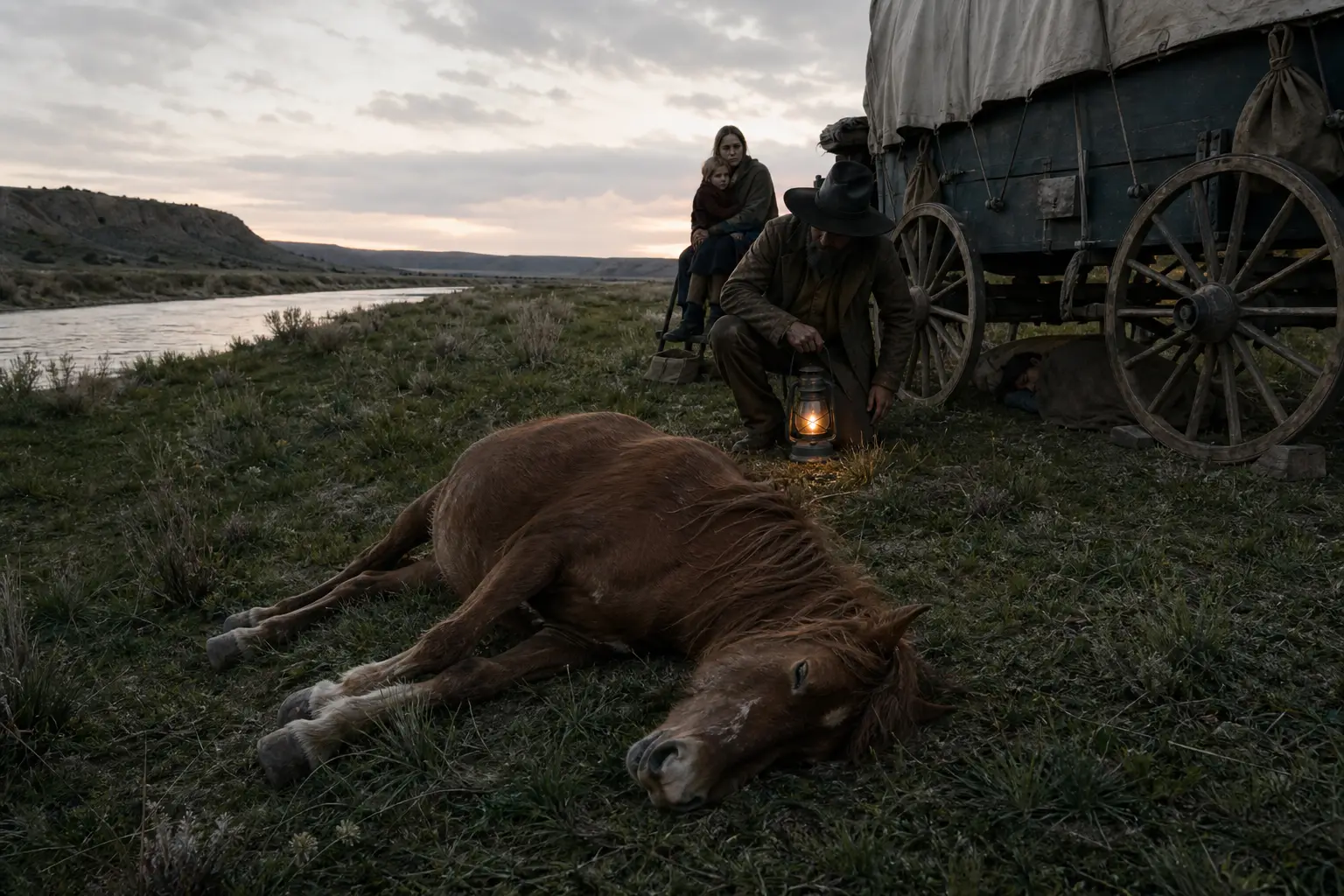
You wake before light because the chestnut mare is down. It is early June, 1848, on the north bank of the North Platte, and the sound that pulled you out of sleep is not a voice but the absence of one, the mare breathing hard and low through her nose and not getting up. The grass along the river is thin this year, and the last water you crossed had a clay taste to it, and now the mare lies with her front right leg bent under her and a shine like fever in her eye. You already know before you put your hand on her. You just do not want to know it yet.
Your brother-in-law Sam is the first one at your shoulder with a lantern, and he says nothing, because a man who has kept stock his whole life does not need to be told when a horse has been pushed one mile past what she had. Hannah is sitting up in the wagon now, holding the smallest of your children against her, and she is watching your face the way she watches a bank of clouds that might or might not carry hail. Morrison is still with you, barely, lying under the wagon with his blanket pulled to his chin, and even he has turned his head to look at the mare, the way a man looks at a thing he recognizes.
The country around you does not care that you are down one horse. It will not wait for you to grieve her. That is the first thing you understand, standing there in the cold with your hand warm on her neck. You are still more than two hundred miles from Fort Laramie, and the mare was carrying a share of the load, and now every pound of it has to go somewhere else, and you do not have enough of anything to cover the loss except your own back.
What a Horse Costs Out Here
Here is what you have learned about a horse on this road, and you have learned it the way you learn everything, by paying for it. A horse is a stomach first and everything else second. She needs grass and water every single day, and on a hard crossing she needs grain, corn or oats, and there is never enough of it. On a good day a horse will keep moving on grass alone. On a bad one, when the grass is thin or the water is alkali or the miles are long, she starts to burn herself from the inside, and there is nothing you can do about it except stop, and the whole train will not stop for one woman’s horse.
So you push the mare when you know better. You push her because the party moves or the party dies, and a horse that cannot help pull or carry is a horse that is eating food somebody else could eat, and there is a hard accounting to that that nobody writes down in the guidebooks. A horse is not a wagon. A wagon does not sicken. A wagon does not pull a tendon or founder on bad water or get stolen by the first band of Paiutes who finds it staked too far from camp. A horse, you have learned, is the most breakable thing on the entire trail, and you have brought three of them to prove it.
You Save Her, Or You Do Not
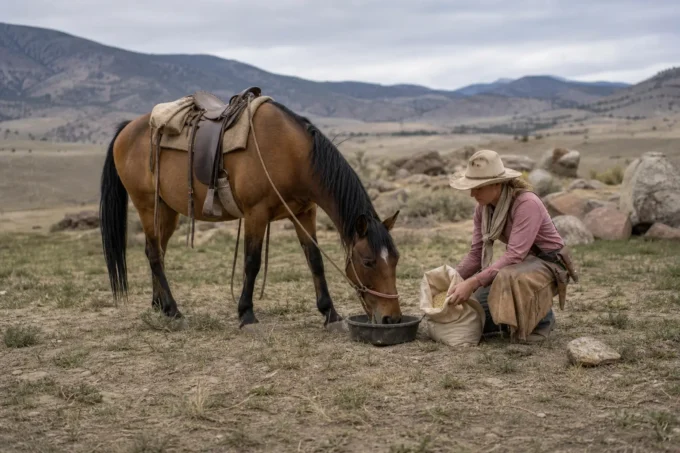
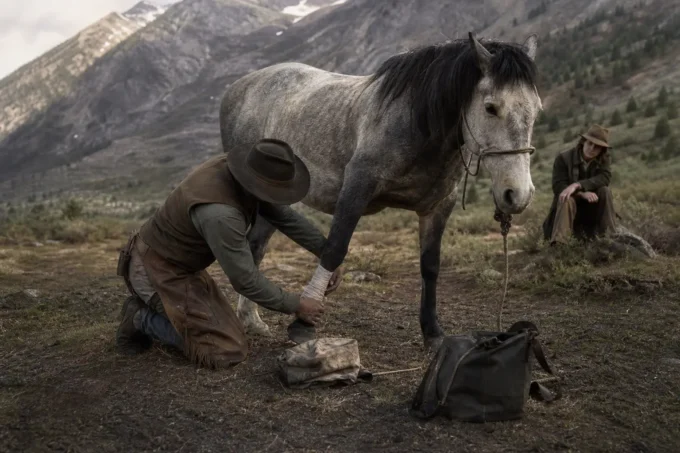
You work on the mare the way you have learned, and none of it is clean or quick. Sam helps you get her up, and when she stands you can see the trouble under the swelling, the front leg gone hot and tight below the knee, the hoof set down careful and wrong, the way a man walks on a bad foot. There is no farrier within two hundred miles, and the shoe on that foot is missing, and you know it came off in the last crossing, in the gravel and the fast water, and you did not catch it because it was dark and you were tired and the river was louder than your worry.
You should have felt for that shoe. That is the thought that keeps you company while you kneel in the dirt with the mare’s leg in your lap. You wrap the hoof in a strip of canvas and grease, and you tie it tight, and you walk her in a slow circle to see if she will put the weight, and she will not, and Sam says, from behind you, “She’ll be lame a week, and a week out here is forever.”
The worst of it is that Sam is right, and you hate him a little for saying it in front of Hannah, and then you hate yourself for hating him, because he is only saying the thing you are already thinking. A week of walking a lame horse means a week of losing ground, and a party that falls behind in this country falls behind worse every day after, because the grass gets eaten and the good camps get taken and the people who stay with the weak get weak themselves. You have seen it happen to better people than you.
The Quiet Work of the Others
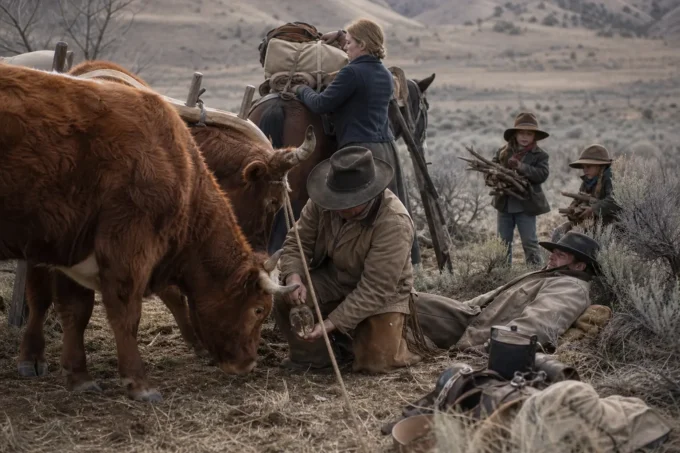
While you argue with Sam in low voices, the rest of the camp keeps moving around you the way water moves around a stone. Hannah has already begun pulling the extra load off the dead packs and rearranging what goes on the ox team, and she does it without asking you, because she knows the answer to the question you have not been able to ask out loud. The children are gathering what dry brush they can find, because a sick horse still needs a fire to warm water over, and Morrison, who can barely lift his head, has pulled himself up on one elbow to watch the mare with something you cannot name on his face.
Sam waters the oxen and picks the stone out of one ox’s hoof with a patience you do not have in you this morning, whistling the way he always whistles, soft and tuneless. You think briefly about the men back east who keep horses in a barn and feed them twice a day and call a veterinarian when they cough, and for a long moment you envy them with a feeling so sharp it is almost shameful. Then you go back to the mare, because standing around envying dead people and east-barn men is a thing you can no longer afford.
What You Actually Do
You do the only arithmetic this road respects. You cannot save the leg and you cannot wait it out and you cannot turn back. So you sell her, for whatever a lame mare is worth to a man with nothing in his hands, and the price is so low it would make you sick if you let yourself think about it. The trader who takes her is headed east, back toward the settlements, and he swears he will have her shod proper and rested, and you know it is mostly a lie, but it is the kind of lie that lets a man sleep, so you take it.
Then you do the thing people do not write about. You redistribute. The flour and the salt and the iron kettle and the spare cloth all get moved, and the children walk more, and you walk more, and Sam takes the heaviest of it on himself without saying a word about what it is doing to him. The mare’s empty halter you hang on the wagon bow, because selling the gear would get you nothing and you might, if the road turns kind, need a halter again before the year is out.
You are down one horse. It is not a tragedy. It is a subtraction, and the trail runs on subtractions. You have seen people lose worse and keep walking, and you have seen people fold up at the first real loss and never be heard from again, and the difference between the two has very little to do with luck and everything to do with whether a person can do the arithmetic with a steady hand.
The Complication
The complication arrives two nights later, and it is small and mean and it nearly undoes all of you. A storm comes up off the mountains while you are not watching, the kind that turns the sky green and drops hail the size of a man’s thumb, and in the confusion of covering the wagon and getting the oxen turned, the sound of horses has gone wrong, and then gone entirely.
The other horse, the big roan, got loose in the hail, spooked by the noise and the ice, and he is gone into the dark with half the lead rope trailing. You spend the rest of that night and half the next morning walking the flats calling for him, and you find him at last in a draw full of tall grass, standing against the wind with his head up and his sides still heaving, no worse for it except a cut on his shoulder and a look in his eye like a creature that has met the devil in the shape of weather.
You bring him back and you do not sleep and you do not sit, and for the first time since you left the settlements you understand in your bones what the old hands mean when they say a man out here owns nothing, that he is only holding things for the country to take back when it gets bored. You check the picket line three times before dawn and you will check it every night after, the way a man checks a locked door, because a horse is not a possession out here. A horse is the difference between walking out of this country and being left in it.
What Was Real
Livestock, more than wagons or goods, was the fragile heart of the overland migration. A wagon could be repaired, and most goods could be replaced at a trading post for a price, but a dead or crippled horse or ox was a loss that could not be made up on the trail. The animals pulled the loads, carried the sick and the children, and were the standing security that kept a family moving. The trail was littered with the bones of oxen and horses that had foundered, gone lame, or simply worn out, and the emigrant diaries are full of the precise, unsentimental accounting of those losses.
A horse on the trail needed daily forage and water, and on hard stretches needed grain such as corn or oats to keep condition. Grazing was less reliable than many emigrants expected, and the competition among hundreds of animals moving along the same line meant the good grass was grazed out by the animals ahead. Livestock were pushed hard by necessity, and the result was a steady toll of lameness, founder from bad water and overeating, tendon injuries, lost shoes, and sickness. A lost shoe, untreated, could lame a horse within days in rough going.
The loss of a horse carried real consequences. Loads had to be redistributed onto other animals, children walked more, and the pace of the whole party slowed, which in turn brought more risk, because a party that lagged behind found worse camps and grazed-out ground and faced higher danger on the road ahead. Emigrants traded, sold, and abandoned animals constantly, and a lame horse was often sold or swapped for a fraction of its value to any eastbound traveler willing to try to bring it back to condition.
Animals were also among the most common things to be lost or taken. Horses staked too far from camp were stolen or drifted in storms, and emigrants learned to tend the picket lines and the hobbles with the same care they gave a locked door. A single strong horse could mean the difference between making the crossing in a season and wintering over in the mountains, and the families that reached the Pacific were in no small part the families that had managed to keep their animals alive and under them. The overland route from the Missouri to Oregon and California ran roughly 2,000 miles, and between 1840 and 1870 something like 400,000 people crossed it, most of them on foot beside the wagons rather than riding in them.