The boy has been crying in the wagon for two days, and by the third morning you can hear the sound he makes before the sun is up, a low grinding whimper he tries to swallow so nobody will hear him, which is somehow worse than the crying. It is early August, 1849, somewhere on the south side of the Sweetwater, and you are kneeling in the dirt holding the boy’s head by the jaw the way you hold a horse that will not take the bit, and the right side of his face is swollen tight enough that the skin shines, and the smell is sweet and rotten and wet, like meat you forgot under a saddle blanket, and it is coming out of his mouth. The boy is nine years old and his name is Thomas, and the tooth has gone bad, and there is not a sawbones or a dentist within four hundred miles, and Hannah is standing just outside the wagon with her arms crossed, watching you with that look that means this is your job now, and you do not want it.
Morrison comes over and looks down at the boy and then at you with his flat gray eyes, and he pulls a pair of farrier’s pliers out of his own coat, the kind you use to pull staples, and he holds them out to you, and he says “sooner is better, the jaw turns poison if you let it set.” You have seen the same thing Morrison is about to say take a man down a hundred miles back, a mule skinner who let a bad tooth go too long until the whole side of his face blew up and the fever took him in four days, and you helped bury him in a shallow scrape where the ground was too hard to go deep, and you do not want to end up like him, and you do not want Thomas to, either. So you take the pliers, and you heat the nubs in the fire until they are almost too hot to hold, and you soak a strip of clean cloth in the whisky you have been saving for exactly this, and you tell the boy to open his mouth.
The Medicine Chest That Weighs the Same As a Small Child
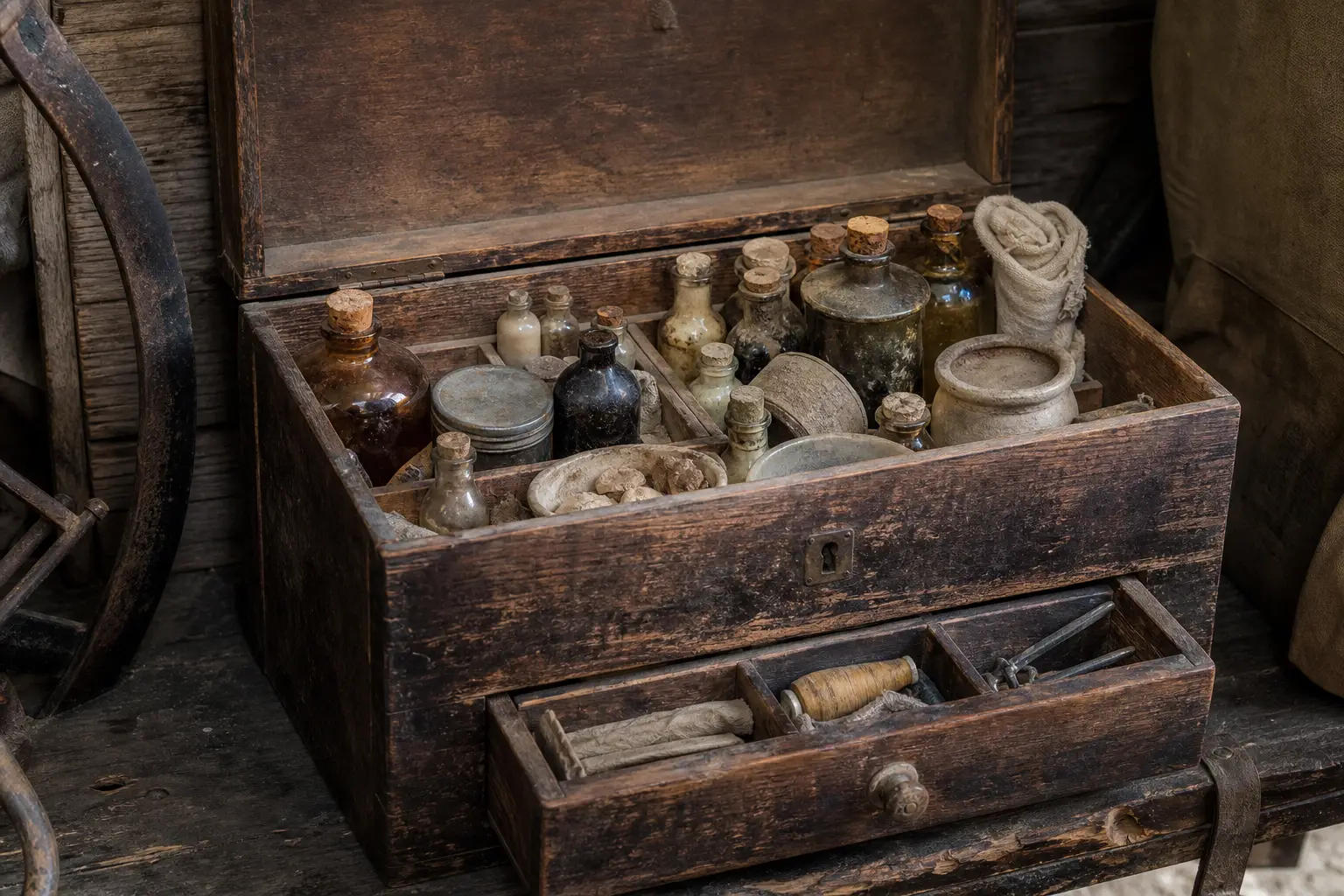
Every family on this road carries a medicine chest, and yours is a wooden box the size of a small travel trunk that sits under the wagon seat, and it is the one thing you never let the boys play near, because everything in it will either cure you or kill you depending on how much you take. The laudanum is in a brown glass bottle with a cork, thirty drops for a grown man’s pain, five for a child, and you measure it out careful, because too much stops the breathing, and you have seen that happen back in Missouri at a neighbor’s house when a woman took laudanum for a headache and never woke up. There is calomel for the flux, though Morrison will tell you the calomel is as likely to poison you as the flux is, and there is quinine bark for the fevers, and there are dried herbs, and there is a packet of opium, and there is the whisky, which is medicine first and everything else second.
The box also holds the things nobody writes home about in the letters that make the road sound like a pleasant jaunt to a better farm. There is a thin flexible saw with an ivory handle, folded in cloth, and you have never used it and never want to, because the saw is for a leg or an arm that has gone bad and has to come off before the poison spreads, and the only thing you have to knock a man down while you work is the same whisky he will scream through anyway. There is a needle and a length of catgut for stitching, and a pair of tweezers, and the farrier’s pliers that Morrison is carrying right now, because the line between man medicine and horse medicine on this road is a thing nobody admits out loud, and a tooth is a tooth whether it is in a man or a mule.

Five Drops of Laudanum and Half the Whisky
You give the boy five drops of laudanum in a tin cup of water and make him swallow it, and then you pour a little whisky on the cloth and have him bite it so the gums go numb, and you tell him to hold it there while you wait for the laudanum to take hold, and you can feel your own heart beating in your hands the way it does before a hard shot. The laudanum is slow, and the sun comes up higher and the flies find the boy’s face, and you wave them off and keep waiting, and Sam comes over from where he has been greasing the axles and stands with his arms hanging at his sides, not saying anything, which is Sam’s way of saying he is here and he is not going to do it for you.
When the boy’s eyes have gone loose and glassy and he stops flinching when you touch the swollen side of his face, you kneel behind him and brace his head against your chest with one arm locked across his forehead, the way your own father held you the one time you had one pulled, and you tell Thomas to think about his mother’s cornbread and you put the hot nubs of the pliers around the bad tooth and you press down and grip, hard, because a slip now means a broken root left in the jaw, and a broken root is the thing that kills a man slow. The tooth cracks, the sound of it coming up through the boy’s skull and into your own, and the boy arches his back, and you twist once the way Morrison told you, twist, do not pull, and the tooth gives with a wet tearing sound, and it comes out in the pliers black and split to the root, and the smell of the thing is enough to make your stomach turn over.
The hole bleeds more than you expect, dark blood that pools in the boy’s mouth, and you pack it with a wad of the whisky cloth and make him bite down and lean forward so it drains, because swallowing that blood will sicken him, and you hold the back of his head and you do not let go. Hannah is already there with a rag and a pan of water she has warmed over the fire, and she washes the boy’s face with a gentleness you have learned to read as the only softness she allows herself in public, and the boy’s breathing steadies out, and the bleeding slows, and somewhere behind you Morrison says “that one would have killed him by the first frost” and spits in the dirt, and it is the kind of thing Morrison says, and for once you do not have it in you to argue.
What the Road Does Not Fix
The tooth is gone, but the road does not let you sit down, because there is still the question of whether the poison has already moved, and for two days you watch the boy the way you watch a lame horse, waiting for the fever, the hot skin, the way the jaw refuses to shrink back to size. The swelling goes down slower than you want, and on the second night you wake and feel his forehead and tell yourself it is just the evening heat and not the start of the sepsis that took the mule skinner, and you lie awake listening to him breathe, and you think about people back east who eat bread without weevils and who can send for a dentist who will come to the house by noon, and you think that no letter you ever send home will be able to explain what this is, this work, and then you think you should not be thinking about any of that, because it is the kind of thinking that makes a man forget to check the harness in the morning.
On the fourth morning the fever has not come. The boy eats a little soft corn mush and drinks water, and the swelling has gone down to a hard knot on his jaw that will stay there a while, and you stand him in front of you and look at the space where the tooth was and tell him the next one that hurts, he tells you the first day and you pull it before it turns, and the boy nods, and you know he will not, because nobody tells you the first day, because telling you the first day is how you end up under the pliers. You walk over to where Morrison is sitting and you hand him back the farrier’s pliers, and the two of you do not say anything, because there is nothing to say, and the road rolls on toward the Green and the Snake and Oregon, and somewhere ahead of you there is a man with a broken leg or a bad tooth who has not even reached the river yet, and whatever is inside your medicine chest will have to be enough, because out here it is the only thing between a family and the dirt, and most days it is barely that.

What Was Real
Toothache and facial abscesses were a constant and genuinely dangerous affliction on the overland trails, because there was no dental care between the towns on the jumping-off points and the settlements far to the west, and a neglected abscess could spread to the jaw and neck and kill through infection. Emigrant accounts describe pulling teeth en route with farrier’s pliers, bullet molds used as improvised forceps, or any other gripping tool that could be boiled or heated and made to fit, and the procedure was done with whatever dulled the pain was at hand, which was usually whisky and, when the family could afford it, laudanum, an alcohol tincture of opium sold widely as a cure for pain, cough, and dysentery.
The family medicine chest was a standard and carefully guarded possession, and it typically held laudanum, calomel, quinine or a quinine substitute such as Peruvian bark, opium, Epsom salts, castor oil, and various dried herbs, alongside instruments such as lancets for bleeding, needles and thread or catgut for suturing, forceps, and sometimes a bone saw for amputation. Disease, far more than Indian attack or accident, was the great killer of the overland migration, and cholera was the single most feared disease of the era, capable of killing a healthy adult within hours, with its worst outbreaks peaking around 1849 in the crowded early years of the California gold rush.
Medicine in the mid-nineteenth century leaned heavily on the belief that the body needed to be rebalanced, and so bleeding and the violent purgatives of the day, chief among them calomel, a mercury compound, were prescribed for everything from fever to flux even where modern understanding now recognizes the harm they could do. Laudanum was depended on so heavily that addiction among emigrants was common and largely unremarked upon, and the same bottle that eased a child through a tooth pulling was also the thing a tired traveler might turn to for sleep and never stop turning to. There was no anesthesia beyond whisky and opium, no antibiotics, no understanding of the bacterial cause of infection, and a limb that became gangrenous had to be removed with a saw in a wagon bed or a tent while the patient was held down and given what whisky or laudanum there was to dull it, and the survival of such an amputation was far from assured.
The distances involved made all of this worse. The Oregon Trail ran roughly two thousand miles from the Missouri River to the Willamette Valley, and along most of it there was no trained physician, no apothecary, and no way to send for help that would arrive in time. Something on the order of 400,000 people made the crossing between the early 1840s and the late 1860s, and the crude, self-reliant medicine of the wagon box was not a quirk of frontier life but a necessity of it, a few bottles and a few iron tools carried across a continent because there was genuinely nothing else, and a man with a bad tooth or a broken leg or a fever was on his own from the first mile to the last.