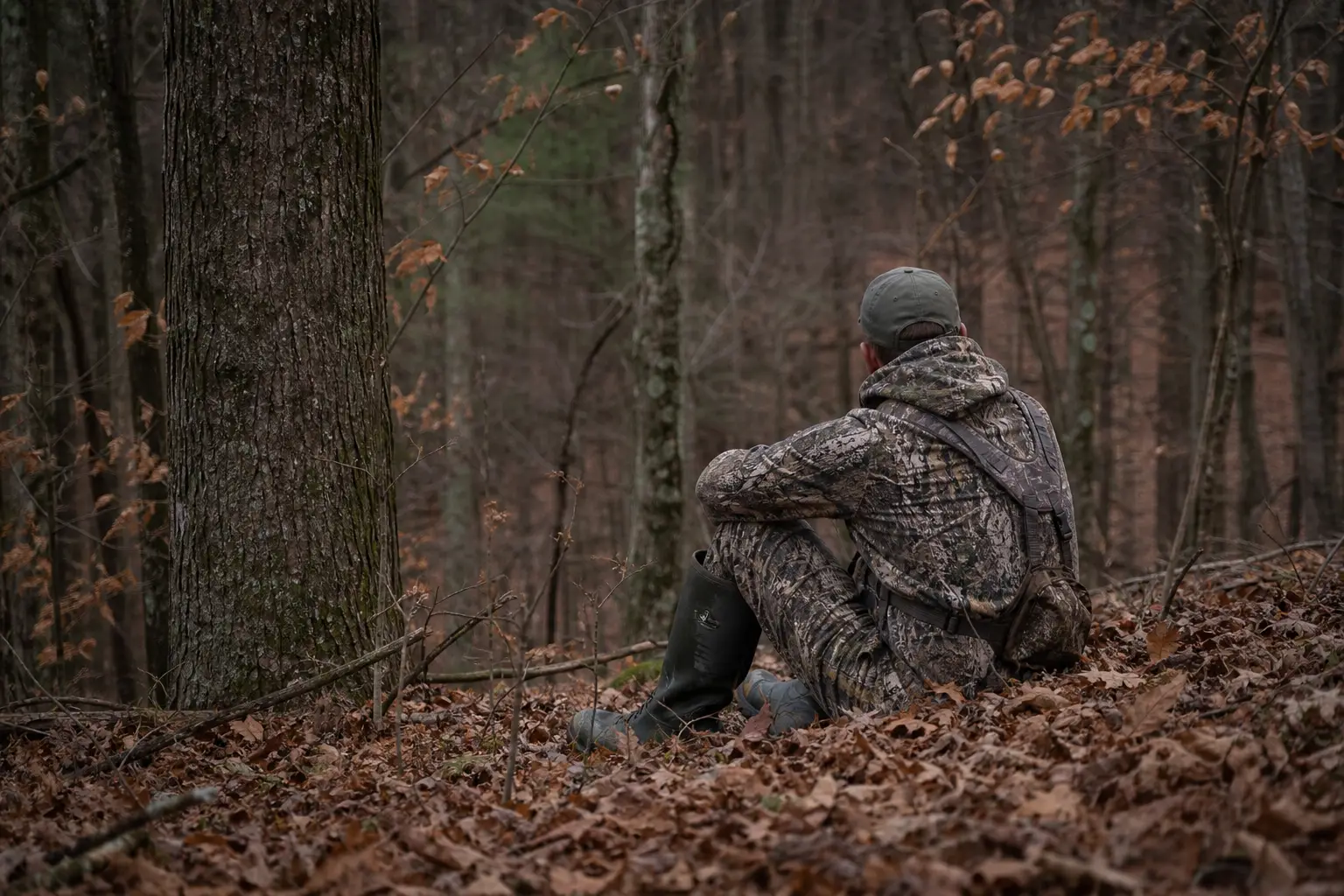
Nobody warns you about it, and that is the part that still bothers me. Every article, every old-timer at deer camp, every fifteen minute video of some guy kneeling behind a downed buck will tell you about the shot. They will tell you about holding your breath, about the dry click of the safety, about the way the sound comes back off the timber a half second later. They never tell you what happens after you walk up and the celebration drains out of you like air from a slow leak. They never mention the silence that shows up uninvited and sits down next to you in the leaves.
The Part That Is Supposed to Be the Good Part
I was thirty one years old when I shot the buck I had been telling myself I was chasing. Not the biggest one on the ridge. Not the one with the crazy drop tine I had named in my head like I was signing a lease on him. Just a solid eight point, heavy in the neck, the kind of deer you call a good clean deer and then stop talking. He came out of a finger of red oaks at last light, head down on a scrape line, and I did everything the way I had practiced doing it in my kitchen with an empty rifle for three straight Novembers. Front sight behind the shoulder. Squeeze instead of pull. The rifle went off and the buck folded like a sack of wet clothes.
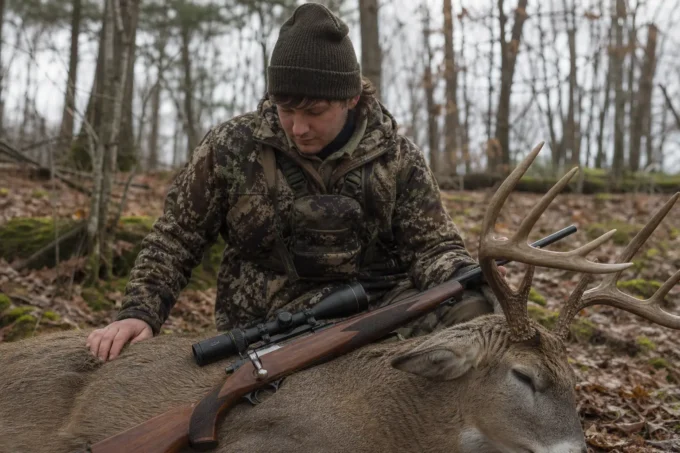
I sat in the stand for a long time because that is what you are supposed to do. Then I climbed down and I walked to him, and here is the thing nobody writes down in the magazine feature. My hands were shaking, and I told myself it was adrenaline. It was not all adrenaline. I stood over a living thing that had been walking on this ridge this morning and now was not, and the first thing I felt, underneath all the relief and the pride, was a big cold flat stone of sadness. I did not have a name for it. I still do not have a good one. I bent down, I put my hand on his shoulder, and I said sorry out loud to an animal that could not hear me and probably would not have understood it if he could.

You Are Not Supposed to Say It Out Loud
The bad part is not the feeling. The bad part is the performance. You learn early that the face you are supposed to wear over a dead deer is the one that matches the photos. Chin up. Rifle resting on the antler. Some kind of grin that says look what the woods surrendered. Every hunter I knew wore that grin like a uniform, and I wore it too, because the alternative felt like admitting you had done something wrong, and if there is one thing a grown man at deer camp cannot be seen doing, it is admitting that the thing he worked all year for made him feel anything other than victorious.
So I stuffed the sadness down and I did the work. I field dressed him with cold hands and I kept my mouth shut when the other guys clapped me on the back and said the thing about freezer meat. I told myself the feeling would go away once he was cut and wrapped and in the chest in the garage. It did not. It got quieter, sure. It became the kind of thing you carry instead of the kind of thing that knocks you over. But I have shot enough deer since then to know the stone does not go away. It just gets heavier and lighter depending on the deer, depending on the morning, depending on how honest you are willing to be with yourself in the dark.
The First One Is a Lesson, the Tenth One Is a Choice
There is a version of this story where I tell you the sadness means I respect the animal, and then I feel good about myself and we all move on. That version is a lie, or at least it is only the polite half of the truth. The real reason the sadness stuck with me long after the first deer is that it finally made me stop performing. When you are young and full of ego, a dead animal is proof. Proof you can shoot, proof you are patient, proof that the long empty mornings were buying something. The animal is the receipt. And for a while, that is all he is, because a young man is mostly interested in what the woods can confirm about him.
Then you shoot a few more, and somewhere along the line the receipt turns back into what it actually was the whole time. A living creature. Something with a heartbeat and a route it ran every day and a place it bedded when the wind was wrong. And that is the choice nobody tells you about. You can keep pretending the sadness is weakness and bury it under more freezer meat and bigger antlers, or you can sit with it and let it change the way you aim, the shots you take, the ones you pass on. The sadness is not the opposite of being a good hunter. It is the thing that keeps you from becoming a sloppy one.
The Grin and the Stone Can Live in the Same Chest
It took me years to figure out that I did not have to pick a side. I grew up around men who acted like the only choices were to be a cold-blooded shooter or a guy who cries into his venison. Neither one is true. You can stand over a deer with your hand on his shoulder and feel the full weight of what you just did, and you can still be grateful for the meat, and proud of the shot, and quiet for a minute. Those things are not enemies. The moment I stopped pretending they were, the whole thing got easier, and heavier, at the same time. Better and harder.
The stone is not a punishment. It is the price of paying attention. A man who kills and feels nothing is not strong. He is just not looking at what is actually in front of him. A man who feels the sadness and lets it make him reckless is not honoring anything either. The honest place is somewhere in the middle, and you find it by walking up to the deer every single time and letting the silence sit down next to you without trying to talk over it.
The Hunter the Woods Kept
I do not have a clean ending for this, because the feeling does not have one. I still kneel and say sorry, and it still sounds a little foolish, and I have stopped caring that it does. I have learned that the men who never feel that stone are the men the woods do not keep, the ones who burn out or turn the whole thing into numbers and antlers and arguments at the check station. The ones who stay, the ones who do this until they are old, are the ones who made peace with the fact that the best moments of hunting are wrapped around a small cold grief you never quite get used to.
So this is not advice about shot placement or stand location or how long to wait before you climb down. This is just me telling you the thing nobody told me, in case you are standing over your own deer right now wondering if something is wrong with you because the moment is not all fist pumps and high fives. Nothing is wrong with you. The sadness in the middle of the success is not the failure of the hunt. It is the part that proves you understood what you were doing. Sit with it for a minute. Then do the work, take the meat, and be grateful for both things at once.