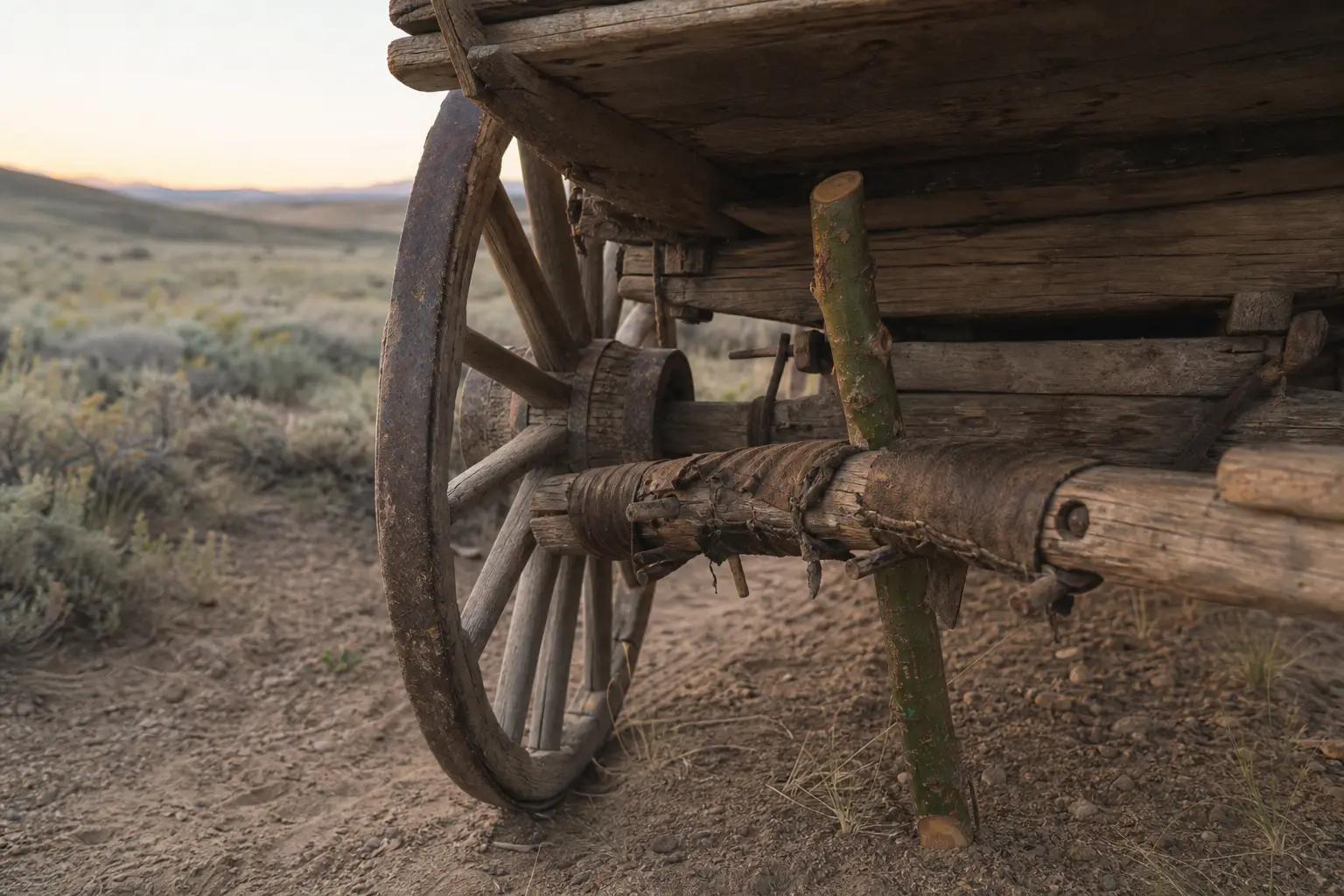
You know the axle is breaking before it breaks, because the wagon starts to sing. It is late May, 1849, on the south side of the Sweetwater, and the whole day has been one long pull through sand that grabs the wheels and will not let go. Then, as you crest a low rise with the sun going down red in your eyes, the wagon lets out a groan that is a different groan, a sound of wood coming apart from the inside, and you feel it through the wagon tongue in your hands, through the soles of your boots, a deep splitting crack that is not the wind and not the harness and not your imagination. You pull up. Everybody pulls up. The train stales to a stop behind you like a beast that has been handed something heavy to think about.
Sam is already off his horse and under the wagon before you can say anything, running his hand along the near rear axle, and his face when he comes out tells you the rest. Hannah is standing in the wagon box with the baby, shading her eyes into the low sun, and she does not ask. Morrison is off to the side, sitting on a flat rock with his chin on his hands, and he keeps saying, quietly, to nobody, “Them wheels. Them wheels will be the death of me.” You want to tell him to shut up, because Morrison has a way of saying a true thing so it lands on you like a wet sack, but the trouble is he is right, and you know it, and so you leave him to his rock and his low muttering and you go see what you are working with.
Here is the thing about a wagon on this road that no guidebook back east ever puts to you straight. A wagon is just a wagon until it is four hundred wheels deep in the ruts and the nearest blacksmith is two hundred miles behind you and the parts you did not bring are the exact parts that have now failed. You do not fix a wagon out here the way you fix a wagon in Pennsylvania. You fix it with what the wagon is carrying, or you do not fix it, and if you do not fix it, you walk, and a family that walks out of this country with its flour and its bedding and its iron kettle on its own backs is a family that is already halfway to being something else.
What You Carry, and What You Do Not
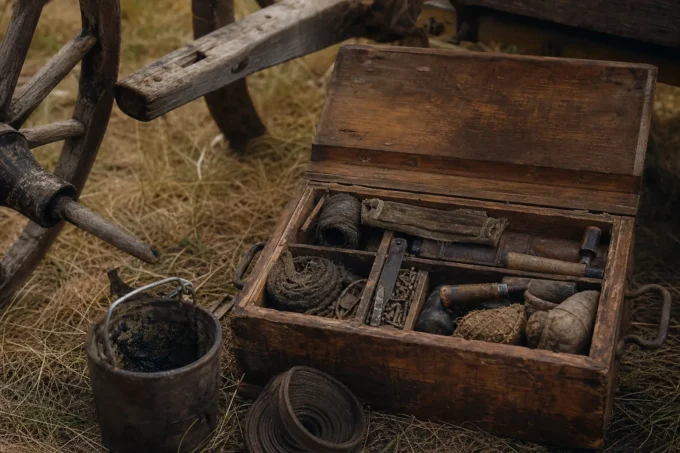
You have learned, in the bad way, that a spare tire box is worth more than almost anything else on the running gear, and you have learned it by watching people who did not have one. Inside your box, packed in grease and old canvas, are the things the road has taught you to never be without a spare linchpin, a spare kingbolt, a length of strap iron, a handful of rivets and nails in a sack, a cold chisel, an auger, a drawknife, and twice as much oakum and tar as you think you need. It is not a blacksmith shop. It is the difference between a day stopped and a week stopped, and out here a week stopped is a thing you do not get back.
The axle is the worst of the lot, because it is the spine and there is no spare spine. A man can splice a wheel or lash a tongue or brace a bed, and the wagon will limp along and hold together until the next post or the next river. But a broken axle, a real one, a snapped half-shaft with the wheel trying to walk off on its own, that is a thing that strands you where you stand. So you have ridden for six hundred miles with your ears tuned to the axles, listening for the change in the song, and it has kept you whole until today.
The Work, Inch by Inch
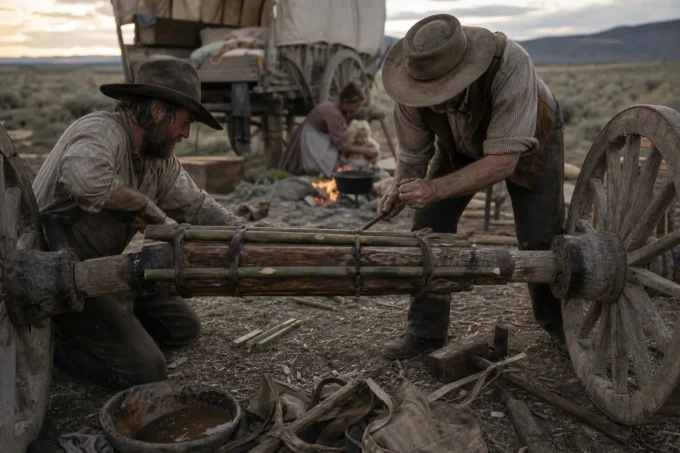
You and Sam unload the bed box first, because you cannot get to the axle with a thousand pounds of it sitting on top of you, and the unloading is the part nobody talks about when they talk about fixing a wagon. It is back-work in the last heat of the day, the dust kicking up into your mouth and your eyes, and by the time the flour and the tool chest and the folded bedding are stacked in the sage you are soaked through and your hands have got the kind of shake to them that comes after you have asked too much of them. The mosquitoes have found your neck by then, and the baby is crying, and Hannah has built a small fire with dried sagebrush so she can at least boil water and keep her hands doing something while the men grunt at a broken wagon.
What is wrong, when you finally get the wheel off and the hub greased clear, is not the half-shaft snapped clean, which would have been a worse thing but a clearer one. It is a split running the length of the axle beam, a crack that opens when the wagon leans and closes when it sits level, the kind of crack you could ignore for another twenty miles and then have it spend the whole wagon on you in the middle of a river crossing. Sam says “There it is,” and you say nothing, because there it is, and now the two of you have to argue with wood all night.
The fix is a splice and a bind and a prayer, and none of it is pretty. You cut two green poles of willow, nothing you would trust for long, but green and straight and thick as a man’s wrist, and you lay them along the cracked beam on both sides like splints on a leg. Then you drill with the auger, and you run your strap iron around the whole business and through the holes, and you cinch it down with the drawknife taking the green bark off where it needs to lie flat, and you drive the whole mess tight with wedges and wet rawhide, because wet rawhide shrinks when it dries and grips a thing like a fist. It will not last to Oregon. It might last to Fort Bridger. That is the whole of your plan, and you do not say it out loud because saying it out loud would be the same as admitting there is no plan, only a gamble with a borrowed day.
The Quiet While You Work
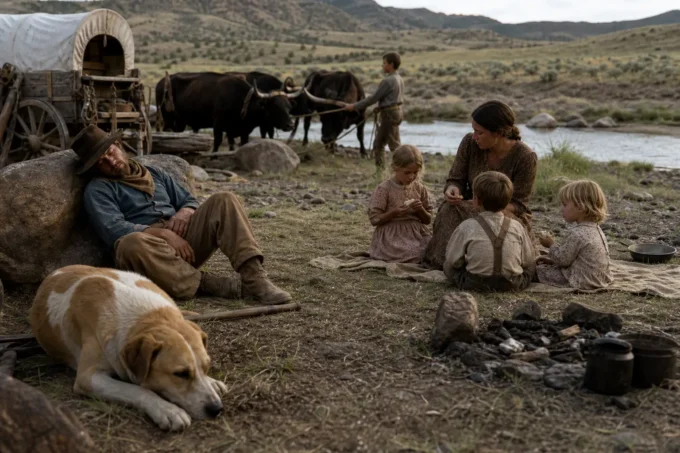
While you and Sam swear and bend, the rest of the camp has already settled into the wait the way people settle into a thing they have done before. Hannah is feeding the smaller children pieces of cold biscuit and telling them a story you cannot quite hear, and the oldest boy, the one who is almost too big to be called a boy, has taken it on himself to gather the team back in and water them, and he does it without being asked, the way a body grows up about ten years in one afternoon out here. Morrison has stopped muttering and fallen asleep sitting up against his rock, his mouth open, a green fly walking across the back of his hand, and for one strange moment you are almost grateful to the broken axle, because it has stopped him talking.
You catch yourself, at one point, thinking about the blacksmith back in Independence, the man who had shod your oxen and charged too much and argued too loud, and you would give a week of your life for ten minutes of his time and his anvil. Then you go back to the rawhide, because thinking about a blacksmith on the far side of six hundred miles is another one of the things you can no longer afford, and the rawhide is tightening around the splice the way it is supposed to, and that is a small real thing you can hold on to.
What Breaks Next
You get the wheel back on an hour before the last light is gone, and you walk the wagon a hundred feet slowly with Sam walking backward beside it with his head cocked, listening, and the song is different now, a rough song but a whole one, and for the first time in a long afternoon you let your shoulders come down half an inch. You reload the wagon in the dark by feel, and you eat standing up, and you do not bother to wash the grease off your hands because the river is cold and you are too tired to care.
The next morning, the other thing breaks. It is the wagon box, the near front corner, where the stress of the unload and reload has started a crack in the sideboard, and you stand looking at it in the first gray light and you almost laugh, because of course it would be that, because a wagon out here never breaks one thing when it can break two and make a man feel like a fool twice in twenty-four hours. It is a small crack, and you will lash it with the strap iron and enough oakum to keep the flour dry, and you will note it down the way you note a sore tooth, as a thing to watch and to curse and to carry.
You do not feel victorious as you roll out that morning. You feel tired in a way that has moved past the muscles and into the bones and the skull, and the only thing you want is to sit down on the wagon tongue for an hour and not be needed. But the train is moving and the sun is up and the splice is holding, and so you walk, and the wagon walks with you, groaning its rough new song, and for today, that has to be enough, because today is the only day this road ever gives you.
What Was Real
Wagons on the overland trails were, in practice, loaded beyond what their makers intended, and the result was a steady stream of breakdowns that every emigrant train expected and planned for. The most common failures were broken axles, split wheels, cracked hubs, snapped tongues, and sideboards and beds that worked loose from the constant jarring of rough ground. Most emigrants did not ride in the wagons over the long haul. They walked, partly to spare the animals, and partly because the wagons were too heavily loaded with goods and supplies to carry people in comfort.
Emigrant guidebooks and the practical wisdom passed between travelers agreed on one thing above all, which was to carry spare parts and the tools to use them. A well-supplied wagon carried spare linchpins, a spare kingbolt, strap iron, rivets, nails, oakum and tar for the boxes and beds, and a small set of tools that typically included an auger, a drawknife, a saw, a cold chisel, and a hammer. The absence of these things could turn a repairable failure into an abandonment, and abandoned wagons and the scattered goods around them were a common sight along the length of the Oregon and California trails.
The axle was understood to be the single most critical and least replaceable part of the wagon. A broken wheel could be spliced or even made to ride on a rough-hewn replacement, and a tongue or a beam could be lashed and wedged back into service, but a snapped axle generally meant the end of the wagon where it lay. Travelers carried spare tongues and spare wheel parts far more often than they carried a spare axle, and the diaries record long, anxious days spent nursing a cracked axle along with splints, iron wraps, and wet rawhide that shrank as it dried and held the wood together.
Green wood and wet rawhide were among the most valued emergency materials on the trail, because both could be cut or prepared on the spot and both gripped as they set. Rawhide lashings, in particular, were used for everything from binding split beams to holding a tongue to a broken axle housing to patching a cracked hub. The repairs were understood to be temporary, good for a few hundred miles at best, and every party aimed to reach the next blacksmith at a trading post or fort, such as Fort Laramie, Fort Bridger, or Fort Hall, where forge work could be done properly and for a price. The distance between those posts, and the possibility of a breakdown in the middle of it, was one of the quiet fears that every family carried west.