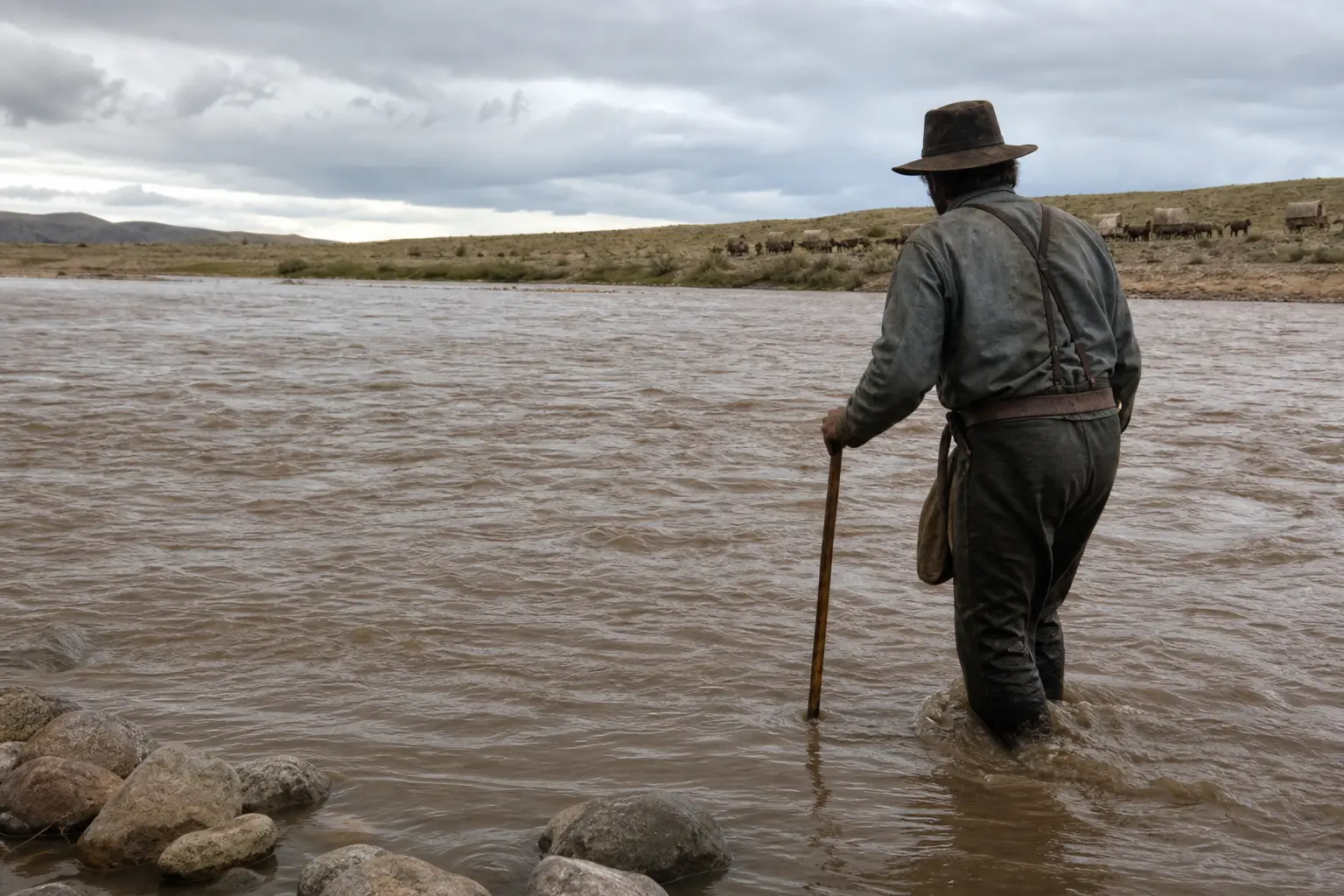
The river tells you it is coming before you see it, because the air goes damp and cool in the throat and you can hear it, a low steady mutter under the creak of the harness, growing until the whole train is leaning forward toward the sound the way thirsty things always do. It is late June, 1849, and you are coming down to the North Platte, and every wagon ahead of you has stopped, and the horses are blowing, and the smell of cold moving water is the first real thing you have smelled in a week that was not dust or sweat or the sour inside of your own boots. The river is wide and brown and alive, and it does not care whether you are ready for it, because the river is the one thing on this road that has never once been sorry.
Sam has already walked ahead to the bank and is standing in water to his knees, feeling the bottom with the butt of a wagon tongue, shaking his head, and you know before he says it that this crossing is going to cost you. Hannah is still up in the wagon box with the baby, holding the ribs, watching the water, and Morrison is off to the side wrapping his blanket around his pipe against the wind, and he keeps saying it, the way he says everything now, in that thin flat voice of a man who has stopped expecting the road to be easy. “They say the Platte is a mile wide and a foot deep,” Morrison says, “and the other half of that story is the part they leave out.” You do not answer him, because the part they leave out is exactly what you are standing here looking at.
Here is what no guidebook back east ever tells you straight, the thing you have learned by watching three other crossings go bad. A river is not a flat place you cross. It is a moving thing with a mind, and it hides its worst tricks under the smooth parts, and the difference between a bad crossing and a drowned wagon is about one wrong step taken by a single ox that can no longer touch bottom. You have seen a wagon go over in the Platte and turn slow on its side like a beast lying down to die, and you have seen the flour barrels bob down the current like fat white coffins, and you have seen a man go under and come up forty yards downriver with his whole life streaming out of his open mouth. So you do not cross a river the way you cross a field. You cross it the way you cross a thing that is actively trying to kill you, which is what it is.
The Work of Reading Water
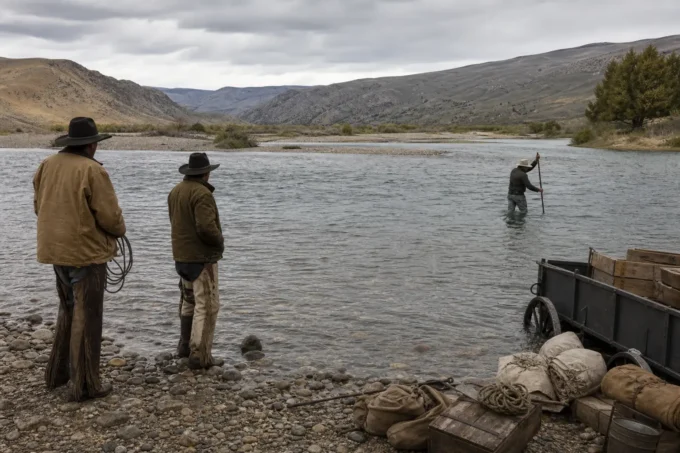
You and Sam spend a long time on the bank before anyone unhitches anything, and that time is not wasted, it is the whole trick. You walk upstream and downstream a hundred yards each way looking for the place where the water runs slow and shallow, the riffle where the bottom shows through, the gravel bar that runs at an angle, because the river always gives you one good seam if you have the patience to find it. The best crossing is rarely the widest and never the narrowest, the narrowest being where the water piles up fast and deep and grabs at your legs. A man crosses where the water spreads out and gets shallow, even if that means walking a longer diagonal than he wants, because a long slow crossing is a wet crossing, and a short fast crossing is a drowned one.
Sam ties a line around his waist and wades in first with the wagon tongue for a staff, feeling each step with it before he trusts the foot, and he goes out until the water is at his chest and comes back and says the bottom is gravel, then sand, then a soft place in the middle that will want to swallow a wheel. You mark it all in your head the way you would mark a trail, and then you go back to the wagon and you begin the part that is all labor and no skill, which is unloading the bed high and light, because a heavy wagon will not float the way you need it to, and a wagon that sinks into a soft bottom in mid-river is a wagon you do not get back.
Lash It High, Keep It Dry
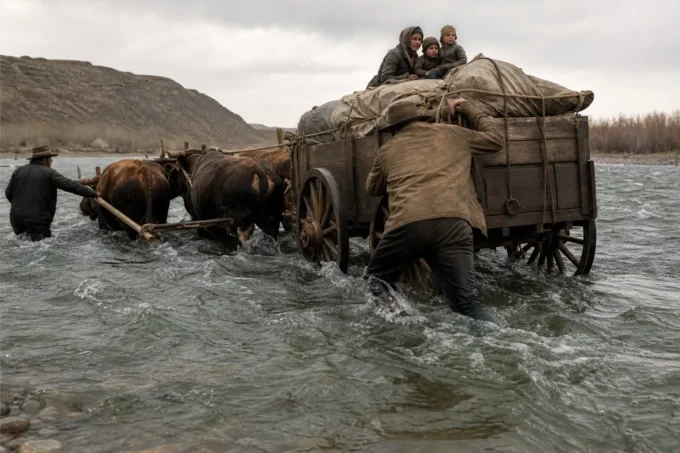
The flour goes up on top where the water cannot reach it, and the bedding, and the goods the wet would turn to nothing, and everything low in the box gets packed in oilcloth and canvas and tied down with the rope you have been saving, because this is what the rope was for. The baby and the small children go into the wagon box on top of the load, and Hannah goes in with them, and you wedge the tailgate and say a thing you will not repeat, and then you hitch the four oxen with the two steadiest in front and the two that shy on the downstream side, because an ox that shies from the current will turn the whole team and take the wagon sideways with it.
Then you are in the water, and it is colder than you told yourself it would be, and the current pushes at your legs with a steady insistent weight you can feel all the way up in your chest, and the bottom under your boots is round stones that roll and shift, and every step is a small negotiation with a thing that wants to take your feet out from under you. Sam is on the upstream side, up to his waist, holding the lead ox by the horn and talking to it in a low voice, and the wagon is groaning behind you, and the water is up over the axles now, and somewhere behind all of it you can hear Morrison shouting something you cannot make out, and you do not turn to look, because if you look you will not be looking at the place your next foot is going.
The soft place in the middle is where it almost goes wrong, because the near front wheel drops into the sand pocket Sam marked and the wagon lurches and the whole load tilts about ten degrees to the downstream side, and for one long second you are sure you are about to watch a year of your life float away down the Platte. Hannah does not scream, which is worse than a scream, and the baby is suddenly silent, and you throw every ounce of your own weight against the upstream wagon box and hold it, and Sam hauls on the lead ox, and the oxen dig in and pull, and the wheel comes up out of the pocket with a sucking sound, and then you are through and climbing up onto the far gravel in water that is only knee deep again, and you want to sit down in the shallows and never stand back up.
What the River Takes Anyway
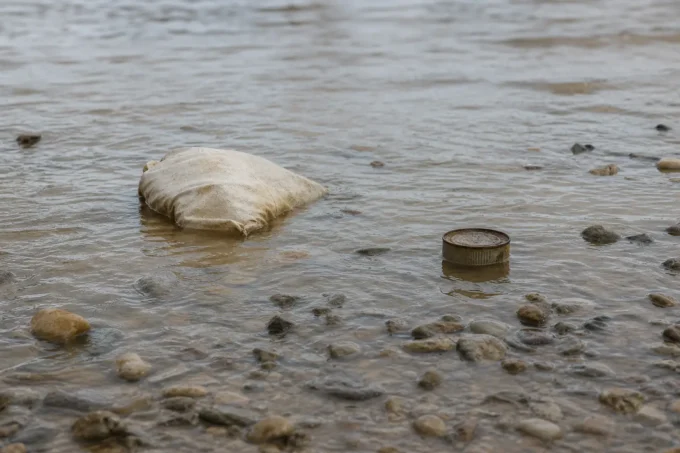
You do not know what you have lost until you are all on the far bank and the heart has come back down out of your throat and Hannah is wringing out the baby’s blanket into the mud. The tailgate has worked loose in the lurch, and the river has reached in and taken one small sack of coffee and a tin of sugar, and the two of them have gone down the Platte together on their way to some beaver dam or some Indian camp where they will be somebody else’s luck. It is a small thing, a few pounds of coffee and sugar, and it is also the kind of thing that means everything to a family on this road, and you stand there looking at the river like a man who has just been robbed by a thing that was never going to give it back anyway.
You do not feel like you have won anything up there on the far bank. You feel cold and tired in a way that has got down into the marrow, and your boots are full of water that sloshes with every step, and the only thing you want is to sit on a rock and let the sun dry you and not have to decide anything for an hour. But the train is rolling on, and there are more rivers between here and Oregon, and Morrison is already walking on ahead with his blanket and his thin flat voice, saying to nobody that the Platte is a liar, and maybe he is right, and maybe every crossing from here to the coast will be exactly this, a few hundred yards of fear and cold and then a coffee sack you will never see again, and you follow him, because there is nothing else to do, and the river does not care, which is, in the end, the only honest thing it ever tells you.
What Was Real
The rivers of the overland trails, chiefly the Platte, the Sweetwater, the Green, the Snake, and the Columbia, were among the most feared obstacles of the westward migration, and their crossings accounted for a large share of the accidental deaths on the route. The South Platte and the North Platte in particular were known for being broad and shallow in places, which earned the Platte the emigrant saying that it was too thick to drink and too thin to plow and a mile wide and a foot deep. That shallowness concealed the real danger, which was not depth but current, shifting gravel bottoms, hidden sand pockets, and quicksand, and an ox or a wagon that lost its footing in fast water could be swept and overturned before help could reach it.
Crossing procedure was far more deliberate than the popular image suggests. Experienced parties scouted for the shallowest and slowest stretch, sometimes walking long distances to find a good ford, and they favored wide, flat riffles over narrow, fast channels. A man or a man on horseback would wade the proposed crossing first, feeling the bottom with a pole, before the wagons were brought across. Wagons were often partially unloaded and loaded high to keep the floor and the goods clear of the water, and perishable goods such as flour were wrapped in oilcloth and raised to the top of the load, while the emigrants themselves frequently walked or waded rather than ride, since a person in the water could brace and save themselves where a wagon could not.
Drowning was common enough that the diaries of the period return to it again and again, and children and those who could not swim were especially at risk. Many emigrants recorded the depth of rivers they crossed as a matter of course, and the names of rivers such as the Green and the Snake appear so often in accounts of loss that they acquired a grim reputation among travelers. The loss at a river was not only life. Wagons, animals, and the goods they carried were lost to the current, and a family that had crossed half the continent could watch its flour, its clothing, its tools, and its food go downstream in a matter of minutes.
The Platte River system carried the great majority of the traffic on the central overland route, and the Oregon Trail roughly followed the Platte, then the Sweetwater, before the emigrants faced the Green, the Snake, and finally the Columbia or the overland cutoffs into Oregon. Something on the order of 400,000 people crossed these rivers between the early 1840s and the late 1860s, most of them on the Oregon and California trails, and the river crossings, far more than the deserts or the mountains, were the places where the road collected its toll in the lives of the young, the unlucky, and the hurried. The rivers did not stop the migration. They only exacted their price for letting it pass, and the price was paid in water, in cold, and in the things that floated away downstream while the living stood on the bank and watched.