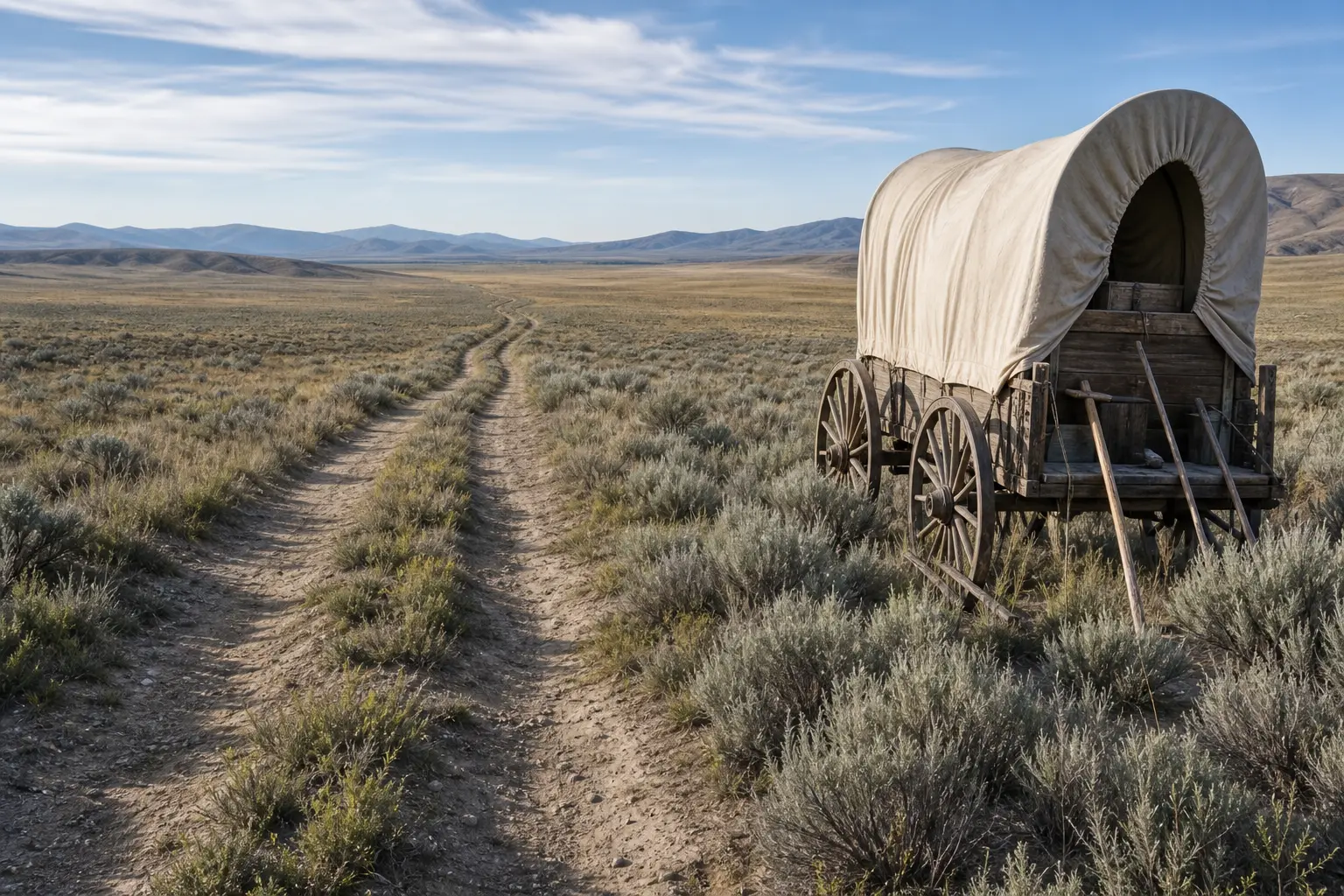
You wake with the taste of dust on your teeth and the knowledge, certain as sunrise, that you have made the wrong turn. It is late July, 1849, and somewhere west of the Sweetwater the wagon road has thinned into a set of wheel ruts that fade into the sage and then into nothing. The sun was supposed to come up over your right shoulder, and it has come up over your left. Your brother-in-law Sam stands at the edge of the little rise with a tin cup of cold coffee and stares at the horizon the way a man stares at a closed door, and he says, quiet, “We’re twenty miles south of where we want to be, at least.” Nobody argues. The boys watch the two of you and wait, because when the grown men go quiet, the children learn to read the silence.
Morrison is dead, has been dead since the flux took him back at Fort Laramie, and that is the trouble in a plain way no one says out loud. Morrison was the one who could read a country. He could look at a rise and tell you which way the water ran, and he had crossed this ground before in the forties with a fur outfit, and he is gone, and his nose for the trail is gone with him. The guide you paid a little money to at the last post turned out to know less than Sam’s ox, and he rode off two days ago with your coffee money and a small sack of flour, and the flour was full of weevils anyway. So it is you and Sam now, and neither of you has ever crossed the rest of this country, and the maps you carry are printed soft and wrong, and the truth is you have been navigating by guess and by luck since the Sweetwater, and this morning the luck ran out.
You are the one who has to fix it, because Sam will drive and handle the stock, and Hannah has the two smallest children and the evening fire, and there is nobody else. Somebody has to decide which way is west, and decide it correctly, because a wrong guess out here is not a detour. It is a day of water you will not find, and a night in the open with the coyotes closer, and two graying children in the wagon box who trust you with their whole lives and should not have to.
Reading the Country When the Map Lies
You do not have a map worth trusting, and that turns out to be a kind of freedom, because it forces you to read what is actually in front of you. The first rule is that the rivers are the highway, and the road was never a line on paper, it was the water. The emigrant road ran up the Platte and then up the North Platte toward the Sweetwater, and the whole point of the early miles was simple: keep the river on one hand and you cannot be lost, the way a man walking a fence cannot leave the field. The Platte has been your compass for a thousand miles, wide and shallow and too muddy to drink until you let it settle, and as long as you can see it or smell it or hear it, you are not truly lost, only mislaid.
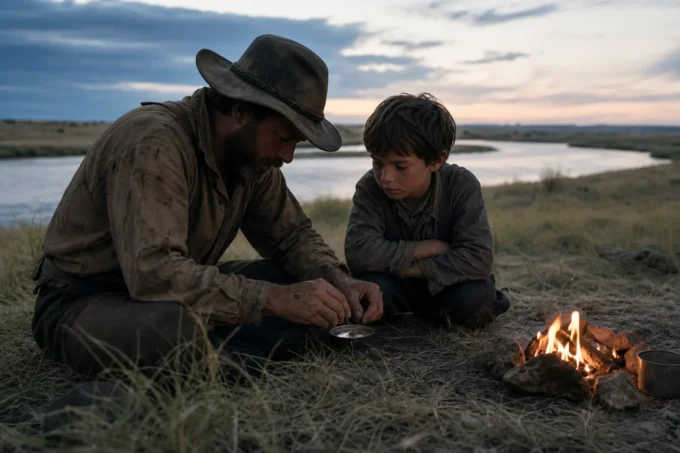
The trouble begins when you leave the Platte for the Sweetwater and the country stops giving you one clean line to follow. That is what has happened now. The second rule is to use the sun and read it honestly. East is where the light comes warm and horizontal in the morning, west is where it goes low and red at night, and noon, the part nobody trusts, shows you where the shadow points. You have never had a real compass that did not stick, and so you make one. A man can set a knife blade or a needle afloat on a scrap of wood in a cup of still water, or on the back of a watch face, and if the iron has been stroked with silk or with your own hair enough times, it will turn north. It is a slow, half-doubted thing, a scrape of metal that swings and points not quite where you are sure north must be, but it is better than a guess, and out here better than a guess is what keeps a family alive.
The third rule is the sky at night, and it is the one you trust most and understand least. By dark, if the sky is clear, the North Star rides the tail of the Little Dipper, and the two stars at the end of the Big Dipper’s bowl point to it, and that fixed white point is true north as surely as any blacksmith’s level. Sam knows the constellations from his father, who could walk to the mill and back in the dark, and he points them out to the smallest boy, who squints and sees only stars. You carry that steadiness into the sleep, and in the morning you have not found your lost road, but you have found north again, and that is the floor underneath everything else.
The Wrong Turn and the Price of It
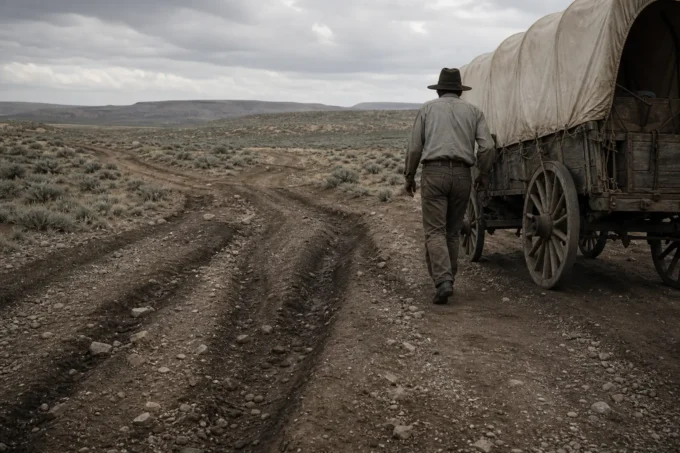
The mistake happened because you trusted a thing instead of the ground. Two days back the ruts split in a place where the sage had been burned and the old road had been scoured out by a spring wash, and you took the left set because it looked more traveled, and it was, and it was more traveled because it led to a dead alkali spring where some other lost party had turned around and made the same tracks back out. You read the wagon tracks, which was right, and you read them wrong, which was the cost. A day of going toward a spring that is not there, and a half day of turning back over your own wheel ruts, and here you are, south and wrong, with the water low and the boys quiet in the box.
Hannah does not scold you, and that is somehow worse than if she had, and she simply asks what the morning shows, and you tell her the sun came up on the wrong shoulder and she nods and goes back to the fire. The smallest boy asks if you are lost, and you tell him no, we are just taking the long way, and you make it sound so easy that you almost believe it yourself. Twenty miles is not fatal. It is one hot day and a dry camp if you push, and you have pushed through worse, and so you turn the wagon north by the needle and you set the sun where it belongs, off the correct shoulder at last, and you put your head down and walk beside the wheel and let the canteen stay sealed until its turn.
What the Land Gives a Man Who Reads It
A wrong turn teaches you more than a right one ever did, and the country, once you stop fighting it, starts to point the way. You learn to watch the way the grass leans, which tells you the long run of the wind and sometimes the slope. You learn that cottonwoods do not grow on high dry ground, they line the creeks and the low places, and a line of green in the distance is a line of water, and water is the road. You learn to read the shape of a butte on the horizon and keep it where it was yesterday, because a landmark a man keeps in one place in the sky is a landmark that keeps him straight. The emigrant road itself was marked for hundreds of miles by the ruts, by the bones of oxen, by the abandoned barrels and the broken wagon parts, and even by the graves, and a man who reads those signs reads the whole sad, steady history of everybody who went before him and showed the way with what they left behind.
By the second afternoon you sight a plume of dust far off to the north and a little west, a feather of it standing up off the plain, and you know it is a wagon train moving, and you turn toward it the way a needle turns to a magnet, and by nightfall you are back on the road, the real road, wide and cut and littered with old campfire stones, and the relief in your chest is a physical thing you can almost put a hand to. You do not cheer. Nobody has the energy for cheering. You just want to sit down and drink the full canteen and not move the wagon another hundred yards until morning, and you do exactly that, and the moon comes up over the correct shoulder at last, and you sleep the sleep of a man who found his way back with nothing but the sun and a floating needle and the memory of a dead man’s habits.
What Was Real
The overland emigrants navigated by a small and practical set of methods, and the rivers were the spine of the whole system. The road along the Platte and the North Platte was deliberately laid close to the water, both for the draft animals and for navigation itself, and emigrants spoke of the river as the guide, the thing that made losing the way almost impossible in the early miles. The phrase that grew up around the Platte, often quoted in period letters, captured the vexed relationship the travelers had with it: it was too thick to drink and too thin to plow, and a mile wide and six inches deep. As long as a party kept the river at hand, it was effectively impossible to become truly lost.
Beyond the rivers, navigation came down to the sun, the stars, and a handful of landmarks. Westbound emigrants watched the morning sun on the right and the evening sun ahead of them, a rough daily check rather than an instrument reading. The North Star, found through the Big Dipper’s pointer stars and the Little Dipper, was the standard nightly reference for north. Magnetic compasses existed and were carried by guides and more experienced travelers, but they were expensive, easily demagnetized, and often distrusted by ordinary emigrants who could not always reconcile what the needle said with what the land appeared to say. A compass made by floating a magnetized needle or knife blade on a sliver of wood in still water was a genuine period practice, and it was one of the oldest forms of the instrument, drawn directly from the mariner’s tradition.
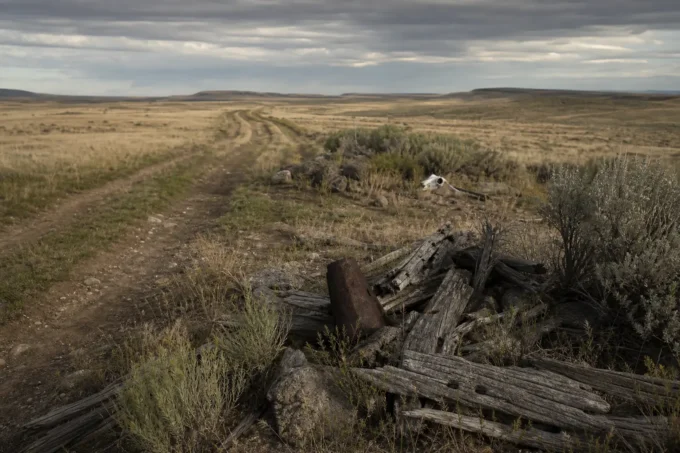
The physical trail itself functioned as a living map. The emigrant road across the plains was never a surveyed line but a braided set of ruts worn into the prairie by tens of thousands of wagons, and those ruts were visible for generations, some still traceable today in Wyoming and Nebraska. Travelers read the road through its litter: the bones of draft animals, discarded barrels and cooking iron and broken furniture, and the headboards of graves, all of it a continuous record of the traffic ahead. Guidebooks, most famously the emigrant guides by Lansford Hastings and others, circulated in printed form, but they were often vague or badly wrong in their distances and descriptions of water and crossings, and experienced emigrants learned to trust the ruts and the rivers and the landmarks over the printed page.
Landmarks and natural signs carried real weight. Lines of cottonwood and willow along the prairie marked the creeks and the low ground where water ran, so that a distant ribbon of green meant a distant supply of water, the single most important piece of information on the trail. Prominent buttes, chimneys, and rock formations served as fixed waypoints that parties checked against one another as they moved, and landmarks such as Chimney Rock, Scotts Bluff, Independence Rock, and South Pass entered the lore of the road precisely because they were the navigation points of the migration. A party that lost the way, misread the ruts, or followed a fading track toward a dry spring was not facing a mere detour but a burning dry camp and a night without water, and the diaries record again and again that the true danger of the trail was less the distance than the failure of water and the failure to find it.