September 1847. The Meat Is Standing Still and the Rifle Will Not Hold on It.
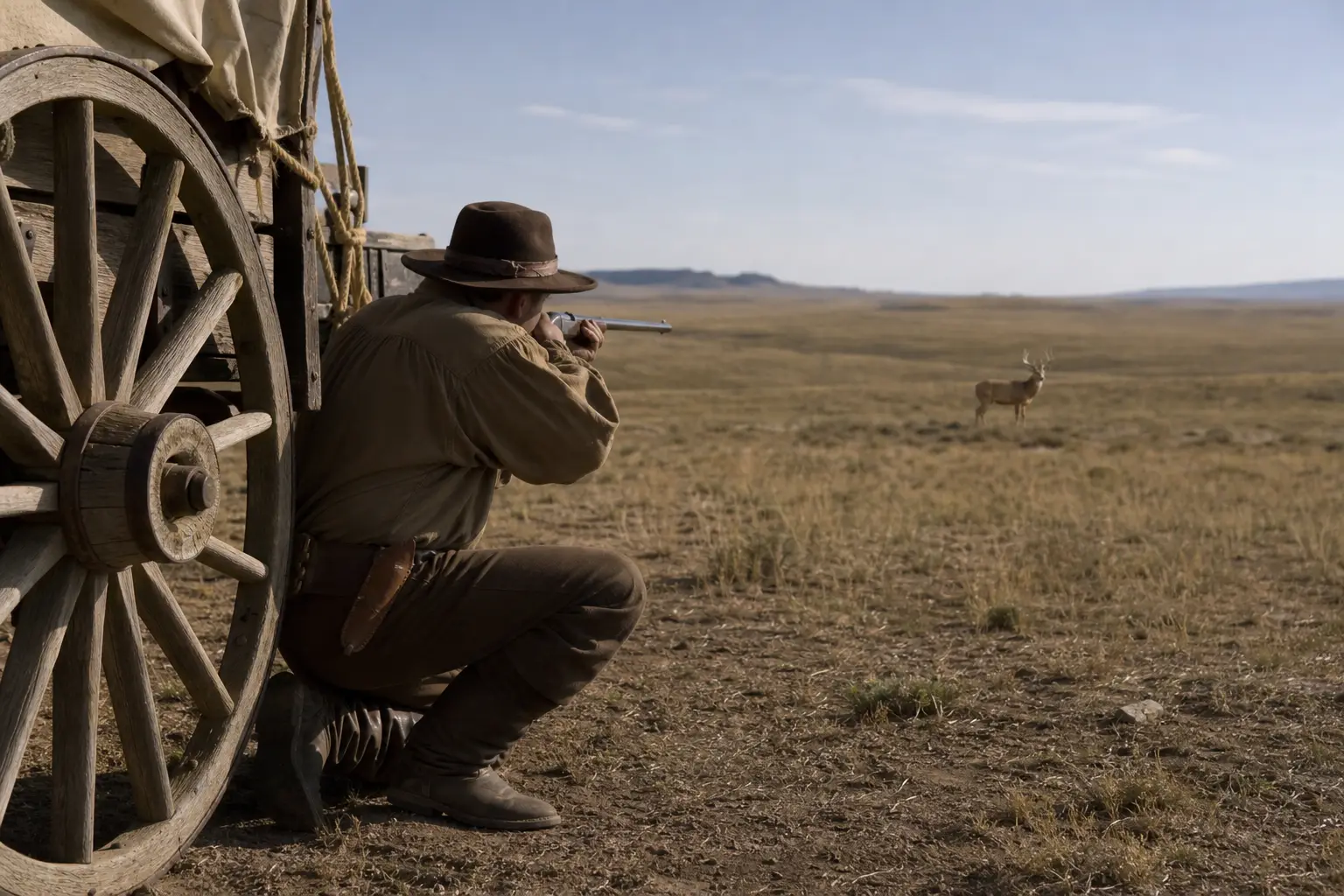
You are braced against the near wheel of the wagon, one knee down in the sun-warm dust two days west of Fort Laramie, and the front sight keeps drifting. The buck stands broadside past a low swale, maybe sixty yards out, and you cannot keep the blade in the notch. Your breath comes in surges that move the muzzle a hand-span at a time. Your pulse knocks in the web of your thumb. The buck lifts his head, chews once, and does not bound away, and that waiting is the worst part, because now there is nothing wrong with the shot but you.
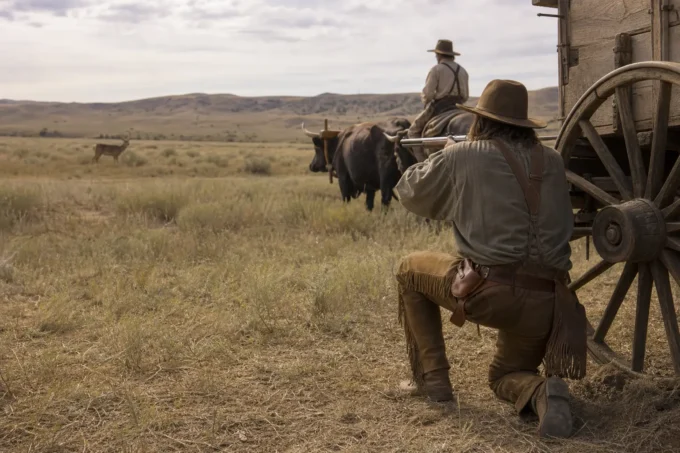
Sam is up by the oxen and has not moved since the buck cleared the grass. He does not say shoot, and he does not say don’t. You can hear his boot grinding slowly into the dirt, which means he is trying not to talk. Hannah is behind the wagon with the boys, holding them quiet by the shoulders. Everyone in this camp knows exactly how much powder is left in the horn and exactly how much meat one clean ball would put in the barrel of salt. The buck takes a single step toward the creek and turns his shoulder toward you like an invitation you did not earn.
You held your breath once already. You dropped the muzzle to reload your grip, then brought it up again and the sight was high, then low, then fine for half a heartbeat before your own body leaned away from the recoil that has not even happened. You remember Morrison saying a thing about this country, back before the flux took him, something sharp and unfair and true. You push it away because right now you need your hands to stop pretending they know what to do.
The Rifle Paper Is Not the Rifle on a Prairie.
Back in Ohio every rifle on the wall was a story. A man would hold his Hawken or his Kentucky rifle sideways in the lamplight and talk about split balls and one-hundred-yard standing shots like they happened every Tuesday. What nobody in the parlor mentioned was how a target is a fixed piece of tin that does not breathe, does not turn, and does not mind if you miss. You learned to shoot at paper and at a painted board nailed to a barn. You learned it indoors, in your head, over a rest.
Out here the shot you actually get is the one the animal allows. The buck on the open flat will not stand quartering-away the way the diagram in your shooting book shows it. He will stand half-hidden, head down, then lift, turn, and walk. He will stand upwind of you long enough to read the air and decide you are not worth the trouble, and the whole opportunity lasts about as long as it takes to count three of your own heartbeats. Nothing out here gives you a rest. There is no rail, no wall, no window to lean the forend on. There is the wheel, which is too high, and the ground, which is too low, and your own shaking frame in between.
Morrison’s voice comes back anyway, the exact words, because he delivered them in that dry half-laugh he used for things he knew would get somebody killed. He said a man sights in his rifle off a stump at home and then spends the rest of his life on ground that has no stumps. You did not understand it in Ohio. You understand it now, with the front blade carving slow circles over the brown flank and the sun going down behind the bluffs.
What You Bring the Rifle up On.
The first lesson is that you do not aim at the animal, you aim at the spot on the animal, and the spot is smaller than your courage. The buck is not sixty yards away. The place behind the near shoulder, low and tight, is sixty yards away and moving. You should be staring at that exact fold of hide until the blade covers it, and the animal’s horns, and his eye, and his beautiful rack should all smear out of your attention entirely. Looking at the whole deer is how a man shoots at a deer. Looking at the fold is how a man shoots through a lung.
You force the stock into your shoulder the way you were shown, cheek down on the wood until the sights line up by themselves, and you find the notch and the blade and you try to hold all three of them still. Here is the thing Morrison never had to say because he had done it so many times his body knew: you do not wait to be steady. Steady does not come on a prairie at dusk after a day of walking. You learn to take the shot in the middle of the sway, on the pass when the blade crosses the spot, and you squeeze the trigger through the rest of it instead of snatching when everything looks perfect, because everything is never perfect and the snatch is what sends the ball over the spine.
Your first real mistake happened before you even lifted the rifle. You are holding too much air and you are not moving the muzzle to the animal first. You brought the gun up, found the buck with your eye, then tried to drag the sights over to him while your arms were already waning. The right way is to swing the whole body, the rifle and the eye and the shoulders as one piece, until the blade comes onto the buck by itself, then stop and settle. When you drag, the muzzle overshoots. When you swing, it comes to rest where the animal already is.
The Ball Does Not Fly Flat.
The second lesson arrives while you are still holding on the fold. A round ball fired from a long rifle drops like a stone the moment it leaves the muzzle, and the men out here who shoot well have burned the curve of that drop into their wrists. At twenty-five yards you hold just under the spot. At sixty, which is what you have, you hold a little high, because the ball has already begun to fall and it will land a fist-width beneath your blade if you do not give it the rise. Past one hundred the drop is a guess, then a prayer, and most of the men in this country will not burn powder on an animal past that unless they are starving and the animal is huge.
You do not know this arc the way Sam does. Sam can look at a distance and his hands already know where the ball will be when it gets there. You have to think about it, and thinking about it is the spacing between trigger and shot where everything gets worse. The target at the barn was thirty paces, always. Every animal you have ever seen on this trail has been some new, unmarked distance, and distance out here is the whole ammunition budget. You count the seconds the buck can stay put against the powder the horn can afford to waste, and both numbers are smaller than you want them to be.
Wind is the third liar. It has been coming off the creek all afternoon, steady from the south, and it does not blow hard enough for you to notice until it is already pushing your ball sideways. A ragged breeze at sixty yards can move a round ball a full span by the time it arrives. Sam would have fired already, because Sam reads the grass leaning and counts the gust. You are still reading the buck.
The People Around the Shot.
Nobody is doing anything useful in the camp while you stand there, and that is the honest part. Hannah has her hands on the two boys and her face is turned fully toward the wagon wheel, and she will not look at the buck because looking might make it real and then it might go wrong. The younger boy whispers something and she shushes him without turning her head. The older boy has gone perfectly still, and you know he is watching the front sight, because that is the first thing any boy watches when a man is about to shoot, as if the act of aiming hard enough could make the ball hit.
Sam rotates one boot in the dirt. It is the only sound. Somewhere down by the creek a frog starts up, then stops, because even the creek is holding still for this. You think, briefly and without wanting to, about people back east who step out of a warm kitchen and shoot at a circle of tin from a bench, and how the worst that ever happens to them is a hole two inches outside the ring. Then you think about the salt in the barrel, and the winter, and the fact that this buck is the difference between walking into the mountains fat and walking in empty, and the thought makes your breath catch again.
You lower the rifle once more and shake your hands out, and that is the human thing the animals do not have to do. The buck has still not left, which is an insult and a gift in the same breath. He has decided you are not a threat, and you are trying very hard to make him right about one thing and wrong about the other.
The Complication That Comes Anyway.
Then the light moves. The sun drops another degree behind the bluffs and the flat brown flank of the buck goes into shadow, and suddenly the blade and the notch and the fold of hide are all the same color and you cannot tell where you are holding. Your eye loses the sight picture completely for a second, the way a man loses his footing on a dark stair, and when you find it again the buck has taken two steps forward and turned nearly head-on, and now the clean broadside shot you were waiting for is gone and there is only a narrow front chest and a head lifted, testing.
You are out of comfortable. The paper target has turned into a real animal that moves with the sun, and the light is bleeding away, and every second of this is powder and winter leaking out of a horn that is already too light. Sam finally says something, one word, low and even, and it is not shoot and it is not wait. It is the bare fact of the distance and the light, spoken the way a man reads a thing out loud so it will stop being loud in his own head.
You could still make the shot. That is the cruel part of it. The buck is close, and the front chest is bigger than the fold, and a man who shoots where Sam shoots would put the ball just so and be back by the wagon with the knives out before the echo rolled off the creek. But you do not know the arc at this distance, not really, and the wind has not told you what it is doing now that the sun is down, and you are learning that a rifle is a slow, honest thing that punishes every lie you tell yourself about how good you are.
And then, quiet as the sunset, you do the only honest thing there is left to do. You do not take the shot. You watch the buck turn and walk back into the swale, unhurried, the way an animal walks when it never knew it was being watched by a man who could not hold still.
What Was Real
The gap between how a frontier rifle performed on paper and how it performed on a moving animal in wind and fading light is the central, least-glamorous truth of subsistence shooting on the overland trails. The Kentucky rifle and the Hawken were heavy, slow, round-ball weapons whose real effective range was measured in tens of yards, not the hundreds claimed in parlor stories.
A patched round ball fired from a typical .50 to .54 caliber long rifle left the muzzle at roughly 1,600 feet per second and dropped fast. Hunter and soldier accounts from the era consistently treat one hundred yards as a long, borderline shot and regard anything beyond that as wasted powder against an animal unless conditions were calm and the shooter was braced. The celebrated long-range kills that fill the old stories were the exceptions, remembered precisely because they were rare.
Wind mattered enormously to a slow, light, spherical projectile. A round ball loses velocity quickly and, unlike a modern pointed bullet, presents the same blunt cross-section to the air for its entire flight, so a modest crosswind could drift it a full hand-span or more by the time it reached a distant animal. Shooters read the grass, the smoke, and the feel of the air as much as they read the distance.
Sighting and holdover were learned skills, not printed ones. A rifle was zeroed at a known distance and the shooter compensated by feel for anything closer or farther away, holding under at short range and over as the ball began to drop. In poor light the crude notch-and-blade sights of the period could vanish entirely against a dark animal, which is why most hunters did their shooting in full daylight and treated dusk as the enemy of accuracy.
The ammunition budget made every miss costly. A pound of lead cast roughly twenty to twenty-four round balls, and a pound of black powder made perhaps forty rifle charges, and both were freighted goods whose price climbed steeply west of the Missouri. A family traveling the Oregon and California trails in the 1840s and 1850s, among the roughly 400,000 people who made the crossing, could not afford to treat powder and lead the way eastern shooters treated them, because every ball fired at a missed buck was meat and protection gone. This is why the practical marksman prized a braced, close, certain shot over a bold, distant one, and why men like the narrator’s Sam, whose hands knew the drop without counting, were the ones who kept their families fed.