The Wheel Breaks Not Long After the River
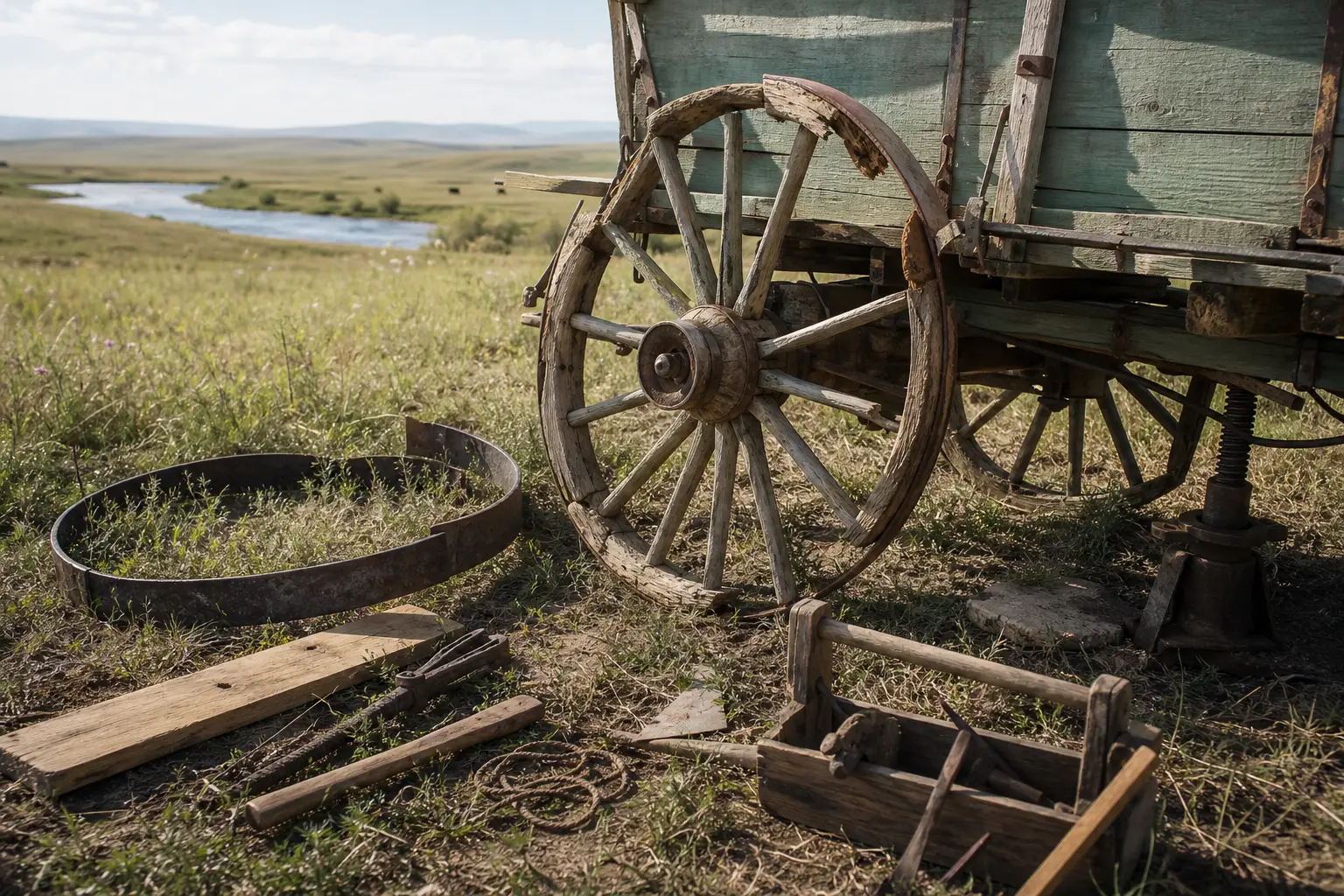
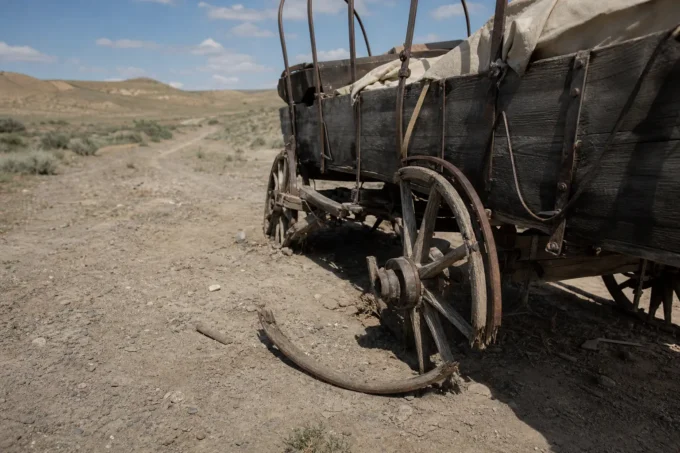
You hear it before you see it. Late July, 1848, two days west of the North Platte crossing, somewhere on ground that will one day be called eastern Wyoming. You are walking beside the wagon through dust that rises with each step, and the wheel makes a sound like a man stepping on a dry stick, only deeper. Then the whole wagon leans. You look back and the right rear wheel has stopped being a circle. Goodyear is a name nobody here has ever heard. The rim has split, a section of the outer felly has sprung its joints, and the iron tire that held it all together is hanging loose and ringing against the hub.
Sam, your brother-in-law, is already swearing in the way tired men swear when they mean it. He has heard that sound before and it cost him three days in Missouri. Tom Miller climbs down from the wagon and stands with his hands on his hips, the way a boy stands when he knows the nearest blacksmith is two hundred miles behind and the nearest one ahead might not exist at all. Morrison is dead now, three weeks from the flux, but his voice is still in your head because it always is: a wheel is a promise the road keeps until it does not. You do not want to end up like him, buried shallow beside a river that did not care.
The Problem Is Not the Wheel You Can See
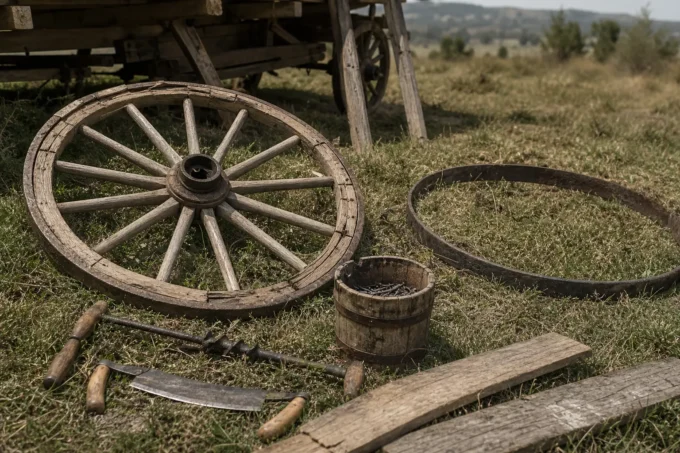
The wheel is dead, but the real problem is arithmetic. A wagon carries one spare wheel at best, and that spare is a luxury most families leave in a barn in Illinois because the freight would be better spent on flour. Your spare is not a wheel. Your spare is a length of green oak back panel, a bucket of iron nails, a hand auger, a drawknife, and two spare felly sections that Sam insisted on back in St. Louis, against your advice. You called him a waste of money. Now that waste is the only thing between you and the prairie.
The rim is off. The oak felly has cracked across a split that ran down through the wood where the grain turned. The spokes are still sound, which matters, because spokes are the heart of the wheel and a broken spoke is a slower, meaner death. The tire, that iron band forged hot and shrunk onto the wood, is now a useless hoop lying in the grass. The first thing you feel is the heat, and the heat is the enemy now, because green wood dries, and wet wood rots, and every hour you spend deciding is an hour the day drains away.
The Repair, Slow and Wrong and Then Right
You untie the spent horse and set it to graze where the boys can watch it. Then you lift the wagon with the screw jack that Sam forged himself, the same jack that has been called useless twice this trip. The axle settles onto a stack of flat stones and a doubled board. The good wheel comes off its iron and the broken one comes off the hub. You lay the broken wheel flat on the ground like a body and you read it the way you would read a wound.
Sam starts by knocking the old felly sections free with the poll of his hatchet, catching the drift with a block so the spokes do not split. The sound of iron on seasoned oak carries a long way across the flats. The wood comes away in pieces that still smell faintly of the linseed oil somebody rubbed into it a year ago. Then he tries the dry fit of the new felly sections and swears again, because timber is never true after it has been through a river and a hundred degrees and a month in the sun. The joints do not close. There is a gap you can fit three fingers into.
So you learn the slow part. You shave the joint with the drawknife, thin curls of green oak falling into the dust, and you stop to cool the blade in the water bucket so it stops losing its edge. The heat makes your eyes run and the salt stings. You fit, shave, fit, shave, until the joint closes tight enough to hold a whisper and no more. Sam holds the two ends while Tom passes the auger. You bore through the felly and into the spoke ends at a slight angle, because the old joinery is angle work, and you drive a pin through each joint. The pin is green, cut from a cottonwood branch, and it swells as it takes on moisture, and that swelling is the only clamp you have.
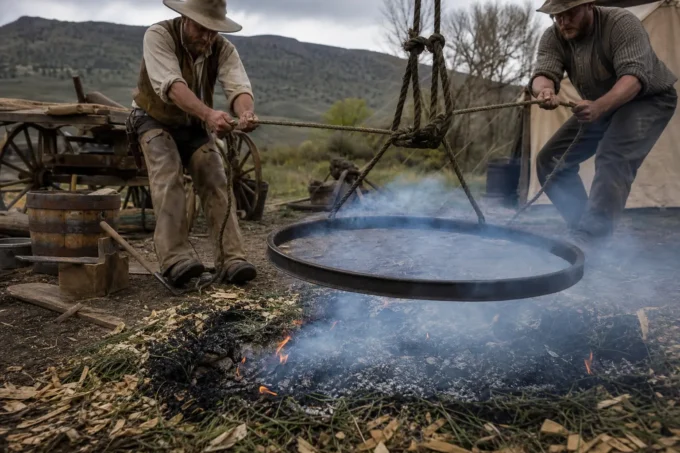
Then comes the tire. The iron hoop that once held the wheel is too big now, sprung open from the break, and a cold tire on a wooden wheel is a promise that will not hold under load. You have heard old men speak of shrinking a tire and you always believed it was a story. Here is the truth of it: you build a ring of green chips and wet grass around the iron, you bank coals under it, and you wait until the iron turns a dull blue at the edges and you cannot hold your hand near it. Then two men lift it with looped rope and settle it back over the new wood, and the wood hisses and smokes and the iron bites down as it cools, pulling every joint tight against every other. The smell is hot iron and scorched oak and sweat.
The tire cools too fast in one spot and the iron does not sit true. You hear Sam mutter something that is half a prayer and mostly a curse. The wheel spins with a wobble, a wide slow wag that will shake the wagon apart over the next two hundred miles. So you do it again, heating the tight joint, tapping the high spot with the poll, quenching with the last of the water, and when it finally turns quiet and round against the hub, nobody cheers. You just stand there with your hands shaking and your back screaming and you want to sit down more than you have ever wanted anything on this whole road.
The Human Part of It
Hannah works through all of it without a word. She dips the drinking water, she keeps the boys back from the iron, she spreads the canvas over the cooling wheel so the evening air does not shock the wood, and she does not once ask whether it will hold, because she has decided already and she will carry that decision without help. The youngest boy sits on a stone and watches the wheel the way he watches a fire, and when you catch his eye he says, is that how the wagon is supposed to look, and you say yes, and you are not sure which of you believes it less. Morrison gets up from his grave, in your memory, and walks to the edge of camp and relieves himself and says nothing, and you are glad for once that he does not speak.
Somewhere east of you there are men in workshops who replace a broken wheel in an afternoon and never touch green wood or banked coals, and you think about them briefly, without envy and without comfort. They make wheels for people who never have to sleep next to one.
What Goes Wrong When You Think It Is Done
The wheel holds through the first night and the first day, and that is when the new wood does its mean trick. Green oak shrinks as it dries and drinks water from the river crossings and swells again, and by the third morning the spokes have worked loose inside the hub and the wheel clacks with every revolution, a sound like loose teeth. You stop at midday, pull the wheel, and drive a soaked leather washer and a greased wedge into the hub, and you re-pin the two worst spokes with green pins cut new. It is not a proper fix. It is a repair you will have to nurse every thirty miles, re-greasing, re-tightening, re-pinning, until you reach a post that has an actual wheelwright and an actual forge. The wheel is not fixed. It is just alive enough to carry you, and that is the difference between a blacksmith and a man on a flat with a drawknife and three spare felly sections.
That night it rains, a thin cold rain from the west, and the smell of the wet oak climbs into the wagon, and you sleep with the wheel propped under the cover and your back against it, listening to it settle and crack in the dark like a thing still deciding whether it wants to hold.
What Was Real
The wagon wheel of the overland trail was one of the most carefully engineered and most frequently broken objects the emigrants carried. A typical freight or farm wagon rode on wheels four to five feet tall, each built from a hardwood hub, twelve or more spokes, and a felly (also spelled felloe) made of six or more curved sections, all bound together by an iron tire that was heated and shrunk on, a technique called shrink-fitting that clamped every joint together as the iron cooled.
The weak points were overwhelmingly the felly joints and the spokes. Dry, dusty plains weather shrank the wood and loosened every joint; river crossings swelled it again, and the alternating wet and dry cycles worked the joinery apart. A split felloe could usually be replaced in the field with a spare section that well-prepared emigrants carried, which is why the guidebooks and supply lists of the period recommended spare felly sections, a screw or lifting jack, an auger, and spare iron pins alongside the more obvious flour and bacon. Wheels were broken far more often than axles, and a broken wheel on a soft, wet or rocky stretch was a daily event on the busier sections of the trail.
Green wood and rawhide were the standard emergency materials. A green branch could be driven into a worn hub or used as a spoke or pin, and its tendency to swell with moisture made it clamp tight as it absorbed water. Wet rawhide was used the same way, because as it dried shrunken it pulled hard around any joint it was tied over. Both were stopgap repairs meant to carry a wagon to the next trading post or fort, not permanent fixes, and the emigrants understood the difference. A proper repair required a wheelwright and a forge, and the posts that had both, Fort Laramie, Fort Bridger, and Fort Hall among them, set their prices accordingly.
The Oregon and California trails were traveled by roughly 400,000 people between 1841 and 1869, and the mortality rate is estimated between 4 and 10 percent, with disease, not broken wheels, doing most of the killing. But the broken wheel mattered because it decided the pace, the distance, the water, and sometimes the difference between a wagon that reached the next grass and one that did not. The wheel was the thing most worth carrying a spare for, and the spare is the thing most families left behind to save fifty pounds of freight. The road took what you could not afford to lose.