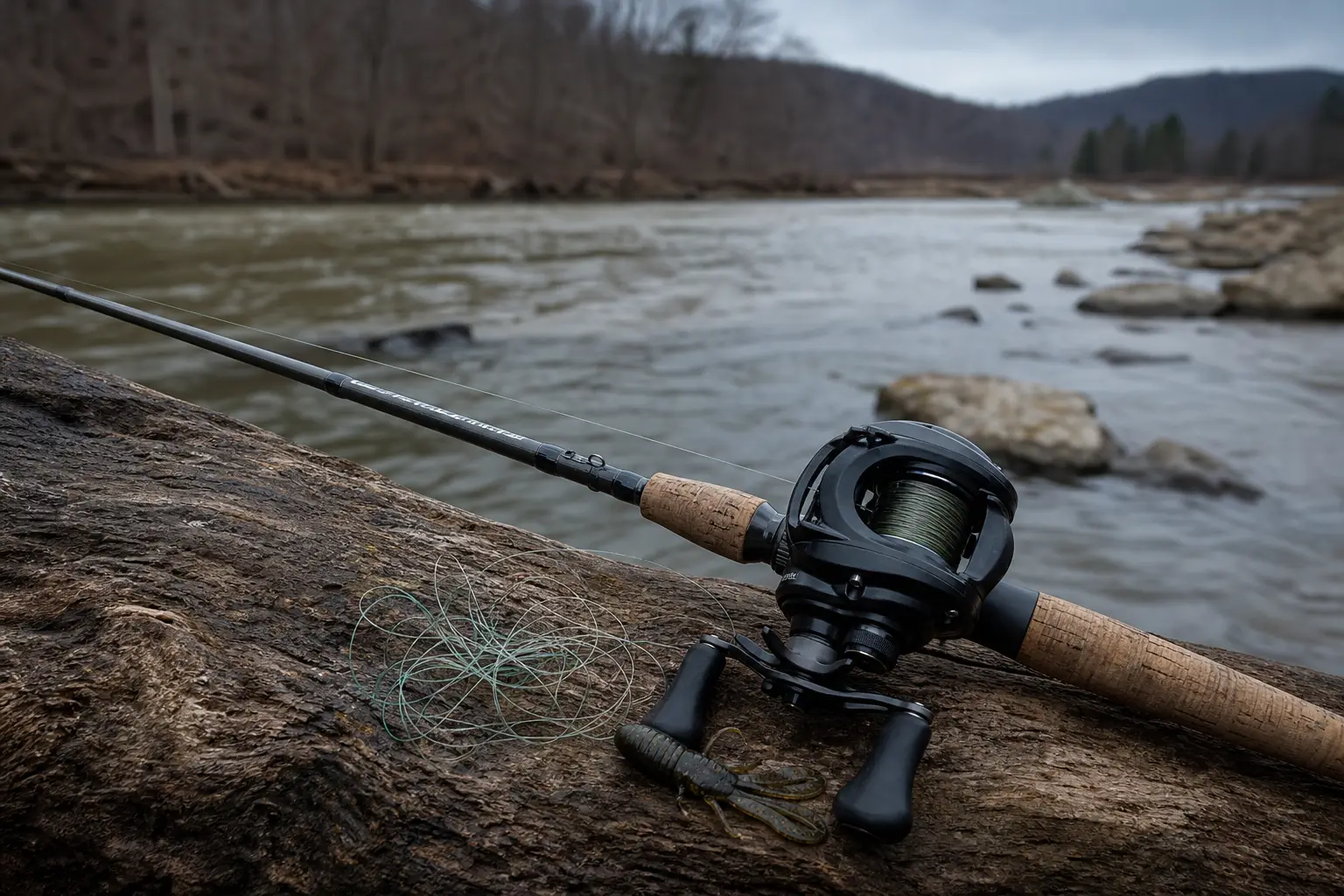
The first fish I ever lost out of my own pride was a smallmouth I am still mad about, and it had nothing to do with the fish. It had to do with a baitcaster I bought because the guy on the YouTube channel made it look easy, a Palomar knot I tied in the dark because I was too stubborn to turn on a headlamp, and a drag I had cranked down all the way because I watched one bass show and thought that is how real fishermen do it.
I will save you the suspense. The fish was maybe four pounds, not a state record, not even the biggest smallmouth in that river that afternoon. But it hit like a truck full of bricks, ran me into a root ball, and then it was gone. The line was not broken where it should have been. It was broken at the knot. My knot. The one I had tied wrong and never checked because checking a knot is something beginners do, and I had stopped thinking of myself as a beginner about three months before I actually knew what I was doing.
That is the whole problem with fishing gear. It does not matter what you buy. It matters what you refuse to admit you do not know yet.
The Baitcaster I Was Not Ready For
Let me back up, because the reel is where the whole thing started and I am ashamed of the details.
I started fishing the way a lot of men start, which is to say fifteen years too late and all at once. I did not grow up on a boat. My old man was a deer hunter, not a fisherman, and the only rod in our house was a fiberglass spinning rod that lived in the garage and had a reel on it from 1982. So when I decided I was going to become a Smallmouth Guy, I went to the tackle shop with no idea what I needed and a strong opinion anyway.
The baitcaster called to me. You know the one. It was black, it was heavy, it had this little whirring sound when you turned the handle that made me feel like I knew what I was doing before I had ever opened the box. I had watched a hundred videos of guys pitching jigs and skipping frogs and working a topwater plug like they had been born with the thing in their hand. I figured the reel was the reason they were good. I was wrong, and I proved it the first Saturday I took it to the lake.
I bird-nested it four times in the first twenty minutes. Not little overruns you pick out with a thumbnail. Full, catastrophic, cut-the-line-and-start-over tangles that eat forty yards of braid and ten minutes of daylight each. I sat on the bank swearing at a spool that looked like a conspiracy of rubber bands, and a kid maybe twelve years old walked past with a $30 spinning combo and caught two bluegill while I was still fetching line off the grass.
That should have been the lesson. It was not. I doubled down, because I am occasionally a dumbass and I had already told my wife how much the reel cost.
The Knot I Never Checked
The backlash thing I mostly fixed by the end of the month. I learned to feather the spool with my thumb, to start the cast gentle and let the rod load, to stop trying to win a distance contest every single time. It stopped being a disaster and started being a reel I could actually fish. That felt like victory, so I stopped paying attention to the rest of it.
The knot was the part I kept ignoring. I tied the same two knots my whole life based on nothing but habit, a clinch knot for most things and a Palomar for braid because somebody once told me the Palomar was the strong one. I never tested them. I never cut one apart to see where it failed. I just tightened them with wet fingers and a tug that felt secure and called it good, which is exactly how you lose a fish you will think about for two years.
The afternoon I lost the smallmouth, I had been on the river since before sunrise. February. Forty degrees. My fingers were cold enough that tying knots felt like working a sewing needle in oven mitts. I had swapped from a jig to a jerkbait and tied a fresh Palomar, and I remember thinking, while I was doing it, that it did not feel quite right. The tag end did not want to cinch the way it normally did. The braid bit into itself on one side. And I looked at it, and then I looked at the river, and I said the exact worst sentence a man can say about his own knot, which is “it is fine.”
It was not fine. It was a knot that was already eighty percent failed before the fish ever bit, and the fish found the other twenty.
The Fish That Found My Mistake
The hit came on maybe my third cast of the afternoon. I was standing on a gravel bar where the current cut a seam against a fallen sycamore, fishing a jerkbait slow and twitchy. The smallmouth hit hard, the rod bowed, and for about four seconds I had the whole thing, the line tight, the reel singing, my dumb heart hammering in my chest.
Then he ran for the root ball, and I cranked down on the drag because that is what I thought you did when a fish runs for cover. I did not let him take line. I leaned on him like I was trying to drag a stubborn mule up a hill. The line went slack, and I knew before I reeled in that it was not going to be the hook that let go.
I reeled in four feet of braid with a little curly pigtail on the end, the coiled remains of a knot that had never been right. The jig, the fish, and the excuse were all gone together.
I sat down on the riverbank and did not fish for a half hour, and I thought about every link in the chain. The reel I had to buy to feel like a real fisherman. The drag I had cranked down because I confused tight with strong. The knot I tied in the dark of my own impatience and then certified with two words and a shrug. The fish did not beat me. I beat myself, one small lazy decision at a time, and then I stood there holding eight inches of curled braid pretending it was his fault.
What I Finally Learned the Slow Way
None of this is new to a real fisherman. That is the humiliating part. I lost a fish to lessons that every nineteen year old on a canoe already knows. But I am writing it down anyway, because the only thing worse than being the guy who learned it the slow way is being the guy who never learns it at all, and I see that guy on the bank every single season, usually wearing the same expression I wore for a whole year.
Here is the stuff I now believe, and it cost me a four pound smallmouth and most of my dignity to believe it.
Tie the knot and then prove it. Every knot I tie now gets wet, gets cinched slow, and gets a hard straight pull test before it ever sees water. If it slips a hair, it is cut and redone. Knots fail at the tag end, at the loop, at the line-to-lure connection, and the only way to know is to break a few on purpose until you learn what a good one feels like and what a bad one looks like the second before it fails.
Cold fingers mean slow down. If your hands are cold enough that you cannot tie a knot clean, tie it twice as slow or do not change baits. I would rather fish the wrong lure on a good knot than the right lure on a knot I tied with numb hands in a hurry.
Drag is a valve, not a winch. Tight is not the same as strong. The drag exists to let a big fish run without snapping your line or popping your knot. I do not care what the internet says about horsing fish in, I set the drag light enough that a hard run takes line, and I adjust it with the fish on only when I know exactly what I am doing, which is less often than I like to pretend.
Check the whole chain before you blame anything outside it. When a fish gets off, the lazy answers are “the line was junk,” “the knot slipped,” “the drag was wrong,” “the rod was too light.” Most of the time those are the same answer wearing different coats, and all of them point back at the man holding the rod. I have never once lost a fish and looked at the tackle and found that the tackle was the one who tied the knot loose.
The Second Fish
I am going to tell you the ending so you know I am not just writing this from the bank with a book of excuses.
Two weeks later I went back to the same river, same gravel bar, same sycamore. I had my baitcaster, but I had stopped pretending it made me a fisherman. I tied a fresh Palomar in the daylight, wet it, cinched it slow, and pulled it hard enough to hurt my finger. Then I backed the drag off until a good solid pull would slip line, and I stood there and fished like the knot was the only part I was allowed to be proud of.
The smallmouth hit on the same jerkbait, in the same seam, maybe the same fish for all I know, and this time when he ran for the root ball I did not lock him down. I let him take line and I used the drag like it was meant to be used, and thirty seconds later I was lipping a three and a half pound smallmouth in forty degree weather with my hands shaking half from cold and half from what it felt like to finally get it right.
He slid back into the river and I watched him disappear into the seam, and I did not feel like I had beaten a fish. I felt like I had finally stopped beating myself.
Buy the reel you actually need, the one that fits the fishing you do and the hands you have, not the one that looks right in a thumbnail. Learn to tie one knot until you can do it with your eyes closed and cold fingers and a fish burning a hole in the water in front of you. Set the drag like a grownup. And the next time something feels off and you open your mouth to say “it is fine,” close it, sit down, and fix it. The fish will still be there. The knot, if you get it wrong, will be gone before you know it was the whole thing.