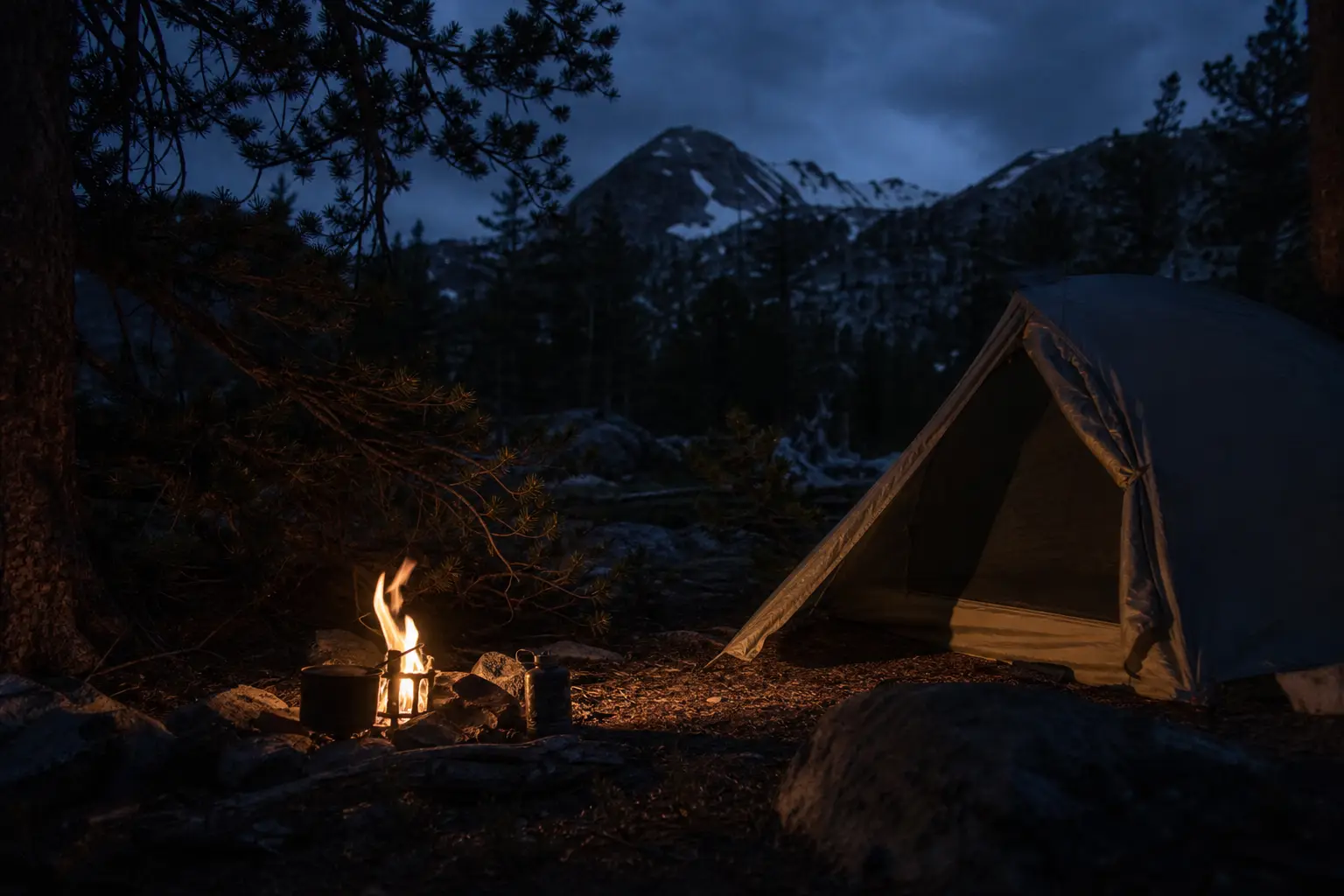
The Brighter the Light, the Bigger the Fear Behind It
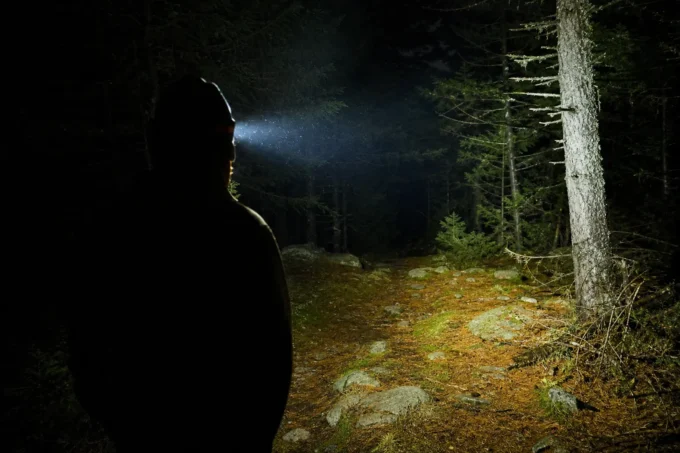
For three years I carried the brightest headlamp I could afford into the backcountry. Four thousand lumens, with a red mode I pretended to use and a strobe I had no business owning. I told myself it was a safety thing. The truth was simpler and harder to say out loud: I was scared of the dark, so I bought light the way a nervous man buys a deadbolt and a dog and a gun for the drawer. More of it, always more of it, until the night could be pushed back against the trees like something that would stay pushed.
The problem with a headlamp like that is it does not cure fear. It just moves the fear out to the edge of the beam and aims it back at you. Everything inside the circle is sanded clean and everything outside it is suddenly, actively watching. I would sit in camp after full dark and swing that beam around like a lighthouse with a grudge, and every time it swept past a pair of eyes I had already convinced myself were there, my heart would kick once. The woods never got less scary. They just got loud in the dark, and I got very good at pretending the loud was nothing.
Being Alone Does a Thing to Your Ears
The first thing you notice when you finally stop walking and your own breath quits being the loudest sound in camp is that the forest is not quiet at all. It was never quiet. I had just been drowning it out with four thousand lumens and a phone and the constant small noises a man makes to tell himself he is still in charge. A twig snaps somewhere past the firelight and you will swear it is twenty feet away and closing. It is a deer. It is always a deer. But your body does not know it is a deer, and your body is the one holding the decision.
I spent my first few solo nights waiting for that snap, mistaking every gust through the pines for something walking a circle around my tent. I would lie stiff in my bag and hold a knife I had no plan to use and rehearse what I would do. That is the thing nobody tells you about being alone in the dark. The fear is not a fact you solve. It is a skill you have to practice, same as anything else, and you cannot buy a brighter version of it at a store.
The Night the Batteries Quit
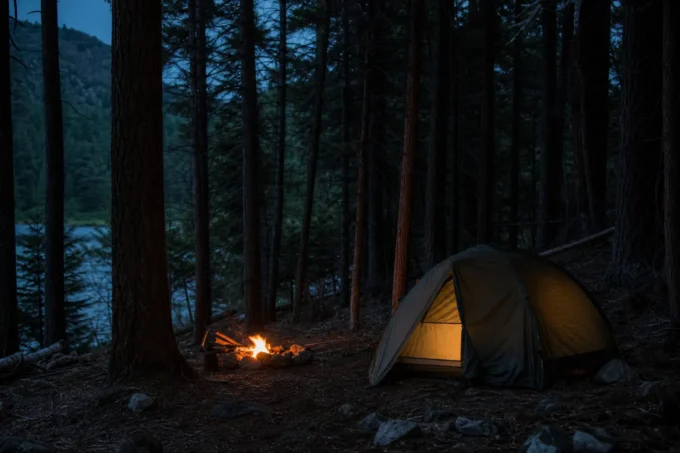
It happened on a trip I will not pretend was planned well. I had driven out late, hiked half my distance in the last light, and pitched on a flat spot that looked better in a dying hour than it ever would have in daylight. I reached for my headlamp to set up the stove and it flashed once, went green, and died. I had left the spare batteries in the truck. I had carried a charger I had never checked. Every single thing I owned to keep the dark away was now a very expensive paperweight hanging off my forehead.
I sat there in the dark with my stove half assembled and listened to the forest go on without me. And here is the part that surprises me to write: the world did not collapse. The eyes I had spent three years imagining were still out there, and the deer, and the wind, and the creek I could not see but could suddenly hear running like it had been there the whole time. Nothing about the danger changed when the light went out. The only thing that changed was that I could not pretend anymore.
Letting Your Eyes Catch Up
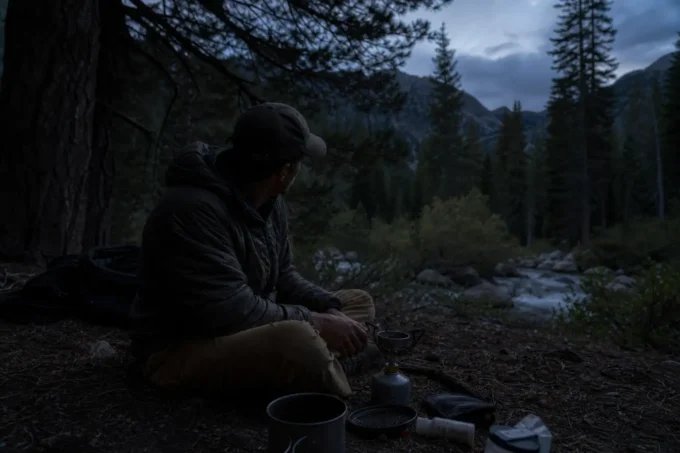
Here is a field skill I learned by accident and have been embarrassed about ever since, because it costs nothing and I avoided it for years: your night vision is a muscle, and it needs twenty minutes before it gives you anything back. Fire a four-thousand-lumen beam into the dark every time you hear a sound and you are choosing to be blind. You reset yourself to zero over and over and then call the woods black, when really you have just been flashing yourself in the face all night like an idiot.
The first time I actually sat still and let my eyes adjust, I could see the whole silhouette of the ridge, the shine on the creek, the outline of every pine against a sky that was never once truly black. I could stand up without a light and walk a few careful steps and not fall. It turns out the dark is not a wall. It is a dimmer switch, and it only works if you stop turning the other switch on and off like a nervous teenager in a power outage.
Fire Is a Skill, Not a Prop
I used to build fires the loud way. Too much of everything, pine needles and dead twigs and a whole lighter gone, and what came out the other side was a big roaring thing that died in an hour and left me colder than if I had never started. It took me a while to understand that a fire is not there to push back the dark. It is there to keep you honest about the dark, to give your hands something patient to do, to hold a small circle of heat that your own skill produced out of frozen ground.
A good fire is boring. It burns low and hot from the inside, the kind you can cook over, the kind you build once and tend twice and it is still alive at two in the morning when you wake and feed it a single stick without thinking. Getting to that fire is a field skill. Reading the dry side of the deadfall, splitting a branch down to its white heart where the water never reached, feathering it thin enough to catch a spark. Nobody posts a photo of the boring fire, but the boring fire is the one that keeps a scared man calm, and calm is the whole point.
What the Dark Actually Teaches
The night I stopped trying to beat the dark was the night I actually slept in the woods for the first time. Not dozed with one eye open and a knife in my fist, but slept. I had no light, no phone, no plan for the eyes in the trees, and somehow that turned out to be the cure. Not because the danger went anywhere, but because I finally trusted that the sounds were sounds and the risk was ordinary and I was, after three years of fighting it, capable of being one more quiet animal in a quiet place.
I still carry the bright headlamp. A man does not throw away four hundred dollars of paranoia just because he got one good night. But I use the red mode now, and I use it sparingly, and most nights I barely reach for it at all. The dark turned out not to be the enemy I had been blasting with lumens since day one. It was just the place my ears and my patience finally got a turn to work. And the fear did not go away, not entirely. It just stopped being the whole story, and once it was not the whole story, the woods let me in.