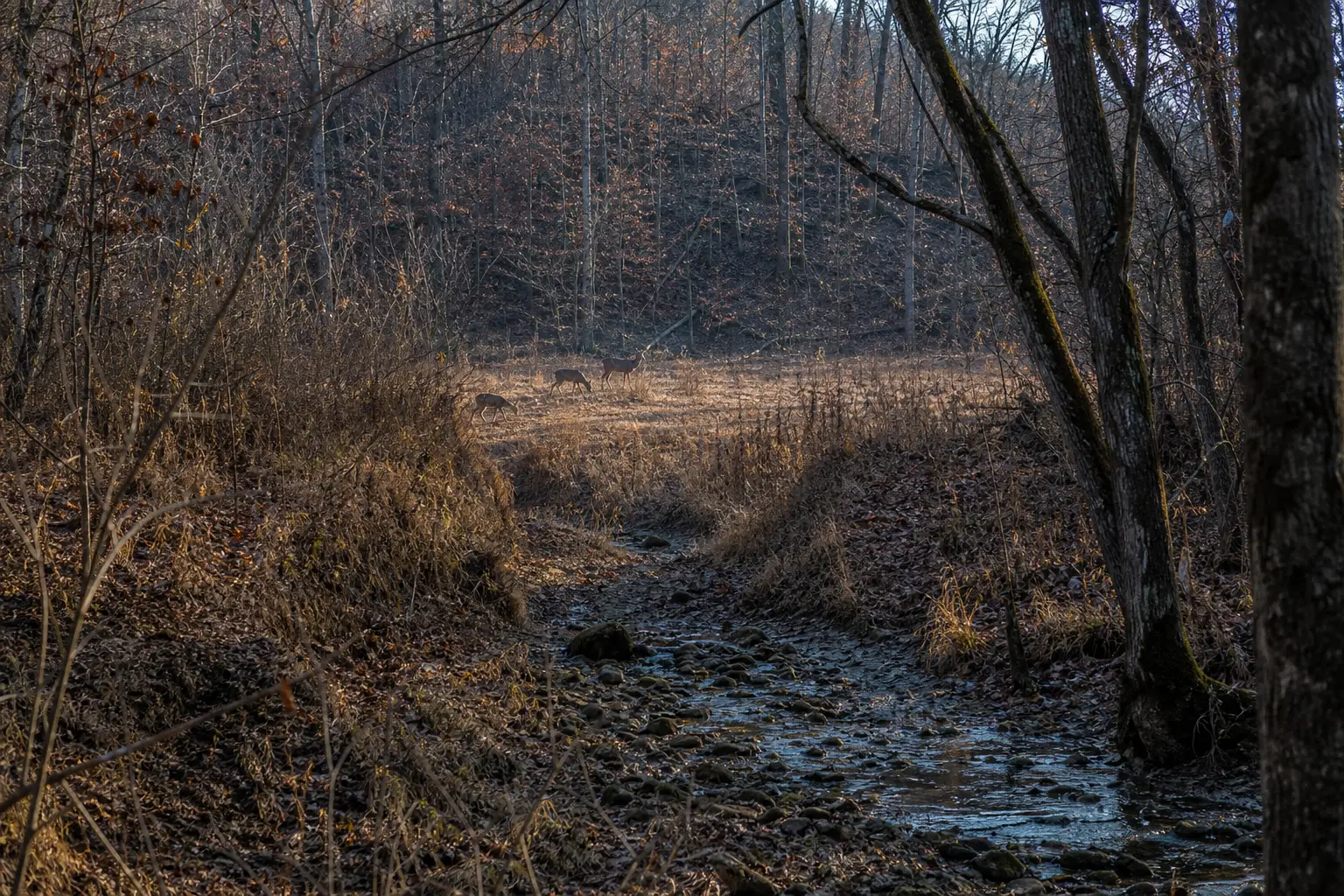
I used to think wind was the only thing that mattered, and the wind was always in my favor, because I checked it once at the truck and then forgot about it for the next four hours. November, forty degrees, southeast breeze, perfect. Man, I had that whole ridge drawn out like a man with a plan. The buck came in at nine in the morning and I never saw him. He walked out of the draw on the exact line I had scouted, got to maybe sixty yards, and then his head came up and he was gone, no bolt, no sound, just a white tail going over the hill. I sat there for half an hour trying to figure out what I did, and the honest answer was nothing, which was the whole problem.
Here is what I did not know then and what nobody bothered to tell me because it sounds like old man superstition. The wind at thirty feet above the ground is not the same as the wind that passes your face when you walk to the stand in the dark. The air over a creek bottom and the air over a south-facing hill move different directions in the morning, because the sun warms the ground and the ground warms the air and the warm air goes up and something else has to come down to take its place. That something else was my scent, and it was not blowing southeast into the empty timber like I told myself. It was sinking down into the draw and sliding along the creek bottom and curling up the other side, right where a nine point was standing wondering what smelled like an out of shape guy who ate gas station jerky for breakfast.
I spent two more seasons making the same mistake and calling it bad luck, because it is easier to blame a buck for seeing you than to admit your own nose is lying to you. I moved stands, I bought a different jacket, I started showering in some green bottle that smelled like a chemical spill at a pine tree factory. Every opening morning, same result. I would sit there all day in a spot that I had chosen on a map because it looked like a place a deer would be, and the deer would be somewhere else, and I would go home and tell my buddy Dale that the property was just pressured, the neighbors were running ATVs, somebody shot a gun too close, all the things that keep a man from saying the words “I do not know what the wind was doing.”
The morning that cracked it open was not a morning anything went right. I had overslept, so I walked in at first light instead of in the dark, which everybody knows is a sin, and I was halfway up the ridge when I saw a small herd of does feeding in the bottom, forty yards off my boot path, heads down, tails flicking, completely unaware that I was standing there in broad daylight. I froze and stood there for ten minutes feeling like the dumbest man in the county, because the wind was straight out of my chest and into their faces, and they still had no idea I was there. Then one of them lifted her head, and she looked at me, and I watched it happen in slow motion, her nose working, and then she blew and the whole bottom exploded and I was left standing in the oak leaves holding a bow and a very specific new theory about what I had been doing wrong all these years.
What I finally understood, standing there like an idiot, is that the wind that matters is not the wind where you are, it is the wind where the deer is, and those are two different airs separated by a thin hot line that rises off the ground every morning and sinks every evening. The does had not smelled me because I was above them and the air was still rising, taking my scent up and over their heads and away. When a buck smells you on a morning like that, nine times out of ten you are not getting winded because the wind shifted, you are getting thermaled because your stand is high and the air is falling down the hill into his face. It is a completely different failure and it has a completely different fix, and nobody teaches you the difference because standing in a scent control commercial is more profitable than teaching a guy to watch a little puff of dust drift off his own boot.
The Powder Puffer Saved More Hunts Than the Green Bottle Ever Did
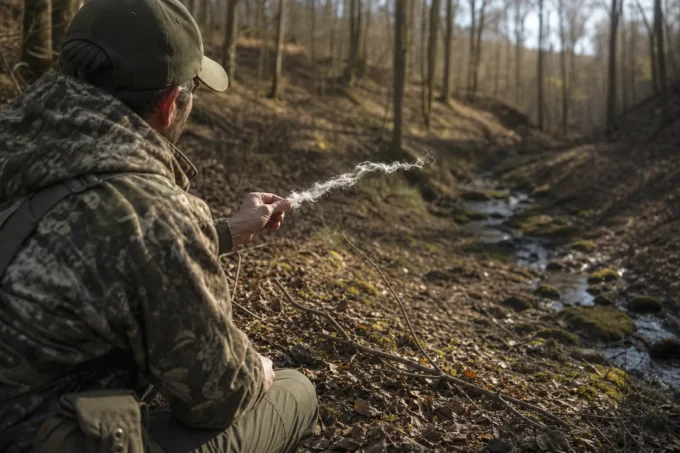
The next thing I changed cost me six dollars. I bought one of those little squeeze bottles full of chalk dust that archers use to check the wind, the kind you see old men blowing into the air like they are testing a baby’s bottle. I started using it every twenty minutes, not once at the truck, and I stopped trusting the answer for longer than a few minutes at a time. The first thing I learned is that the wind on your face is lying to you about half the day. The second thing I learned is that it changes more than I ever believed, little back-and-forth currents that cave the dust off in a direction I would have sworn was wrong. The third thing I learned, and this is the one that actually killed a deer, is that the air down in the bottom does the opposite of the air up on the ridge in the first hour of light, and if you do not check the bottom air before you sit, you are hunting a blind man’s guess.
So I started doing a thing that felt stupid at first and then stopped feeling stupid the first time it worked. I would walk to my stand in the dark, and instead of climbing straight up like I wanted to, I would stop at the base of the hill and blow a little puff of that chalk dust into the air and watch where it went. Then I would walk the stand route I actually intended to use and stop halfway and blow another puff, because the air at the bottom of the draw is the air that is going to carry whatever is on my boots straight to whatever is bedded in there. If that air was falling, I did not climb that tree. I turned around and went to a stand on the high side, or I sat on the ground on the edge, or I went home and lived to hunt another morning, because the deer you do not spook is worth more than the deer you spook trying to sit in a spot that the air never wanted you in.
Dale thought I had lost my mind. He watched me blow chalk dust into a November wind once and said he would buy me a real wind checker, which is not a real thing, and I told him the little bottle was the real one and the green pine tree bottle was the one lying to him. He argued with me for ten minutes about milkweed and how it is what the serious bow hunters use because it floats in the air instead of dropping like chalk dust, and the funny part is he was right, and I would not hear it, because a man does not like to trade his six dollar solution for a weed he has to go pick in August and keep in a film canister in his hoodie pocket like a damn weirdo.
Anyway. That season I shot my first archery buck, a wide six point, and I watched it happen like a man reading a weather report. The wind was west, which should have pushed my scent away from him, but I had been sitting there all morning watching the chalk and I knew that the air in that bottom was doing this little falling slide down the slope and back toward the creek, so instead of sitting my pretty stand on the west side, I sat on a blowdown in the middle, below where my scent would pool, and I let the morning air pull everything up and over his head. He came in at thirty two yards, and I remember thinking, almost bored, that the reason he could not smell me was not a secret, it was just physics, and physics does not care whether you bought the ninety dollar boots or filled a plastic bottle with white powder. It just does what it does.

Morning Air Rises, Evening Air Falls, and Your Nose Is Not a Weather Station
If I had to hand a new hunter one thing and nothing else, it would be this. The sun heats the ground all day, and the ground heats the air sitting on top of it, and that warm air rises, and your scent goes with it. That is why when you walk into a bottom at first light and the air feels still and heavy, your scent is not going very far at all, it is pooling and spreading like spilled coffee across a table, low and slow and everywhere. Then the sun gets up and the whole business reverses somewhere around mid morning, when the ground cools and the air falls and slides downhill into the bottoms and the creeks, and that is when a buck bedded up on the hill can smell you down in the road even though the wind in your face swears it is blowing the other way.
That is the thing nobody tells you. Your nose is not a weather station. It feels the air where your face is, and your face is four or five feet off the ground, and the deer that is going to bust you is standing somewhere between a creek and a ridge where the air is doing something your cheek never gets a report on. You cannot feel a thermal. You can only watch it, and the only way to watch it is to give the air something you can see and let it show you. Chalk, milkweed, a piece of spider silk, a little wisp of fuzz from your sock if you are desperate, anything light enough that it goes where the air goes instead of where gravity says.
I am not going to tell you scent control does not matter, because keeping your clothes clean and your boots out of the gas station and your coffee breath off the morning still counts for something. But I will tell you that I spent more money than I want to admit on the idea that I could make myself invisible with a bottle, and the first deer I ever killed with a bow died because I finally sat down on the ground in the middle of a bottom and let the air carry me up and over his head like I was not even there. It was not the jacket. It was not the soap. It was the six dollar bottle of powder and the thing it finally made me see, which is that the deer I had been blaming for outsmarting me was just standing there breathing the honest truth, and I was the one who kept showing up wrong.
I still get skunked. Wind and thermals are not a magic trick, they are just the layer of the hunt that most men never bother to learn because it does not come in a camo pattern. But these days when I get busted, at least I usually know what happened, and there is a weird kind of peace in that, the difference between being outsmarted by a deer and being outsmarted by your own lazy belief that the air in front of your face was telling you the whole story. It never was. It was only ever telling you the part that could reach you, and the deer were out there reading the rest of it, the invisible falling part, the part I spent ten years pretending did not exist because it was easier to drive to a new property than to stand still and watch a little puff of white dust decide where I actually was.