
The first thirty-five days I fished that stretch of river, I did not catch one smallmouth. Not a dink. Not a rock bass that accidentally drifted into my line. I am talking a genuine shutout, five straight weekends, dawn to dusk, the kind of streak that makes a man start pricing kayaks and lying about why he is sore on Monday mornings.
I blamed the river. I blamed the weather. I blamed a bait shop owner in a town I will not name who sold me a dozen crankbaits and did not once warn me they were the wrong shade of whatever a smallmouth cares about. I blamed the moon, and I do not even believe in the moon. Every Sunday evening I would stand on that gravel bar with my rod in one hand and a can of something in the other and announce to nobody that this river was fished out, and I would mean it, and I would be wrong.
The river was not fished out. The river was full of smallmouth. I know this now because an old man told me so in fewer words than it takes to tie a clinch knot, and then proved it while I watched.
The Man at the Ramp
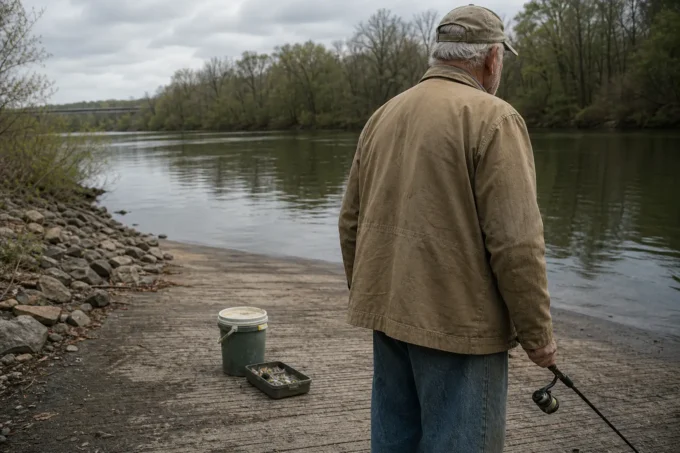
He was at the boat ramp, not in a boat. He had a beat-up spinning rod, one small tray of lures, and a bucket with a lid. He looked like he had walked out of a photograph from before I was born. I had been skunked for the thirty-fifth day in a row and I was in a mood, and when he asked me how the fishing was I told him the truth, which was that the fishing was a son of a bitch and this river owed me money.
He did not laugh. He looked at the water the way you look at a clock you have stopped trusting. Then he said two things that rearranged my whole understanding of what I had been doing for five weekends.
He said, “You fish like you already know where they are.”
And then, after a pause long enough to make me feel like a boy caught lying, he said, “Fish like you are late for an appointment you cannot miss.”
What I Had Actually Been Doing
I thought about it the whole drive home, and the more I thought, the more embarrassed I got. Here is what thirty-five days of fishing actually looked like for me, and it shames me to write it down.
I would pick a spot because it looked good from the bank, which mostly means I picked the spots that were easy to stand on. I would cast a few times. Nothing. I would change lures after eight or nine casts, because clearly the size or the color or the exact wobble of the thing was the problem, and not anything to do with me. I would cast to the middle of the river because that is where a man’s eye lands when he is not thinking. I would check my phone, because a man standing on a riverbank with no bites for three hours will invent reasons to check his phone.
And every time I finally did get the faintest tick, the softest tap, the kind of nudge that makes your thumb twitch on the spool, I would reel in and look at my now-bare line and tell myself a story about how that was a snag, or a stick, or a smallmouth that just did not have his mouth all the way around it. I set the hook late, and I set it soft, because somewhere along the way I had confused being gentle with being good.
I was not fishing the river. I was visiting it. There is a difference, and the difference is the whole ballgame.

Thirty Casts to One Seam
The next Saturday I drove back out with one change in my pocket that cost me nothing. The old man’s rule, the way it came out of his mouth and the way I have carried it since, boils down to this: pick a piece of water, not a view. One seam. One current break. One rock. And then put thirty or forty honest casts into it before you let yourself move on.
I picked a seam where the current slid along the edge of a fallen sycamore, maybe forty feet out, where the water went dark and the foam stacked up in a line that never broke. I told myself I would not move until I had hit it forty times or my arm gave out, whichever came first.
The first ten casts, nothing, and my hands were already itching to reach for the tray and swap baits. I did not. Eleven through twenty, nothing, and I started to feel stupid, standing there throwing at the same invisible underwater street corner like a man demanding the fish respect his consistency. Twenty-one through thirty, nothing, and I had a full argument with myself about whether this old man had been messing with me, whether I had driven an hour and a half to be the butt of a joke at a boat ramp.
Cast thirty-one caught a fish.
Not a big one. Maybe a pound and a half, a river smallmouth that hit on the pause and fought harder than it had any right to. But the point was not the fish. The point was that I had thrown thirty times into the same water before the water told me anything, and three of those casts had passed within a foot of a fish I did not know was there, and if I had done what I normally do, which is bail after nine, I would have missed every one of them.

Count the Fall
There was a second thing, and it was the one that actually fixed me, and it is so stupid simple I want to slap myself for needing an old man to say it out loud.
Count the fall of your bait. Every single cast. One one-thousand, two one-thousand, three, all the way down to where you figure the bottom is. Not because the count is magic. Because counting does something to your attention. It locks your eyes onto the line instead of the phone, and it puts your mind on the bait instead of on whatever argument you lost at work or whatever the weather app says is coming.
A smallmouth does not announce himself with a violent rip most days. He comes up under the bait, flares his gills, and slurps it in, and if your mind is on your phone or on the bank in front of you, you feel nothing at all. You will catch that fish and never even know he was there, because your thumb was not on the spool when it mattered. Counting the fall fixed that. I caught my first real fish because I was watching the line the way you watch a fuse, and the line jumped once, and I was already leaning into it.
The Phone Stays in the Truck
I will say the part I do not want to say. That phone was the real problem, and it was a problem I carried in my pocket and charged every night and called my buddy and said, “well, the river is dead anyway.” I was not present. I was half-there at best, and a smallmouth in current can tell the difference between a bait that is being worked and a bait that is being dragged around by a man who is scrolling. The fish can feel it. I am convinced of this the way some men are convinced about barometric pressure.
So the phone stays in the glove box now. The tray stays closed unless I have a reason that is better than boredom. And when I stand on that gravel bar, I am actually standing on it, the way the old man stood at the ramp, eyes on the water, no urgency in his body and none wasted.
What the River Was Trying to Tell Me
By the end of that season I had caught more smallmouth than I had in the three seasons before it combined, and before you ask, no, I did not buy a new rod or a better pair of waders or a single crankbait the old man would have laughed at. I changed nothing about the tackle. I changed everything about the idiot holding it.
The river was never dead. It was waiting the whole time, under the sycamore, in the seams I drove past to get to the pretty spots, in the current breaks I was too restless to work. The problem was standing on the bank with a phone in his pocket and a story in his head about how none of it was his fault.
If you have been skunked more weeks than you want to count, do not run out and buy your way out of it. Pick one seam. Throw thirty honest casts into it while you count the fall and watch the line like it owes you money. Leave the phone in the truck. And for God’s sake, fish like you are late for an appointment you cannot miss. The fish are not the problem. They never were.