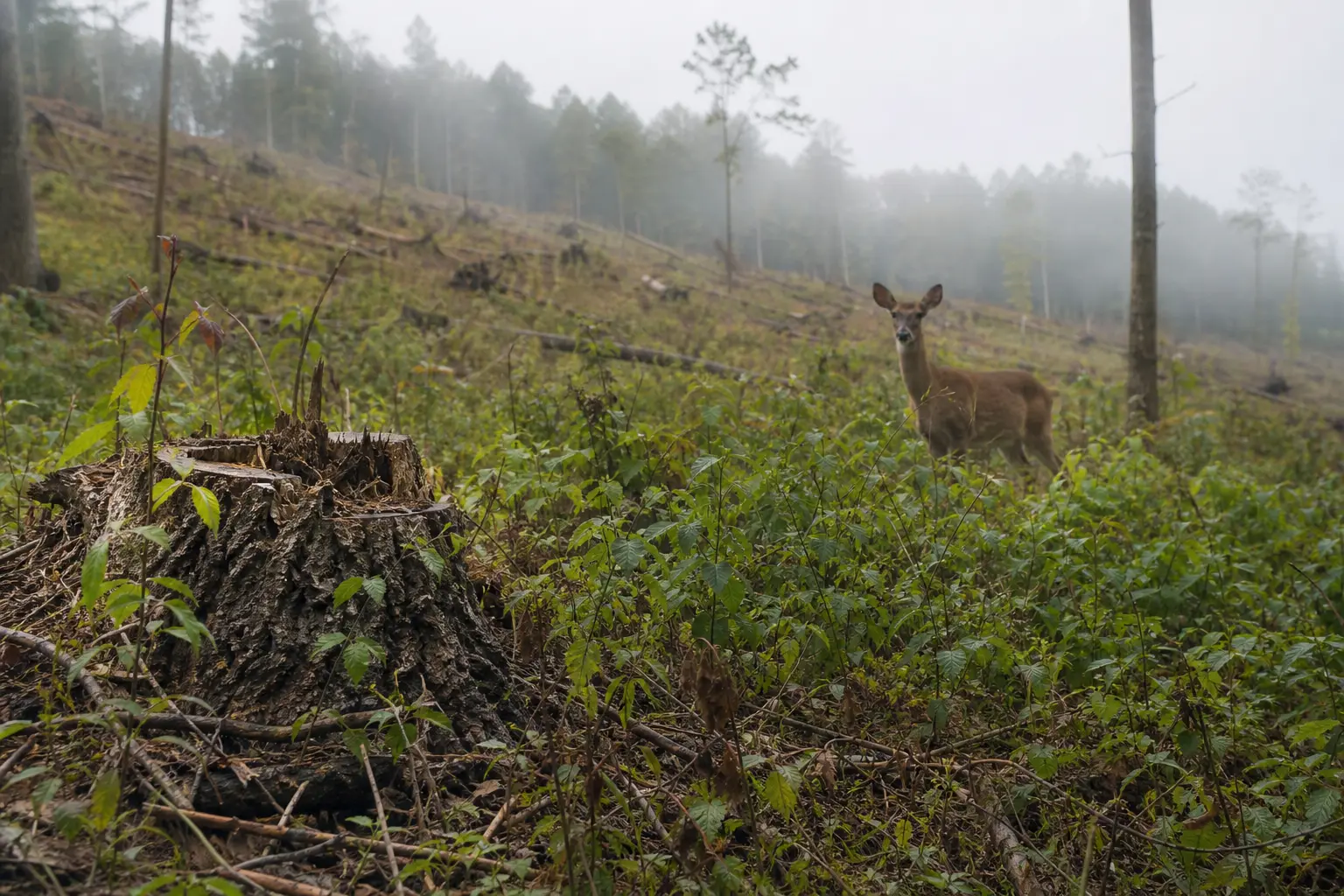
I spent a decade telling anybody who would listen that the timber company was the enemy. They owned the thousand acres behind my house, the ground I learned to hunt on next to my dad, and every few years they would come through with feller bunchers and skidders and turn a piece of the prettiest, oldest woods in the county into a war zone of stumps and slash and mud. I called it clear-cutting. I called the loggers a lot of things I won’t repeat. And when they finally got to my spot, the ridge where I killed my first buck, I called my buddy Dale from the truck and ranted for twenty minutes about how they had ruined the whole place for good.
Here is what I should have done. I should have shut up and watched. Because what I spent that season hating turned out to be the best thing that ever happened to the deer, and it took me until the third spring to admit I had it backwards the whole time.
The Timber Was Doing What Timber Does
That first spring after the cut, I walked the ridge to be mad at it. The place I knew as a cathedral of mature oak and maple was gone, nothing left but stumps and piles of limbs and a few scraggly seed trees the forester left standing. I stood there and felt genuinely sorry for myself, like a man visiting a grave. Then I looked down and saw green. Every stump had sprouts pushing off it. Every stretch of bare dirt was coming up in blackberry and greenbrier and the kind of tender browse a man will step over without a thought. The place was not dead. It was roaring.
Dale said it first, and it made me mad because he was right. “Ain’t much eats a hundred-year-old oak but acorns in the fall,” he told me. “Everything eats what grows after a cut. You been standing in a food desert your whole life and calling it pretty.”
He was right, and I hated that worse than the loggers. Mature woods are beautiful, nobody argues that. But a closed canopy shades out the ground so hard that there is almost nothing for a deer to eat at belly height. Old timber gives you acorns for a few weeks in the fall and browse lines along the edges where sunlight still leaks in. A fresh cut gives you a salad bar from your ankles to the tips of everything, and it does it for years straight. The deer herd does not live in the old woods. It lives on the edges of it, in the thick stuff, where the light hits the dirt.

The Herd Paid the Real Price
That second fall I saw more deer on that ridge than I had seen there in five years combined. Does with twins, yearlings stuffing their faces in the blackberry tangle, a couple of bucks working the edges at first light. The browse had pulled them in and held them, and the thick regrowth gave them the bedding cover the open woods never did. I sat a stand on the south edge of that cut and watched the sun come up over ground I had written off as ruined. It turned out the deer had never gotten the memo.
What stung the most, sitting there, was not the deer. It was realizing how much of my whole hunting life I had spent learning the wrong thing. I thought conservation meant keeping the woods exactly the way I found them, locked in place, untouched. I thought the only good ground was the ground that was already good the day I got there. That is comfort, not conservation. Deer need disturbance. A wood that never gets opened up, never burns, never gets cut, slowly starves itself into a pretty room with nothing in it but trees.
My grandpa, before he died, used to say a phrase I finally understood on that ridge: “You gotta tear a little to grow a little.” I spent twenty years noddin along and not hearing him.

Who Actually Pays for the Habitat
Here is the part most of us never think about, and it is the reason I quit bellyaching about loggers. That timber company owed me nothing. They cut trees because that is what timber companies do, and the deer benefit was a side effect somebody smarter than me planned around. But the habitat work that actually holds a deer herd in a place, the food plots and the burns and the edge feathering and the openings, a lot of it gets paid for by hunters whether we notice or not.
Every rifle and box of shells and bow and scope I ever bought threw a few dollars into the pot through the excise tax that has been flushing wildlife management money since before I was born. My hunting license, my deer tag, my boots, they all kick in. A deer hunter is not just a customer standing at the edge with a weapon. He is one of the main reasons there is any habitat left to stand on in the first place. Non-hunters love the deer too, but they are not the ones funding the million little cuts and burns and plantings that keep the ground productive. We are. I was funding the thing I was standing there cursing, and too thick to see it.
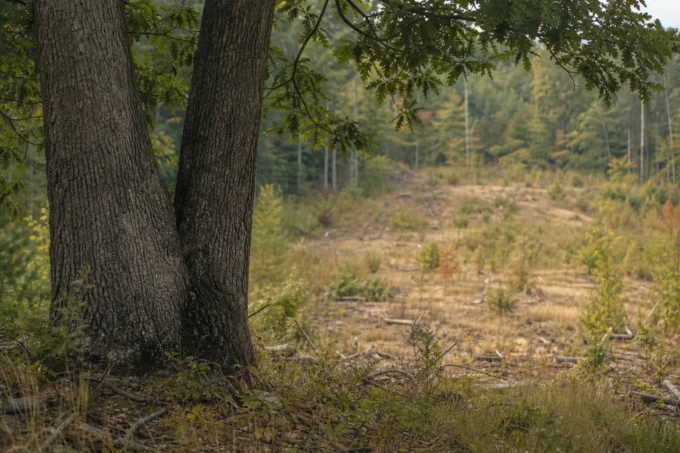
Dale put it in his usual one-liner, standing under a double-trunked oak that the forester had left for seed. “You been payin to help the deer for twenty years and you’re mad the deer finally showed up.”
What I Changed After That
I went from hating the cut to hunting it on purpose, and from there I started looking at every piece of ground with different eyes. Now I watch for the edges instead of the old-growth. I look at a thicket the way I used to look at a hardwood ridge, because the thicket is where the deer actually are. I quit treating a food plot or a fresh cut or a controlled burn like some kind of insult to the woods and started treating it like what it is, which is a farm for wild animals, paid for partly by me.
And the big one. I learned that wanting a thing to stay the same is not the same as taking care of it. A man who refuses to let a piece of woods be disturbed is not protecting it, he is slowly loving it to death with his own nostalgia. The ground does not owe me the exact woods I remember from childhood. It owes the deer food and cover, and if I get out of the way, both of them usually sort it out better than I ever could.
That first buck from the old ridge hangs on my wall still, a whole different woods behind him. The newest one came off the south edge of the cut, three springs after I stood in the middle of it and called the loggers criminals. I ate that deer with a clear conscience and a red face. The woods were never ruined. They were just getting started, and I was too proud and too sentimental to watch the whole thing happen while it was happening.