My Uncle Ray used to tell me that a man’s first buck is a coin flip between the best day he ever had and the worst walk of shame back to the truck. He never said which side I’d land on. I found out at twenty yards, which is close enough that you can count the tines and smell the wet leaves on his hide, and I still blew it like I’d never fired a rifle in my life.
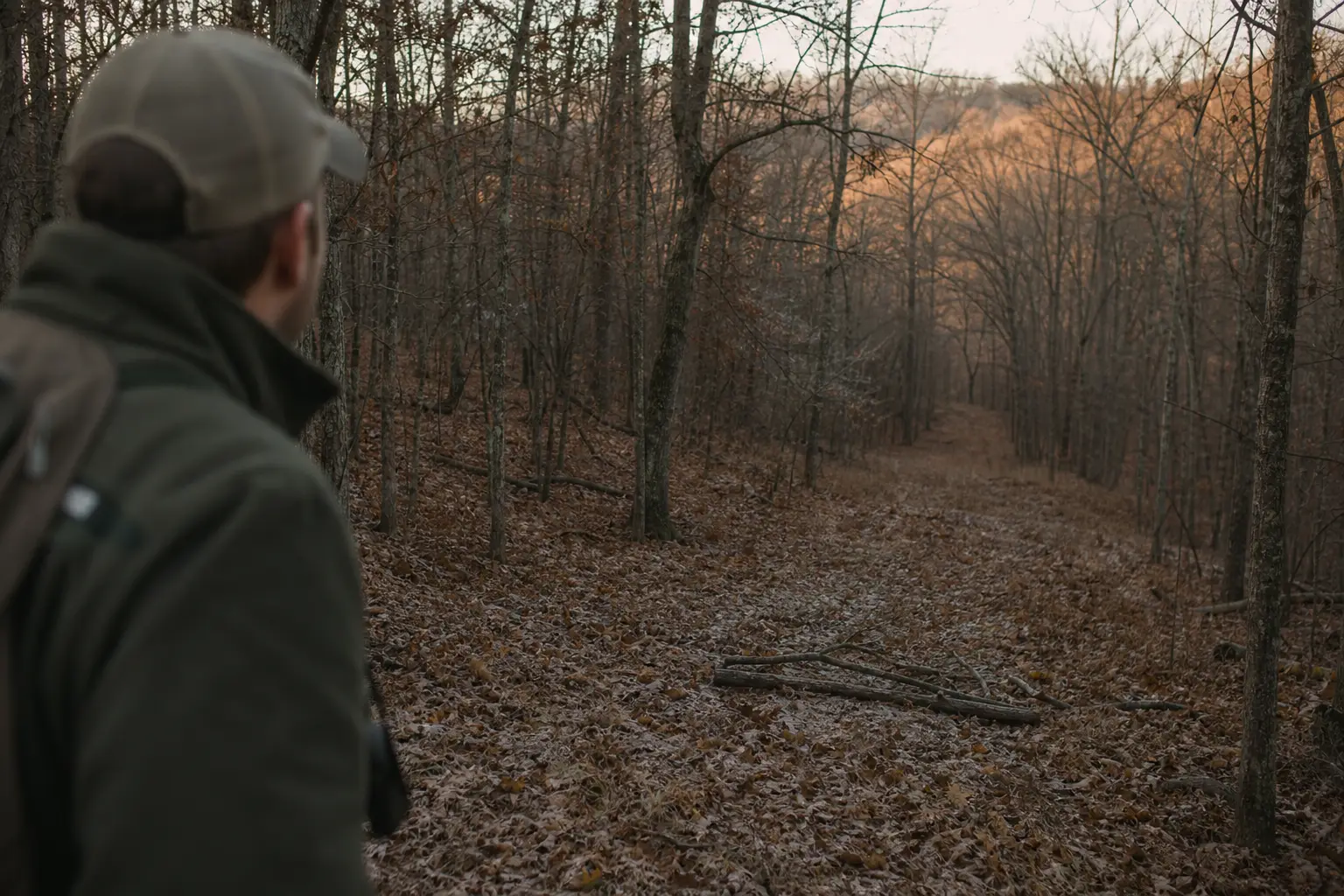
This was a cold November morning in the Ozarks, one of those hunts where the frost is heavy enough that your boots sound like somebody crumpling paper with every step. I’d been hunting deer for six years by then, short seasons, all of them ending the same way. I’d see a doe at three hundred yards, or the white flash of a tail in thick stuff, or nothing at all. I had never killed a buck. I had convinced myself it was bad luck, which was easier than admitting the truth, which was that I got a rifle because my buddies had rifles and I never really learned what to do with one when my heart was beating out of my chest.
That morning I was in a ladder stand my buddy Dale let me use, because he’d killed his buck out of it the year before and figured the mojo was still in the tree. I’d been sitting since an hour before light, coffee going cold in my hand, and I’d already run the whole reel of bad thoughts. My feet were numb. My nose was running. I had to pee and I wasn’t going to climb down and spook the whole hollow. The usual.
Then I heard him before I saw him, which is a thing they don’t tell you in the magazines. A buck in dry leaves doesn’t walk quiet the way a doe does. He came through the brush with his head down, only his antlers showing first, and they were bigger than anything I’d ever put a crosshair on. Eight points, maybe, though I stopped counting the second my hands started shaking. He stepped out into the little opening at twenty yards, broadside, and stopped to browse.
And my brain just rolled over and died.
I remember the crosshair swimming around on his shoulder. I remember thinking I should click the safety off and I couldn’t remember if I already had. I remember my thumb feeling like it belonged to somebody else. I know I fired. I don’t remember deciding to fire. The buck took one stiff step, looked right at the stand like he was trying to figure out which idiot was up there, and then he was gone over the ridge with his tail up and no blood trail that ever amounted to anything more than a few drops under where he’d stood.
I spent the next four hours walking in a circle, tracking a deer that wasn’t hit, talking myself into and out of the idea that I’d grazed him. I found muscle hair on the ground once and convinced myself it was his. It was probably off my own coat sleeve. By noon I was sitting on a stump beating myself up, and that’s when Dale called, because Dale always knows.
“Did you hold in the middle or did you aim at the whole deer?” he asked.
“I aimed at the whole deer,” I said. Which was generous. What I’d actually done was point the rifle in the general direction of a buck and twitch.
Dale was quiet for a second. Then he said the thing I still hear whenever I’m about to do something stupid in the woods. “A deer ain’t a target, boy. He’s a spot on the target. You figure out which spot before he shows up, or he’ll decide for you when your knees are knocking.”
I’d like to tell you I learned that lesson right there and never blew another shot. I didn’t. I spent most of that winter telling myself it was the cold, or the scope, or that the buck jumped the string, which is a bow thing and I was shooting a rifle so it didn’t even make sense. What actually saved me was that Dale made me spend the off season doing the ugliest kind of practice there is. Not punching paper off a sandbag at a hundred yards, pretending I was a sniper. He made me run up a hill with the rifle on my back, then shoulder it with my heart going full tilt and shoot a milk jug fifty feet away.
The first time I did it I missed the jug entirely. The second time I hit dirt. The point wasn’t the jug, though. The point was learning what my own body does when there’s adrenaline in it, because twenty yards from a buck is not the time to find out. That off season I learned that I pull the shot to the right when I’m breathing hard. I learned that I jerk the trigger when I rush. I learned that a rifle I could shoot fine from a bench in September turned into a stranger in my hands the second my pulse got up, and the only cure was doing it a hundred times until the shakiness was just background noise.
The next November I climbed back into that same ladder stand, not because the mojo was in the tree but because Dale said a man has to sit where he lost if he wants to understand what he lost. A buck came through at almost the same place, a smaller one this time, a seven point. And here’s the part I almost don’t believe myself, so take it for what it is. I saw the antlers and my heart started the same old drum solo. But this time I didn’t look at the whole deer. I looked at one spot, a spot behind the front leg I’d stared at on a hundred paper targets all spring, and I let the crosshair settle there and I squeezed slow, like I was pushing a quarter off the edge of a table and trying not to hear it drop.
The shot felt like an afterthought. The buck went down and I sat there with my ears ringing, and for a second I didn’t climb down because I didn’t trust that it had really happened. Then I got down and I put my hand on him and I thanked him, and then I called Dale and he laughed at me for about thirty straight seconds before he said, “Told you. You just had to aim at the deer instead of at your own panic.”
He didn’t say it like a lesson. He said it like a man who’d been where I was and knew there’s no way past it except through it.
Here’s the honest version of what I’d tell a new hunter, because I was that new hunter and I remember hating everybody who made it sound easy. Buck fever isn’t a character flaw. It’s just your body dumping a fistful of adrenaline into your hands and telling you this matters, and if you haven’t rehearsed what to do when that happens, your hands will vote without you. So rehearse. Not on a bench, not at paper from a rest, but tired and cold and breathing hard, because that’s the version of you that shows up when a buck steps out. Pick the spot before you ever sit down. Pick it a hundred times. And the next time a deer walks out at twenty yards, you won’t be aiming at a deer. You’ll be aiming at a spot, and your thumb will already know what to do.
I still have the seven point’s skull in my garage, and every time I walk past it I think about the eight point I never shot, the one that’s probably out there still, old and gray by now, teaching some other dumb kid the exact same lesson I had to learn the hard way. Some lessons only stick when they cost you a walk back to the truck with an empty tag and a full head of what if. That one cost me a whole season. Worth every cold mile.