
The first time somebody called jump shooting “the poor man’s duck hunt,” I took it as an insult. I was twenty-four, I had just bought a twelve-gauge that cost more than my truck payment, and I was convinced that real waterfowlers sat in blinds with a thermos and a dog that fetched like a machine. The guys who walked the ditches and poked their heads over the cattails, those were the ones who couldn’t afford the whole show. I wanted the show. I wanted to be the man in the catalog, not the man wet to his knees in a drainage ditch while the mallards laughed at him from a hundred yards out.
The Blind I Never Built
Every September I told myself this was the year. I would build a blind. I would buy the decoys, the weighted keel keels, the dozen magnum shells that cost as much as a nice dinner. I researched layouts for two weeks straight, drew diagrams on napkins, priced a layout boat that I had no business owning. And every September the season opened and I was still standing in the marsh at first light with nothing but a gun, a box of steel shot, and a pair of boots that had already soaked through.
The truth is I was scared of the whole production. A blind meant commitment. A blind meant being in one place for hours, and if the birds didn’t fly, I had to sit there and own it. Walking was easier because walking felt like doing something. I could convince myself that the ducks were just over the next rise, that the smart play was to keep moving, that standing still was for men with nothing to prove. So I walked. For three seasons I walked miles through that marsh and came home with nothing but a sunburn and a story about how close they’d been.

Stealth Is Just Silence With Mud on It
Jump shooting is a real method, and like every real method it punishes you until you learn its one hard rule. The rule is not about how you shoot. It is about how you move. A duck’s ears are better than yours, its eyes are better than yours, and it has spent its whole life learning that a walking man is the only animal that announces itself louder than the weather. You cannot hide your size. You can hide your sound, barely, and only if you accept that the marsh tells on every step.
I learned this the hard way, the way I learn everything, which is by doing it wrong on opening day in front of thirty birds. I would come over a berm like a man climbing stairs, boots slapping, shell loops rattling, and every single duck on the water would lift off before my barrel ever cleared the grass. I called it hard luck. What it was, was me walking like a man and expecting ducks to not notice. You cannot stomp up to a wild bird and ask it to die politely. The marsh does not care that you paid four hundred dollars for that gun. It only cares how loud your feet are when you move through it.

The Day the Water Kept Its Word
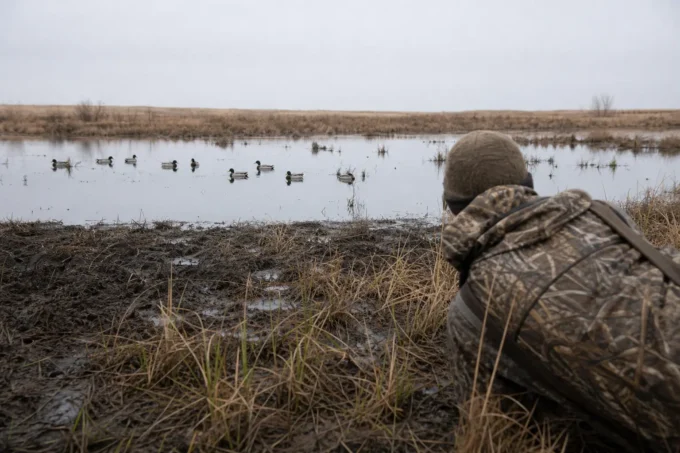
There was one morning in late October that changed how I saw the whole thing. It was cold enough that my breath moved slower than I did. I had been walking for an hour and a half without seeing a single duck, which in my old way of thinking meant the marsh was empty and I was wasting my time. Then I came up a slight rise, slow, and there was a puddle maybe thirty yards wide with a dozen greenheads on it, and they did not know I was there.
That moment before they flush, before the world explodes into wingbeats, is the whole point of jump shooting. It is the only kind of duck hunting where you get to be fifteen feet from a wild bird and decide, with your body, whether you deserve the shot. I dropped to a crouch. I eased the gun up. I picked one bird, a drake quartering left, and I swung through it the way I’d practiced on clay in the summer. The shot came, and he folded, and it was the cleanest thing I’d done all season.
The reason that shot worked is not that I was a good shot. It is that I had finally moved quiet enough to get close enough that my bad shooting didn’t matter. Jump shooting is not a test of how far you can kill a duck. It is a test of how close you can get before the duck decides you are a man and not just part of the marsh. That morning I was part of the marsh for about four seconds, and those four seconds were worth more than every blind I never built.
What Three Seasons Taught Me
Here is the part where I admit the method beat me before it ever taught me. For two seasons I treated jump shooting like a walk with a gun, and I shot a lot of empty shells at birds that were already too far gone. The fix was so simple it embarrassed me. You do not start walking toward ducks. You start walking quietly through country where ducks might be, and you let the puddles come to you. You pause at every ditch. You glass with your eyes, not your hopes. You step heel to toe on the soft edges, and you stop making noise with the same hands that are supposed to be steady on the gun.
A jump shooter who thinks he is sneaking is usually just a man crashing through the marsh fast enough that the ducks hear him from four puddles away. The ones who kill birds move like the marsh is listening, because it is. Steel shot does not forgive the way lead did. You have to be close. And the only way to be close is to be quiet, which is the one thing I kept refusing to buy because you cannot hang quiet on a peg in the garage. It costs nothing and it took me three years.
The Man Who Walked and Finally Stood Still
The joke, the one I didn’t get until I was older and a little less worried about looking the part, is that jump shooting made me good at the exact thing I was avoiding. Standing still. Waiting. Reading water and wind instead of charging through it. There is no blind in jump shooting, not in the way I used to mean it, and there is no dog and no decoys and no show. There is just a man, a gun, and the quiet, and the marsh decides whether you get a bird or a long walk home. Some mornings it gives you both.
I still don’t own a layout boat. I probably never will. But I walk those ditches now like a man who finally figured out that the ducks were never hiding from me. They were just watching, the whole time, to see if I could slow down enough to be worth their trouble. It turns out I could. It just took me three cold seasons and a single clean drake on a silver puddle to stop being the loudest thing in the marsh.