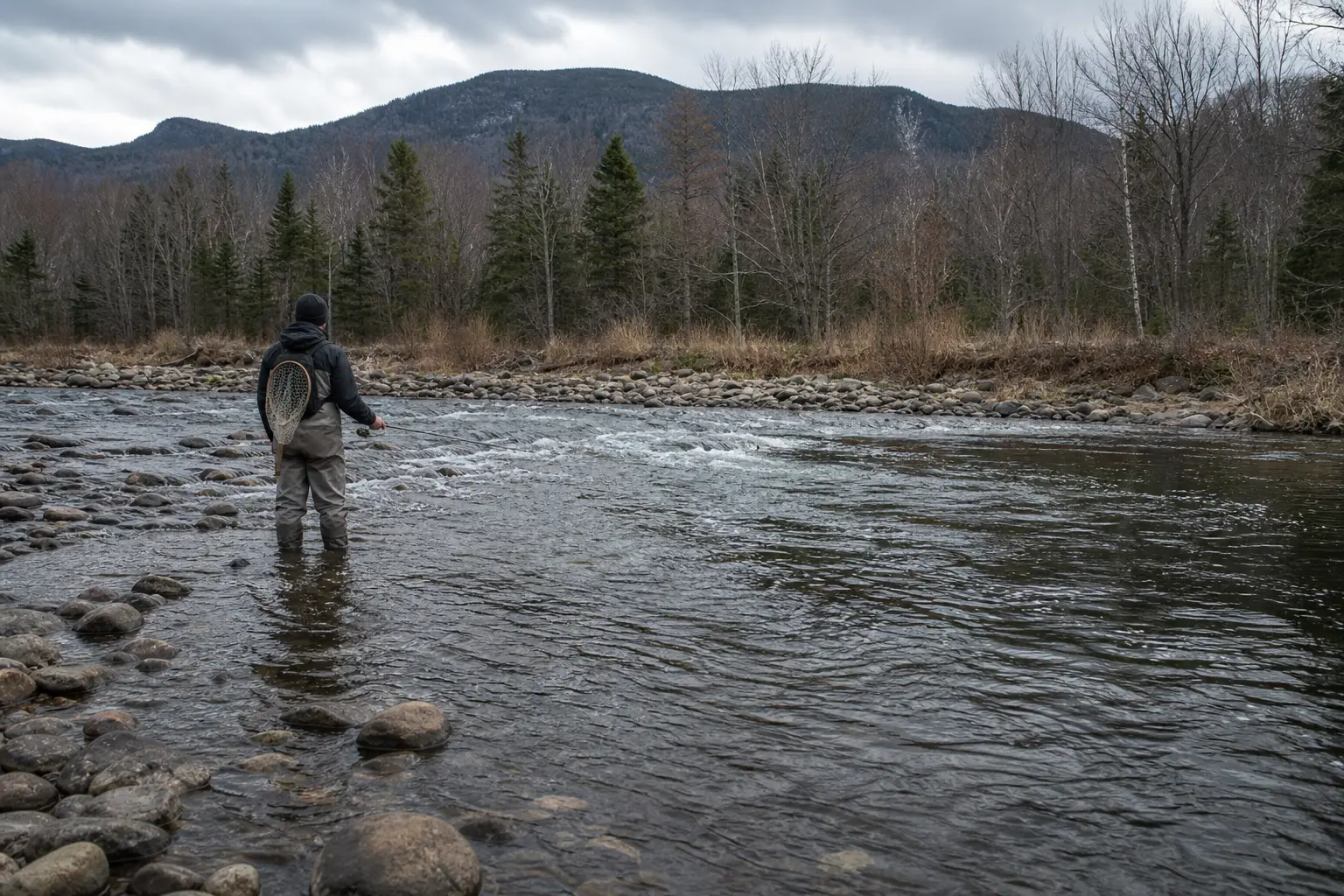
There’s a specific kind of stupidity that only exists when you’re standing in a river at 6 AM, convinced you’ve cracked the code, and you haven’t caught a fish in three hours.
That was me. Every Saturday. For about two years.
I started fishing when I moved to a town with a river running through it — the kind of river that shows up on fishing forums with guys holding trout the size of their forearms. I showed up with brand new waders, a decent rod I’d researched for weeks, and a box full of flies I didn’t know how to use. I looked the part. I felt like a guy who was about to figure this whole thing out.
Spoiler: I did not figure it out.
Not for a long, long time.
The Guy Who Couldn’t Read
Let me explain what I was actually doing during those two years. I’d walk to the river, find the prettiest looking water I could see — usually a wide, deep, slow pool with a nice smooth surface — and I’d stand there casting for hours. The water looked perfect. It was deep. It was calm. It had to be full of fish.
It was not full of fish.
What I didn’t understand — what nobody had explained to me because I was too stubborn to ask — is that trout don’t sit in the pretty water. They sit in places where food comes to them without making them work for it. The seam. The riffle. The pocket behind a rock. The bubble line that runs along the bank.
I was fishing the fish equivalent of a furniture showroom. Looks great. Nobody lives there.
The Seam Revelation
The breakthrough came on a Tuesday afternoon in August. I’d taken a day off work because I was frustrated and obsessed. I was standing knee-deep, doing the same thing I always did, when an old guy walked down the bank and just stood there watching me for about five minutes. Didn’t say a word. Just watched.
Then he said: “You know they’re not in there, right?”
I turned around. “What do you mean?”
He pointed about fifteen feet to my left. “See that line? Where the fast water meets the slow water? That’s where they eat. They sit in the slow side, watching the fast side for food coming down. You’re casting into a dead zone.”
He didn’t give me a lesson. He just nodded, walked upstream, and started casting into places I’d never even considered. Places that looked messy. Places where the water was broken and chaotic. Fifteen minutes later he had a fish on.
I moved to the seam he pointed at. First cast — nothing. Second cast — nothing. Third cast — I felt a tug so subtle I almost missed it, set the hook like a maniac, and pulled out a 12-inch brown trout that I still remember more clearly than any fish I’ve caught since.
That was the moment I realized I’d been fishing for two years without actually understanding what I was looking at.
Reading Water Isn’t Magic — It’s Just Paying Attention
Here’s the thing about reading water that nobody tells you: it’s not some mystical skill that takes decades to develop. It’s literally just asking yourself one question over and over: where would a fish be right now?
Fish want three things: food, cover, and comfortable current. Find two of those in the same spot and you’ll probably find fish. Find all three and you’ve found their living room.
Once I started thinking this way, the river completely changed. Those deep calm pools I used to love? Dead zones during the day — fish move there at night for safety, but during daylight they’re up in the feeding lanes. The choppy water I used to ignore because it was “too fast to cast”? That’s where breakfast is.
The bubble line — that trail of foam and debris that snakes along the surface — is basically a dinner conveyor belt. Bugs fall in upstream, get caught in the current, and ride that line right into a waiting trout’s mouth. Cast into the seam next to the bubble line, not into the bubbles themselves. The fish are beside it, not in it.
The Rock That Taught Me Everything
There’s a specific boulder in my local river — about the size of a refrigerator, sits mid-current, water splits around it on both sides. For the first year I fished there, I cast upstream of the rock because it seemed logical. Cast above, let it drift down, fish sees it coming.
I caught exactly zero fish doing that.
What I eventually learned: the fish aren’t in front of the rock. They’re behind it. That boulder creates a pocket of slow water on its downstream side — a break in the current where a trout can sit without spending energy, while watching both sides for food coming around the rock. It’s the trout equivalent of a recliner facing the TV.
Once I started targeting the pocket behind that rock, I pulled fish out of it consistently. Same rock. Same pool. Completely different approach.
The Edges Nobody Fishes
The biggest lesson I learned — and the one that still pays off every trip — is that most fishermen are lazy. They walk to the easiest spot, cast into the most obvious water, and go home. The fish that survive get smart. They move to the edges.
Undercut banks. Overhanging trees with branches dipping into the water. That scummy little side channel that’s too shallow to wade and too brushy to cast properly. The riffle at the head of the pool that everyone walks past on their way to the “good” water.
I’ve caught my biggest fish in places I initially dismissed as “not worth fishing.” A 20-inch rainbow from a pocket the size of a bathtub, wedged between two deadfalls. A fat brown from under a bridge where drunk college kids throw beer cans. Fish don’t care about aesthetics. They care about not getting eaten by herons.
The Debil Checklist
If you’re where I was — showing up, looking the part, catching nothing — here’s what I wish someone had told me day one:
- Stop fishing the pretty water. Deep, calm pools are gorgeous and mostly empty during the day. Fish structure, not scenery.
- Learn to spot the seam. Where fast water meets slow water — that line is the grocery store. Fish sit in the slow side and watch the fast side.
- Fish behind things. Rocks, logs, bends in the riverbank. Anything that breaks current creates a resting spot.
- The bubble line is your friend. Follow it. Fish the edges of it. Don’t ignore it.
- Look for feeding signs. Rising fish, dimples on the surface, subtle splashes near the bank at dusk. If you don’t see any sign of life in 20 minutes, move.
- Approach like you’re stalking, not walking. Trout can feel you coming through their lateral line. Wade slowly. Stay low. Don’t silhouette yourself against the sky.
- Fish the ugly spots. The places where you lose flies in branches and snag your line on submerged roots. Those are the spots nobody else touches, and that’s where the big ones hide.
Two Years to Learn What a Saturday Could’ve Taught Me
Looking back, I’m almost embarrassed by how long it took. Two years of standing in the wrong water, casting to the wrong spots, convinced my gear was the problem or the river was fished out or the trout had collectively decided to stop eating.
The gear was fine. The river was full of fish. The only problem was the idiot holding the rod.
But here’s the thing — I don’t regret those two years. Every fishless morning taught me something, even if I didn’t understand it at the time. I learned how the current moves around different structures. I learned what the bottom feels like under my boots in different sections. I learned the difference between a splash that means “feeding trout” and a splash that means “carp being dramatic.”
Most importantly, I learned that the river doesn’t care about your feelings. It doesn’t care that you drove an hour to get there. It doesn’t care that you bought the nice waders and watched the YouTube tutorials. The fish are going to be where the fish are, and your job is to figure out where that is.
The old guy who pointed at the seam never told me his name. I never saw him again. But if you’re out there, old man — thanks. You saved me from year three.