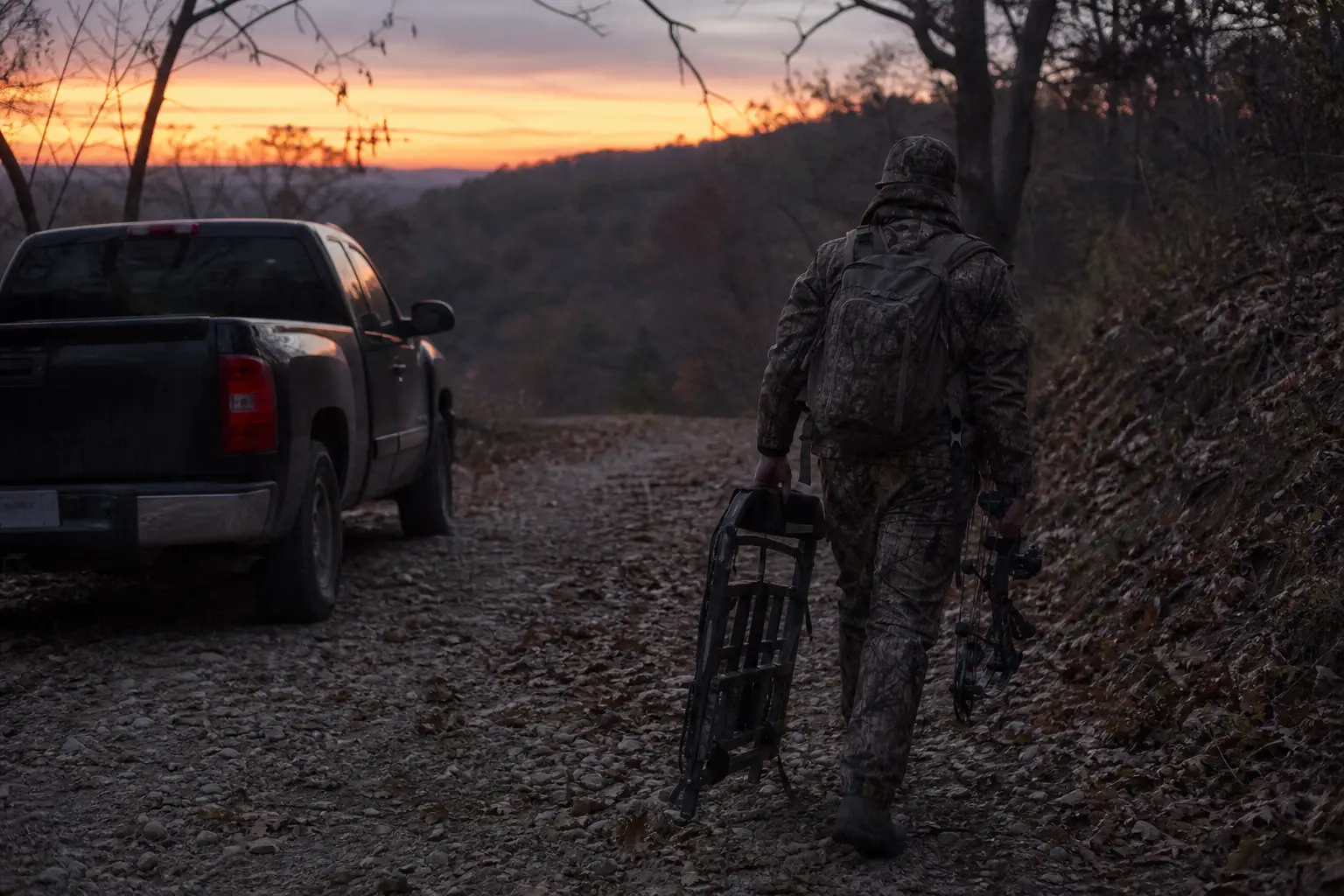
I showed up to my first public land hunt with everything I’d read on forums. Camo head to toe. Scent killer sprayed on my boots. A climber stand I’d practiced with exactly twice in my backyard. I was ready.
I was not ready.
The 4 AM Disaster
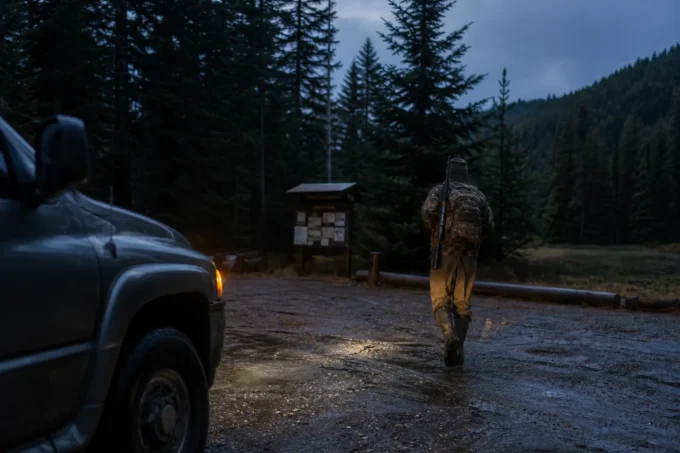
I pulled into the parking area at 4:15 AM, feeling proud of myself for getting there early. There was already a truck in the lot. No problem, I thought — public land, plenty of room. I grabbed my climber, my pack, my bow, and headed into the dark.
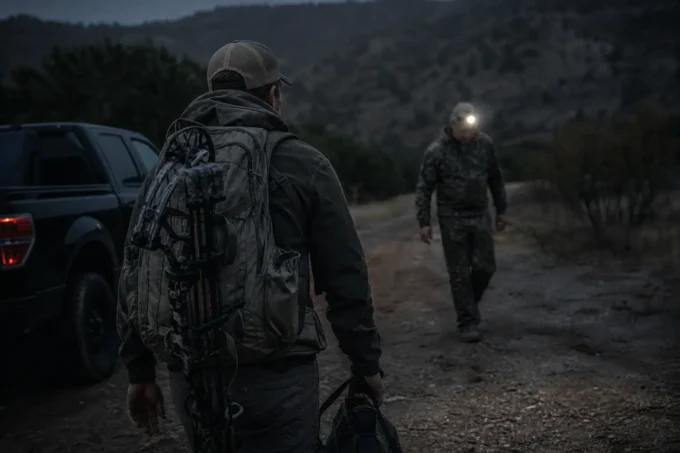
About 300 yards in, I saw a headlamp bobbing toward me. A guy in his fifties, moving fast. He stopped about ten feet away and said, real quiet: “Where you headed?”
I told him. Southeast ridge, near the oak flat I’d scouted on Google Earth.
He stared at me for a second. Then he said: “I’ve been in that tree since 4 AM. Walked past my truck, didn’t you?”
I hadn’t even noticed. I’d been so focused on my own plan that I’d blown right past another hunter’s vehicle without a second thought. Worse, I’d walked straight toward his setup, broadcasting my scent and noise right through the funnel he was hunting.
I apologized, mumbled something about being new, and turned around. He just nodded and walked back into the dark. I didn’t see him again, but I thought about that exchange for the rest of the season.
The Unwritten Rules Nobody Told Me
There’s no manual for public land hunting. Nobody hands you a rulebook when you buy your license. You learn by screwing up, by getting the look from the old-timers, or — if you’re lucky — by finding someone willing to tell you what you’re doing wrong before you ruin someone else’s hunt.
Here’s what I wish someone had told me before that morning.
If there’s a truck in the lot at 4 AM, someone is already in the woods. Don’t be the second guy. Take the hint. Find another access point or adjust your spot. Walking in behind someone isn’t just rude — you’re burning both your hunts. The deer know you’re there, and so does every other animal within half a mile.
Headlamps are Morse code for “stay away.” If you see a light moving through the timber before daylight, change direction. Don’t walk toward it to say hi. Don’t flash your light to signal. Just go somewhere else. The woods are big enough.
If someone is already parked at the trailhead you planned to use, you don’t “share” that trailhead. You find another one. Sounds harsh, but think about it from their side. They got up at 3 AM, drove an hour, hiked in the dark, climbed a tree, and sat freezing their ass off. Then you come crashing through at 6:45 because you overslept and figured you’d just “go a little further in.” Don’t be that guy.
The Time I Was “That Guy”
Second season, different piece of public ground. I’d learned my lesson about parking lots — I checked for trucks, found an empty access point, congratulated myself on being smarter now. Hiked in an hour before first light. Got set up in a promising spot where two ridges pinched down into a narrow saddle.
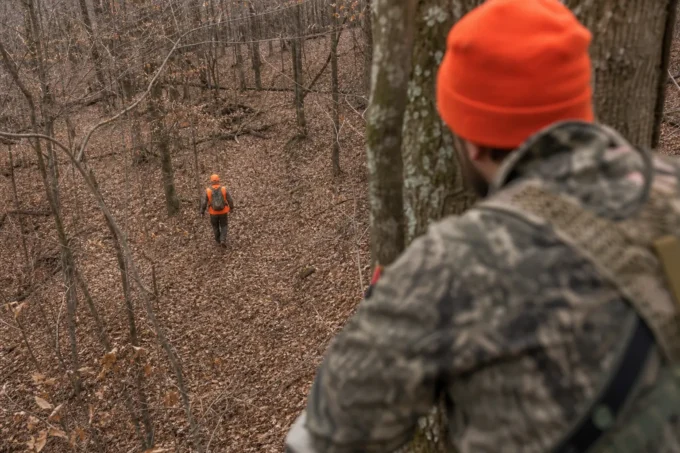
Dawn came. Nothing moving. Fine, that’s hunting. Around eight, I heard something coming through the leaves. Not a deer — heavier, two-legged. A guy in orange walked right through my shooting lane, looked up, saw me in my stand, and froze.
“Oh. Didn’t see you there,” he said.
He kept walking. Right past me. Right through the saddle I’d been watching. I sat there for another two hours out of stubbornness, but that spot was dead. I packed up and walked out.
And then — this is the part that still pisses me off — I realized halfway back to my truck that I’d done the exact same thing to someone else two weeks earlier. I’d been hiking out mid-morning, cut through a draw instead of following the ridge, and walked right under a guy’s treestand. I’d seen him, waved, kept going. At the time I thought the wave made it okay. It doesn’t.
A wave doesn’t un-ruin a hunt.
The Ego Problem
What I eventually understood — and it took longer than it should have — is that my public land screwups weren’t really about ignorance. They were about ego. I’d scouted that saddle on my mapping app. I’d picked that tree. I’d hiked in the dark. That was my spot. The other guy was the one in my way.
Except it wasn’t my spot. It’s nobody’s spot. That’s the whole point of public land.
Public land doesn’t care who got there first, who scouted harder, or who drove farther. It doesn’t care that you studied the topo map for three hours or that your cousin told you about that ridge back in ’09. The only thing that matters is who’s there right now. And if someone beat you to it, you tip your cap and go somewhere else. No drama, no staring contests, no passive-aggressive “guess we’re sharing this draw” bullshit.
The hardest thing about hunting public land isn’t finding deer. It’s swallowing your pride.
What I Do Now
I still hunt public land almost exclusively. I’ve had better years and worse years, but I’ve never had another 4 AM parking lot confrontation. Here’s what changed.
I always have at least three spots planned, not one. If the access point has a vehicle, I drive to the next one — no second-guessing, no “maybe they’re hiking the other way.” I don’t check. I leave.
If I bump into someone while I’m hiking out, I backtrack and loop wide around them. Not because I have to, but because I know what it feels like when someone walks through your morning. Even if that guy isn’t hunting — even if he’s just hiking — I give him the space I’d want someone to give me.
I carry a red headlamp instead of white. White light cuts through the woods for hundreds of yards and every animal — including the two-legged ones — knows you’re coming. Red preserves your night vision and doesn’t broadcast your position to every hunter within a mile radius.
And when I do see another hunter set up where I wanted to be, I don’t get pissed. I remind myself that he got up earlier than I did. He earned it.
The Other Side of It
There’s a flip side to all this, and I’d be lying if I ignored it. Sometimes you do everything right and some asshole still walks through your setup at 7:45 AM with a Bluetooth speaker playing country music. I’ve had it happen. You probably have too.
When that happens, you’ve got two choices. You can lose your mind and scream at a stranger in the woods — which never goes well and usually just makes you look unhinged. Or you can accept that it’s public land, that some people are clueless, and that you’ll be back tomorrow. I’ve chosen option B every time, and I’ve never regretted it.
Public land hunting is a shared resource. It’s not perfect — you’ll deal with idiots, you’ll screw up yourself, and you’ll lose mornings to other people’s headlamps. But it’s also the reason most of us can afford to hunt at all. Without public land, I’d be staring at deer from my truck on the highway, same as most guys I know.
The least we can do is not make it worse for each other.
I’m still not a great public land hunter. I’m better than I was, but I’ve got plenty of seasons left to prove I’m still an idiot. The difference is, now I try to be an idiot who doesn’t ruin anyone else’s morning.
That’s progress, I guess.