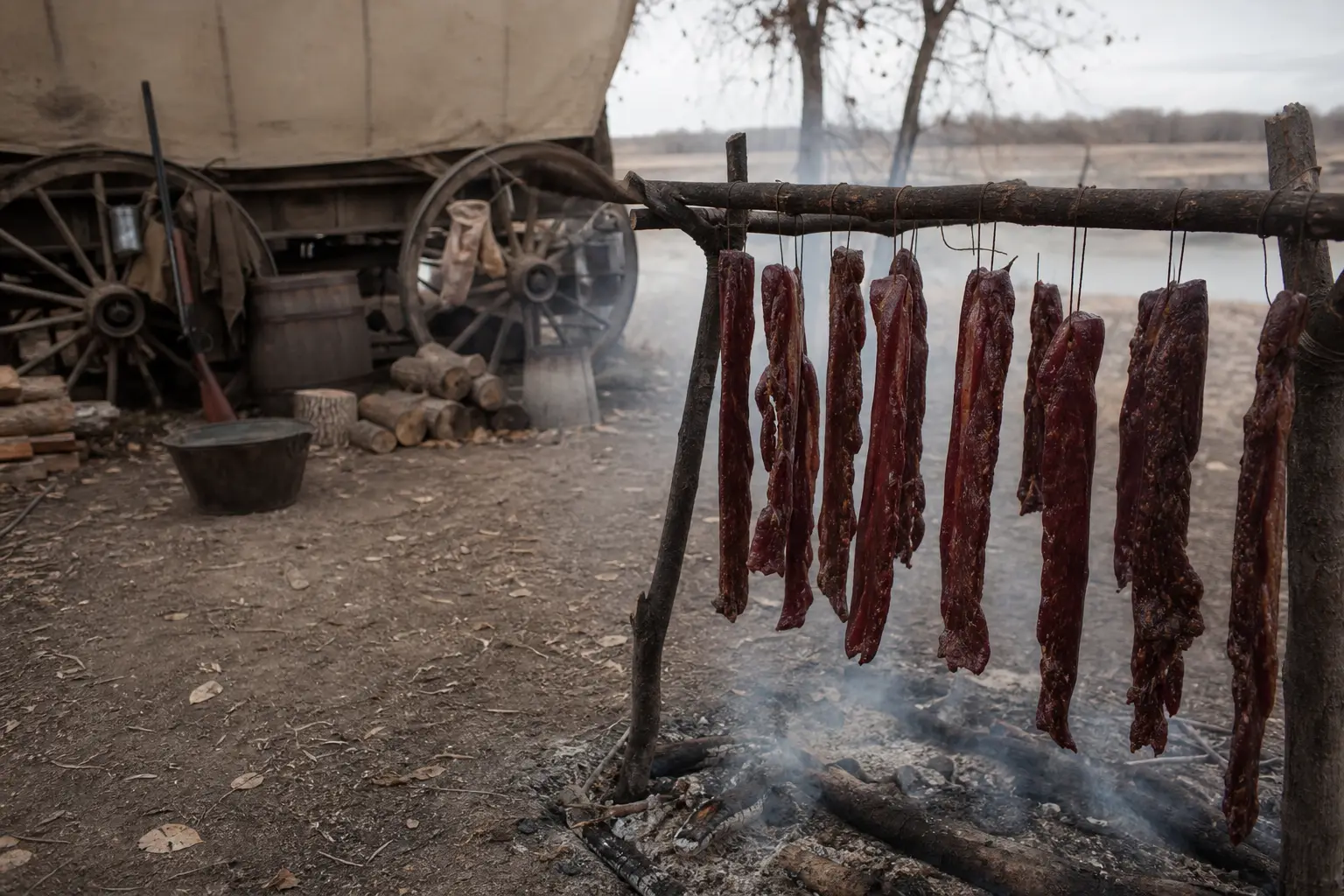
Late October, 1844. Somewhere along the bottomlands of the Platte, two days east of Fort Laramie. The wind has teeth in it now, and the cottonwood leaves have gone the color of old leather. You wake because the fire has burned down to a whisper and the cold has found the small of your back.
Sam is already up, crouched beside the pit with a tin cup of coffee he is not really drinking. Your brother-in-law has a way of staring at a problem like he can shame it into fixing itself. Beside him, Hannah is cutting meat off a deer you shot the day before, her knife moving in long even strips that she drops into a wooden bucket. The two Miller boys watch from under the wagon, wrapped in the same blanket, their breath hanging in the air like little gray flags.
And Morrison is dead.
He died three days ago of the flux, the way men die on this road, fast and ugly and quieter than you want to remember. Before he went, he told you the one thing that matters now. The meat you hauled across half a continent would spoil before the snows broke if you did not learn to keep it the way his people kept it. You did not listen hard enough, because Morrison always talked too much. Now he is gone and you are standing over two hundred pounds of deer with no ice and a wind that will not stop blowing.
The Meat Does Not Care About Your Plans
The deer is fresh, but freshness means nothing out here. A warm day will turn it green inside forty-eight hours. You know this because you have seen it. A family a week back left a hindquarter hanging off their wagon like a flag, too proud to admit they had nothing to cook it with. By the third day the crows would not touch it.
So you do what Morrison said. You smoke it.
Cold smoking is slow. It dries the meat and lets the smoke work into the surface without cooking it through. For that you need a fire that smolders instead of burns, a low thin ribbon of smoke that runs for hours. Hot smoking cooks the meat while it smokes, which is faster but leaves you with a cooked joint that still needs eating or more smoke to last. On a road with no ice and no tomorrow you can count on, cold smoking is the answer for keeping meat long enough to reach the next post.
The smell is the whole business. Green cottonwood and willow throw a thick yellow-white smoke that coats the meat and keeps the flies honest. Hickory is what you want, but hickory is a thousand miles behind you in Missouri. You use what the river gives you.
Building the Smoke You Can Trust
First you cut the meat thin. Hannah has done it right, strips no thicker than your thumb, cut with the grain so they hang instead of tear. A thick strip smokes on the outside and rots on the inside. You learned that the hard way in the spring, when a slab you thought was done came apart and the middle was the color and smell of something that had lost an argument with the sun.
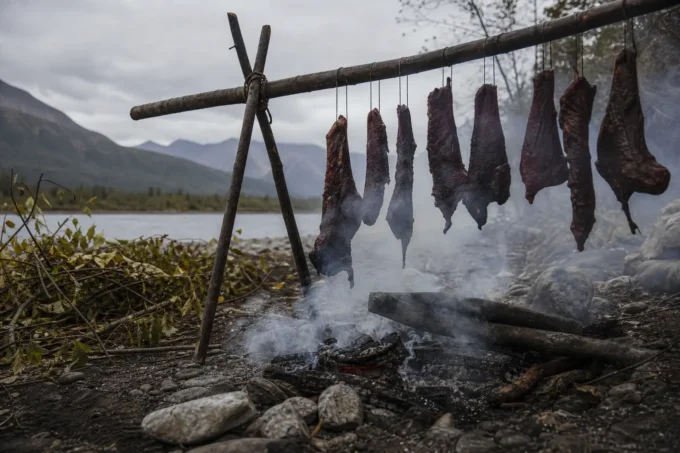
Then you dig. The pit is knee deep and as long as a man. At the bottom you lay a bed of coals, banked so they throw heat without flame. Over them you build a little tent of willow poles, one end higher so the smoke climbs and the meat catches it instead of the black ash that ruins the taste and grits your teeth.
The strips go over the poles, not touching, so the smoke can find every edge. You hang them from string and withies and the wire you have saved from a broken harness. Anything that drips falls into the coals and hisses, and the smell of it makes the Miller boys edge closer even though their stomachs are already full of yesterday.
Then you wait. Cold smoking is not a burst of work. It is hours of sitting a few feet from a fire that is trying to go out, feeding it one handful of damp chips at a time, watching the smoke curl and reading it the way a man reads water. Too thin and the meat is just drying. Too thick and you choke and the meat tastes like a chimney fire.

The Small Hours and the Small Failures
The first night you keep the smoke going until your eyes burn and your throat feels sanded. You feed the fire through the long dark, squatting in the cold, and every hour you turn a strip and press it with your thumb. It should be stiff at the edges and give just a little in the middle. By dawn your hands are black and your fingernails hold smoke so deep it will not wash out for a week.
Then the wind comes.
It is a dry west wind that jumps up with the sun and flattens your ribbon of smoke sideways and scatters the coals in a red shower. The strips that were shielded overnight sit dead in the open air while you scramble to bank the pit again. By the time you have it, an hour of smoke is gone and the meat has cooled. You cuss, and Hannah shoots you a look that says the boys can hear.
You lose some of it. Not all of it. A few strips near the downwind edge catch a gust of ash and are too black and bitter to keep, and you scrape them off the rack and give them to the dog, who eats the ruined meat and then licks your hand like it was kindness. The rest you get back under the smoke before the morning warms, and you tell yourself it is enough.

What the Smoke Gives Back
By the second afternoon the meat has the look of it. The strips are dark on the surface and stiff, almost brittle at the thinnest edges, and when you tear one open the inside is a deep even brown, not the gray-red of meat that only pretended to smoke. It smells like a wood fire on a wet morning, sharp and clean in a way that makes your mouth water in spite of the cold.
Hannah packs it for the journey, layering it in clean cloth inside the flour barrel where the bugs are fewer. Sam says nothing, which from Sam is the highest praise there is. He only takes a strip, strips off a piece with his teeth, and chews it slow with his eyes on the west. The Miller boys each get a piece and stand with it like it is a prize, eating it in tiny bites to make it last.
You think, briefly, about people back east eating bread without weevils and meat from a butcher who was not afraid of the weather. Then you stop thinking about it, because it does no good and the wind is turning colder.
The smoking was not the whole answer, and you know it. Nothing on this road is. But tonight there is meat that will not rot, and a fire that a man can still feed, and that is more than Morrison had when he went into the ground. You sit down near the pit with your back against a wagon wheel and close your eyes just for a minute, because you have not slept more than an hour at a stretch in three days, and tomorrow you have to do it all again with the next deer.
What Was Real
Smoke curing is one of the oldest ways humans have ever kept meat, and it was standard practice on the overland trails. The two methods were distinct. Cold smoking, done below about 85 degrees Fahrenheit, dried and flavored the meat without cooking it, which made it last. Hot smoking cooked the meat through while it smoked, which was faster but produced food that still had to be eaten or further preserved. On the road, emigrants mostly relied on the low slow smoke because it could stretch a fresh kill across the days and weeks between water and game.
The wood mattered. Hickory, oak, and fruitwoods were prized, but on the Platte bottomlands emigrants burned what grew there, mainly cottonwood and willow, which threw a heavy smoke and a fair amount of ash. Green or damp wood smoldered better for cold smoking than dry wood, which burned too fast and too hot. The process was labor intensive and needed almost constant attention, feeding the fire a little at a time for hours or even a full day.
Cured and smoked meat was not a luxury on the frontier. It was survival arithmetic. A large deer could yield well over 50 pounds of usable meat, and without salt in quantity or reliable ice, smoke was the thing that kept a family from eating rotten meat or starving between kills. The Oregon Trail ran from about 1841, with heavy emigration from 1843 through the 1860s, and by some estimates around 400,000 people crossed before the railroads made the wagon road obsolete. Nearly all of them ate smoked, salted, or dried meat at some point on the way.
The word itself is old and unglamorous. Smoke as a method of preservation predates writing, carried across Europe and Asia and the Americas by people who had no ice and no refrigeration and learned, one spoiled meal at a time, that what the fire could not kill, it could at least hold off.