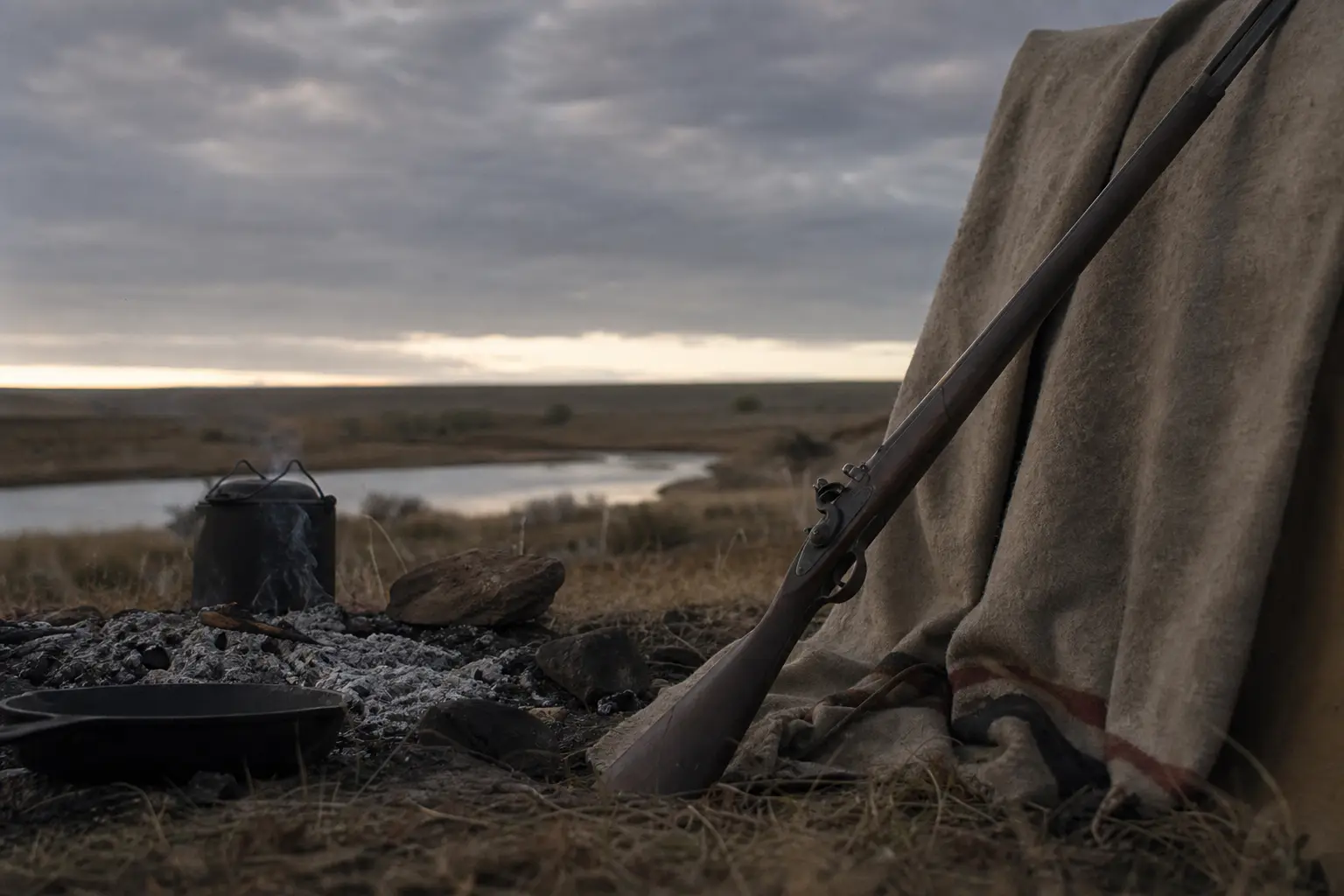
The rifle is the only thing standing between this party and empty bellies. You know the arithmetic the way you know your own name. You carry three pounds of powder in a horn, a tin of caps in a pouch, and about forty balls in a greased leather bag. That is your whole larder for the next six hundred miles, and it has to last you until the next trading post, where powder costs more than you can pay. This rifle is a Hawken, half a year of a man’s wages back in St. Louis, and it is wet, and it is clicking instead of firing.
You don’t want to end up like Morrison. Morrison’s smoothbore got soaked in the last river crossing and he set it aside to dry without oiling it, and by the time he looked again the bore was red with rust down the whole inside. Two days later he tried to load it, the ball jammed halfway, and now he walks at the back of the line carrying a club. He feeds nobody. He has taken to boiling grass and calling it tea, and his hands shake all morning because he hasn’t eaten meat in five days. You look at Morrison and you understand that a man on this trail with a dead rifle is a man who will eat his own shoelaces before they reach the Sweetwater.
You sit down by the fire and take the rifle apart in your lap. This is the work now, and nobody else is going to do it.
First the lock. You pull the barrel pins and lift the barrel out of the stock, because a wet rifle fouls from both ends and you clean from the breech when you can. You set a pot of water on the coals to boil. While it heats, you work the lock over with a rag and the little brass brush you keep in the patch box. The spring is fine. The trouble is in the bore. You push a wet rag down on the jag and draw it back, and it comes up black, then gray, then finally a clean smear of oil you wiped on the night before. The fouling from the last two shots has gone to paste in the damp, and paste is what grabbed the ball.
The water boils and you pour it through the barrel, holding it hot with a piece of leather, and the steam smells of sulphur and burned charcoal and old meat grease. You run hot water until it comes out clear, then jam a dry rag after it, then grease the bore with bear oil from the little clay jar you keep in the bottom of your possibles bag. Grease it or it rusts by sundown. Rust is what killed Morrison’s gun, faster than any river.
Then you check the caps. You open the tin and there are eleven left, and one of them has gone green with corrosion at the rim from a morning it spent too close to your skin. You pick it out and set it aside to throw away later. Eleven caps. A cap is a shot. A shot, if you do it right, is a deer. A deer is meat for a week and a half. You do not shoot at anything you don’t mean to kill, because every cap you fire walks your family a little closer to Morrison’s pot of boiled grass.
Sam watches all of this without a word. Behind him, Hannah is already working at the morning fire, and the two Miller boys are pulling the horses in from the picket line, and the smallest boy stops to watch a pale gopher snake the dog has just killed. The dog eats it in two gulps while the boy stares, and Hannah does not look up. You think, briefly and without much weight to it, about people back east sitting down to bread and coffee in houses where a rifle is only a thing on a wall.
Then it goes wrong, the way it always goes wrong.
Fifty yards out, a coyote cuts across the open ground, and you have not fully seated the barrel back into the stock. Your hand is still greasy from the bore. You snatch the rifle up out of instinct, cock, and squeeze, and the hammer falls on a cap that has gone soft with damp from sitting in the open tin. It snaps once, like a twig. Nothing. The coyote stops, looks at you with yellow eyes, and trots off into the sage. You tap the vent, dig the dead cap off the nipple with your thumbnail, and the next one, dry from the bottom of the tin, is the one you should have loaded first. But the coyote is gone, and you have spent a cap on nothing, and the lesson sits in your gut like a stone.
You do not get a deer that day. You get down and finish seating the barrel into the stock, and you screw the nipple out and dry it against your shirt, and you put the rifle back together slow, checking that the barrel lies square and the hammer falls clean. By noon it is ready, oiled and dry and capped right, and you carry it loaded the rest of the day. A loaded rifle is a promise. You just don’t get to collect on it today. You want, more than anything, to sit down.
What Was Real
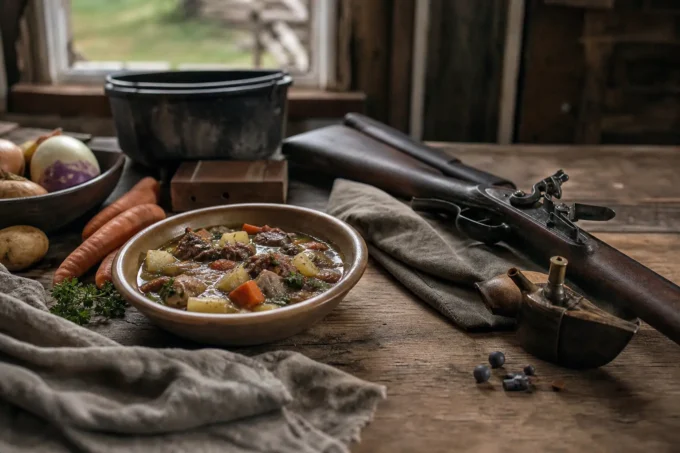
The rifle that fed a family on the Oregon Trail was a muzzleloading rifle in the line of the Hawken, made in St. Louis, and the older Pennsylvania long rifle. By the 1840s it fired with a percussion cap. The flintlock was going out of use, because a cap loaded with mercury fulminate fires in rain and snow where a flint spark will not strike. A Hawken ran around 11 pounds with a barrel usually 30 to 36 inches. It threw a round lead ball wrapped in a greased cloth patch, and the patch gripped the rifling and spun the ball, and it was that spin, not the powder, that put the ball where a man aimed.
The powder was black powder, a rough mix of saltpeter, charcoal, and sulfur. It burned dirty and left a hard black fouling in the bore. Every few shots the fouling built up enough that the next ball would not seat, and the rifle had to come apart. The standard cleanup was a wet patch pulled down the barrel with a cleaning jag or a tow worm, and boiling water was the best solvent. After the bore came clean it had to be oiled or greased at once, because a bare steel bore rusts in one wet night, and rust ruined more rifles than any accident on the trail.
The grease was bear oil when the man had it, or tallow, or the sperm oil and neat’s-foot oil already kept for harness. A greased patch sealed the gas and slowed the fouling. At the lock a man carried a tin of caps, and losing the caps left the rifle as useful as a club. A round ball ran about 20 to 24 to the pound of lead, and a .50 or .54 ball weighed around 200 to 230 grains. The effective range for most hunters was well under a hundred yards, because the round ball dropped hard and the wind moved it. The rifles were accurate, far more accurate than the smoothbore trade muskets many emigrants carried instead.
A trade musket was a smoothbore, bored large, and it threw either a loose ball or a charge of shot out to maybe 50 or 60 yards. It was a scatter gun and a ball gun in one, the poor man’s do everything piece. The rifleman carried the slow, accurate, expensive weapon worth half a year’s pay. That difference mattered for subsistence. The rifleman took one measured shot and ate farther away with less lead per animal. The musketeer poured a bigger charge down a wider unrifled tube and took closer game, or loaded shot and took birds and rabbits. Both ate. Men argued rifle versus musket around the fires the way men argue guns in any century.
The trail ran from Missouri to Oregon between 1841 and the late 1860s, and around 400,000 people crossed it. The rifle got wet in river crossings, dusty on the flats, and cold in the passes. Rust, damp powder, and lost caps took more meat off the table than any want of skill. A man who kept his rifle oiled and dry fed his family. A man who let it rust ate what the country gave him and went hungry when the country gave nothing.
You wake up because the hammer won’t fall. October, 1845. You are camped beside the Platte, three days east of Fort Laramie, in a country of low gray sage and buffalo grass that rustles all night like paper. The cold has gotten into your Hawken overnight. When you cock the hammer and squeeze, you get a dry click, and the sound of it hangs in the air over the dead embers while your brother in law Sam sits up in his blankets and watches you with his one good eye.
“Wet morning,” Sam says. He already knows. He has been on this ground two years longer than you.
The rifle is the only thing standing between this party and empty bellies. You know the arithmetic the way you know your own name. You carry three pounds of powder in a horn, a tin of caps in a pouch, and about forty balls in a greased leather bag. That is your whole larder for the next six hundred miles, and it has to last you until the next trading post, where powder costs more than you can pay. This rifle is a Hawken, half a year of a man’s wages back in St. Louis, and it is wet, and it is clicking instead of firing.
You don’t want to end up like Morrison. Morrison’s smoothbore got soaked in the last river crossing and he set it aside to dry without oiling it, and by the time he looked again the bore was red with rust down the whole inside. Two days later he tried to load it, the ball jammed halfway, and now he walks at the back of the line carrying a club. He feeds nobody. He has taken to boiling grass and calling it tea, and his hands shake all morning because he hasn’t eaten meat in five days. You look at Morrison and you understand that a man on this trail with a dead rifle is a man who will eat his own shoelaces before they reach the Sweetwater.
You sit down by the fire and take the rifle apart in your lap. This is the work now, and nobody else is going to do it.
First the lock. You pull the barrel pins and lift the barrel out of the stock, because a wet rifle fouls from both ends and you clean from the breech when you can. You set a pot of water on the coals to boil. While it heats, you work the lock over with a rag and the little brass brush you keep in the patch box. The spring is fine. The trouble is in the bore. You push a wet rag down on the jag and draw it back, and it comes up black, then gray, then finally a clean smear of oil you wiped on the night before. The fouling from the last two shots has gone to paste in the damp, and paste is what grabbed the ball.
The water boils and you pour it through the barrel, holding it hot with a piece of leather, and the steam smells of sulphur and burned charcoal and old meat grease. You run hot water until it comes out clear, then jam a dry rag after it, then grease the bore with bear oil from the little clay jar you keep in the bottom of your possibles bag. Grease it or it rusts by sundown. Rust is what killed Morrison’s gun, faster than any river.
Then you check the caps. You open the tin and there are eleven left, and one of them has gone green with corrosion at the rim from a morning it spent too close to your skin. You pick it out and set it aside to throw away later. Eleven caps. A cap is a shot. A shot, if you do it right, is a deer. A deer is meat for a week and a half. You do not shoot at anything you don’t mean to kill, because every cap you fire walks your family a little closer to Morrison’s pot of boiled grass.
Sam watches all of this without a word. Behind him, Hannah is already working at the morning fire, and the two Miller boys are pulling the horses in from the picket line, and the smallest boy stops to watch a pale gopher snake the dog has just killed. The dog eats it in two gulps while the boy stares, and Hannah does not look up. You think, briefly and without much weight to it, about people back east sitting down to bread and coffee in houses where a rifle is only a thing on a wall.
Then it goes wrong, the way it always goes wrong.
Fifty yards out, a coyote cuts across the open ground, and you have not fully seated the barrel back into the stock. Your hand is still greasy from the bore. You snatch the rifle up out of instinct, cock, and squeeze, and the hammer falls on a cap that has gone soft with damp from sitting in the open tin. It snaps once, like a twig. Nothing. The coyote stops, looks at you with yellow eyes, and trots off into the sage. You tap the vent, dig the dead cap off the nipple with your thumbnail, and the next one, dry from the bottom of the tin, is the one you should have loaded first. But the coyote is gone, and you have spent a cap on nothing, and the lesson sits in your gut like a stone.
You do not get a deer that day. You get down and finish seating the barrel into the stock, and you screw the nipple out and dry it against your shirt, and you put the rifle back together slow, checking that the barrel lies square and the hammer falls clean. By noon it is ready, oiled and dry and capped right, and you carry it loaded the rest of the day. A loaded rifle is a promise. You just don’t get to collect on it today. You want, more than anything, to sit down.
What Was Real
The rifle that fed a family on the Oregon Trail was a muzzleloading rifle in the line of the Hawken, made in St. Louis, and the older Pennsylvania long rifle. By the 1840s it fired with a percussion cap. The flintlock was going out of use, because a cap loaded with mercury fulminate fires in rain and snow where a flint spark will not strike. A Hawken ran around 11 pounds with a barrel usually 30 to 36 inches. It threw a round lead ball wrapped in a greased cloth patch, and the patch gripped the rifling and spun the ball, and it was that spin, not the powder, that put the ball where a man aimed.
The powder was black powder, a rough mix of saltpeter, charcoal, and sulfur. It burned dirty and left a hard black fouling in the bore. Every few shots the fouling built up enough that the next ball would not seat, and the rifle had to come apart. The standard cleanup was a wet patch pulled down the barrel with a cleaning jag or a tow worm, and boiling water was the best solvent. After the bore came clean it had to be oiled or greased at once, because a bare steel bore rusts in one wet night, and rust ruined more rifles than any accident on the trail.
The grease was bear oil when the man had it, or tallow, or the sperm oil and neat’s-foot oil already kept for harness. A greased patch sealed the gas and slowed the fouling. At the lock a man carried a tin of caps, and losing the caps left the rifle as useful as a club. A round ball ran about 20 to 24 to the pound of lead, and a .50 or .54 ball weighed around 200 to 230 grains. The effective range for most hunters was well under a hundred yards, because the round ball dropped hard and the wind moved it. The rifles were accurate, far more accurate than the smoothbore trade muskets many emigrants carried instead.
A trade musket was a smoothbore, bored large, and it threw either a loose ball or a charge of shot out to maybe 50 or 60 yards. It was a scatter gun and a ball gun in one, the poor man’s do everything piece. The rifleman carried the slow, accurate, expensive weapon worth half a year’s pay. That difference mattered for subsistence. The rifleman took one measured shot and ate farther away with less lead per animal. The musketeer poured a bigger charge down a wider unrifled tube and took closer game, or loaded shot and took birds and rabbits. Both ate. Men argued rifle versus musket around the fires the way men argue guns in any century.
The trail ran from Missouri to Oregon between 1841 and the late 1860s, and around 400,000 people crossed it. The rifle got wet in river crossings, dusty on the flats, and cold in the passes. Rust, damp powder, and lost caps took more meat off the table than any want of skill. A man who kept his rifle oiled and dry fed his family. A man who let it rust ate what the country gave him and went hungry when the country gave nothing.