
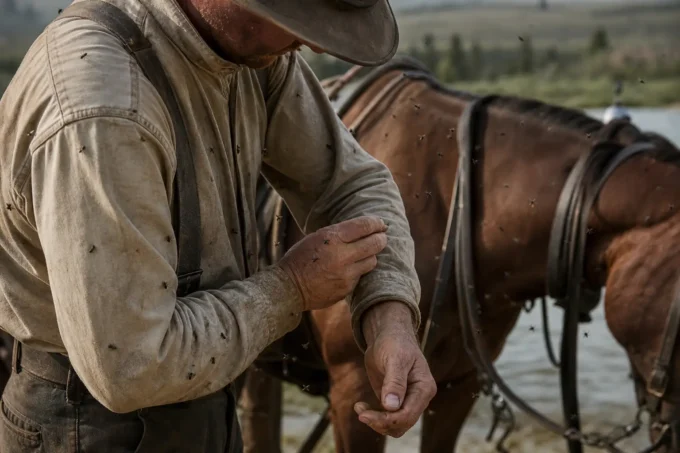
You wake because something is crawling across the back of your neck, and your fingers come away with two gray lice crushed between them, warm from your own skin. It is late May, 1848, on the Platte somewhere east of Fort Laramie, and the wagon train has been moving for six weeks without a real wash. The mosquitoes hang in a cloud over the oxen at dusk, the fleas are in the straw under the mattresses, and the ticks are waiting in the grass for the bare ankles of the children. You have stopped being ashamed of the itching. It is simply the background of everything now, the way the creak of the wagon is the background, the way the taste of bacon in your mouth goes stale by noon.
Your wife Hannah is already up, shaking out the bedding, and the act is mostly a gesture, because the vermin come back by nightfall no matter how many times you boil the blankets. Your brother-in-law Sam is sitting on the wagon tongue with his shirt off, picking at a cluster of tick bites just above his belt, and he looks up and says, flat as a board, “This country don’t want us here. It’s just eating us slow instead of fast.” Sam has a way of naming a thing exactly, and you hate it a little because he is always right.
Morrison is still alive, which surprises everybody, but the flux has hollowed him so thin that the lice prefer the rest of you now. That is how you know how bad it is. Morrison sits against the wheel in the early sun and picks a tick off his own forearm and crushes it with his thumbnail, and he does not even look at it, the way a man does not look at rain anymore when it has been raining a month.
You are the one who has to do something, because nobody else will. Hannah has the children and the cooking and the care of Morrison, and Sam has the oxen and the harness, and so the war against the insects, the small endless war, falls to you. It is not a war you will win. That is the thing nobody told any of you when you left Missouri. You will not win it. You will just learn to live inside it, with small tactics and tired arms and the hope of a river deep enough to drown the worst of the biting off you for a single night.
The Small Enemies, Named
Here is the roster, and you learn to tell them apart the way you learn the tracks of the animals you shoot. The mosquito is the singer, the one you hear before you feel it, and it comes at dusk and at dawn in clouds thick enough to breathe. The buffalo gnat, smaller and meaner, bites in the daytime along the river bottoms and raises welts that itch for a week. The biting fly that swarms around the horses and oxen drives the stock half mad, and a team tormented by flies is a team that will not pull, which matters more than any bite on your own body.
The tick does not sing. It climbs up from the grass and the sage and it buries its head in you, and you must dig it out, and if you leave pieces behind the wound festers. The louse lives in the seams of your clothes, in the wool and the cotton, and it gives you a restless itch that spreads from your wrists and your neck into your whole body, and you scratch until you bleed and then you scratch the scabs. The flea lives in the straw and the bedding and the fur of the dog, and its bite is a sharp little fire that jumps. And behind all of them, invisible, rode the fevers they carried, sickness with no name that a man could not shoot or swat or boil out of the water.
How You Fight Back, Step by Step
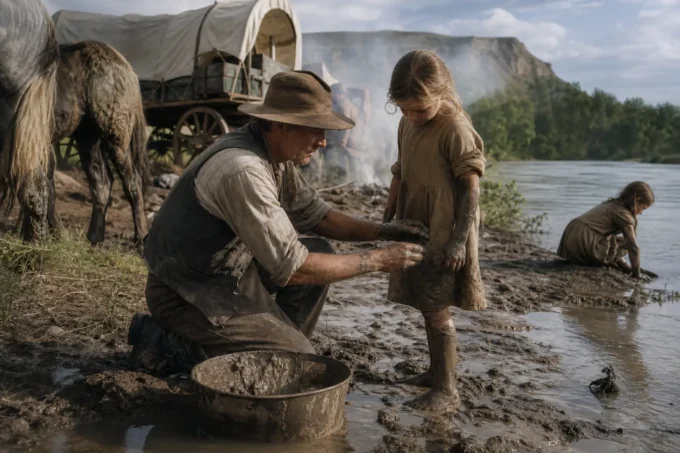
You learn by doing, and most of what you learn is ugly and half failed. The first trick is smoke. At dusk you build the fire with green willow and wet brush and buffalo chips, and you let it smolder low and thick, and you make the children stand in the downwind side of it so the mosquitoes will not settle on them. It works, partly. The price is that you all smell of smoke until the smoke smell becomes a second skin, and your eyes run and your throats rasp, but smoke is cheaper than being eaten, and so you burn it every evening and you bank it through the night.
The second trick is mud. Along the river you coat the bare ankles and arms of the children with a thin paste of mud, and it dries into a crust the mosquitoes cannot bite through, and you coat the flanks of the horses the same way where the flies gather. It is ugly and it washes off in the first rain, and it makes everybody look like creatures risen out of the river bottom, but it keeps the welts down, and welts down means a child that can sleep, and a child that can sleep is worth a coat of mud.
The third trick is to break the life of the louse. Every few days, when you camp near water and fuel for a spare hour, you boil the blankets and the shirts and the shifts in the iron kettle, and you hang them to dry over the wagon, and the heat kills the lice and the eggs. You pick the seams by hand, scraping your thumbnail along the stitching and crushing what you find. It is tedious and it makes your back ache from bending, and it is never finished, because the lice are already crawling back from the straw by morning, but doing it is the difference between a misery you can sleep through and a misery you cannot.
The fourth trick is the grease and the herbs, and it is half superstition and half sense. You smear bear grease or tallow mixed with crushed wild mint or wormwood on the necks and wrists of the children, and you string bunches of the same bitter weeds around the wagon, and whether it truly keeps the insects off or merely makes you believe it does, you do it, because belief is a thing you still get to own. It smells green and sharp and clean in a country that mostly smells of dust and cured meat and sweat.
Hannah and the Quiet Work
While you fight the small enemies, the family goes on around you, and that is the thing that keeps you moving. Hannah combs the nits out of the children’s hair with a fine comb and a cup of vinegar, and she drops each louse into the fire and it pops, a small sharp sound you come to like, because it is the sound of the enemy counting down. Sam picks the ticks off the dog’s ears while the dog lies patient and half asleep, and the dog eats a dead snake the next morning and is none the worse for it. The smallest boy sits in the dust and scratches his ankle with both hands until it bleeds, and you tell him to stop without much heat, because you know he cannot, and neither can you.
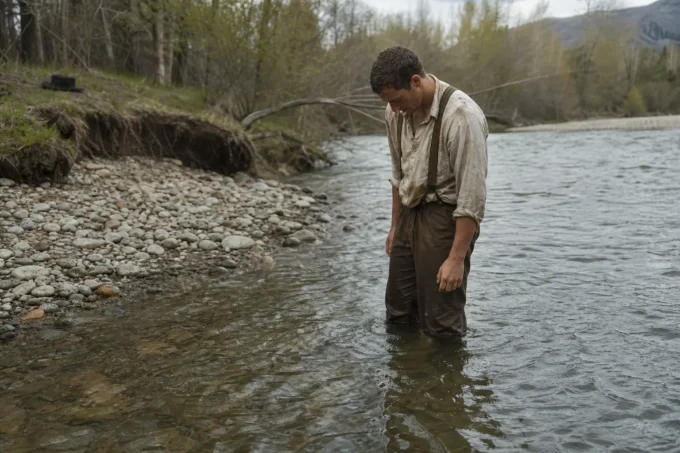
Morrison gets up at midday and walks to the river and stands in it up to his knees, fully clothed, and lets the cold water rinse the lice off his legs, and then he comes back and sits down again without a word. You watch him and you think about people back east who sleep in beds with clean sheets and think a single mosquito in the room at night is a hardship, and you almost laugh, and then you do not, because the laugh would cost you energy you need for the next mile.
The Night the Fever Rode In
The complication comes the night the wind drops. You have been lucky, and you know it, and luck always has a bill. The weather turns still and hot in the late afternoon, the kind of still heat that the mosquitoes love, and by sundown they come up out of the river bottom in a cloud so thick it dims the light. You build the smoke fire high, but there is no wind to carry the smoke, and it hangs and does not screen, and the children cry against you in the dark while the mosquitoes whine in their ears and your hands are not enough to cover all of them at once.
By morning the youngest boy is sick. He burns hot and he shakes and he cannot keep water down, and Hannah sits with him in the wagon with a wet cloth while you and Sam stand outside and do not say the word that is on both your tongues. You do not know if it is the fever the insects carry, or only the flux and the heat and the exhaustion of a five year old who has marched six weeks, and the doctor ahead at Fort Laramie will tell you later that it might have been either, or both. That is the cruel part. You fought the small enemies for weeks and you still cannot say whether you lost this round to them or to plain bad water under a hot sun.
The boy lives. That is the mercy you hold onto. He turns a corner the second day, thin and gray, and Hannah feeds him a little broth and the color comes partway back. You do not sleep well that night, and for a long time after you do not sleep without waking once to listen to his breathing in the dark, the way a man checks a locked door. You just want to sit down, and not scratch, and not count the welts, and drink one long swallow of a moment that does not have to be defended.
The next morning you oil the harness under the wagon and Sam comes and squats beside you and picks a tick off the back of your neck, gently, and flicks it into the dirt. He does not say anything. That is the whole conversation, and it is enough, and you take the small kindness the way a thirsty man takes water, because out here the small kindness is all there is to give.
What Was Real
Insects and external parasites were a constant, grinding reality of the overland migration, documented in almost every surviving diary from the trail. Mosquitoes bred in the river bottoms and the oxbow sloughs along the Platte and its tributaries and came out in genuine clouds at dawn and dusk, so thick that emigrants wrote of breathing them in and of the cattle stampeding through the torment of biting flies and gnats. Flies so harassed the draft animals that parties sometimes halted in midday heat simply to give the teams a rest from the insects, a delay that cost miles.
The biting insects of the plains included several distinct kinds: true mosquitoes, buffalo gnats (black flies), horseflies and deer flies that swarmed the livestock, and ordinary house flies and biting stable flies. Ticks were abundant in the grass and sagebrush and were picked off people and animals daily. Lice, carried from the start or acquired on the trail, thrived in the unwashed wool and cotton clothing of the emigrants, and fleas lived in the straw bedding and in the coats of the dogs that accompanied many families. The itch and the welts were so universal that they became a standing observation in trail letters rather than a complaint worth dwelling on.
The meager defenses emigrants actually used come straight out of period accounts. Smoke was the most common mosquito repellent, produced by smoldering fires of green wood, wet brush, and buffalo chips, and built so that the smoke drifted downwind over the camp. Mud was applied to bare skin and to the flanks of horses as a physical barrier. Clothing and bedding were boiled when fuel and water allowed, and seams were picked over by hand to crush lice and their eggs. Grease mixed with bitter or aromatic herbs, including wild mint and wormwood, was rubbed onto skin, a practice that sat somewhere between folk medicine and genuine mild deterrent. Bonnets, veils, and long sleeves were the last line, and many women and children traveled veiled against both sun and insects.
The fevers carried by insects were real but poorly understood. Emigrants did not connect the mosquito to specific disease in the modern sense, and the great killer on the trail, cholera, spread chiefly through contaminated water rather than through insects. What they did understand was that the insects could carry some febrile sicknesses, and they called the resulting chills and fevers by loose names. A child who fell ill with fever, stomach flux, and prostration might be suffering from cholera, from dysentery, from typhoid, from a malarial-like fever, or from simple exhaustion, and the emigrants could rarely tell which it was. Diarists frequently wrote the same resigned conclusion: the sickness came, and it either spared the family or it did not, and they seldom knew the true cause.
The broader context puts this misery in scale. Between roughly 1841 and 1869, around 400,000 people crossed the plains to Oregon, California, and Utah in the great overland migration. The journey covered roughly two thousand miles and took four to six months, most of it walked on foot beside the wagon, so the emigrants lived in their own clothing and bedding for months on end, washing rare and shallow. Cholera remained the single greatest cause of death on the Oregon Trail, but the everyday erosion of comfort and sleep came just as often from the small enemies, the lice and fleas and ticks and the endless whine of mosquitoes, a war nobody won and everybody was forced to live inside.