
The Sky Turns Green
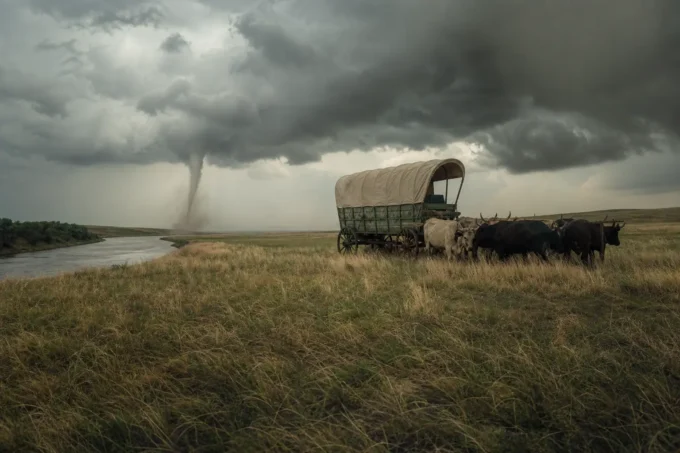
Late afternoon, June 1849. Somewhere on the Platte, two days east of Fort Laramie. You are walking alongside the wagon to save the oxen from your weight, and the first thing you notice is that the wind has stopped. The grass goes still all at once, the way a room goes still when someone who talks too much finally walks out. The air smells like wet iron and crushed sage, and it presses on your ears. Sam, your brother-in-law, stops the oxen and stands with his head tipped back. He says one word, soft, like he is telling himself a bad secret. “Green.”
You look where he looks. The whole western half of the sky is the color of a fresh bruise, a green so dark it is almost black at the bottom, and it is rolling toward you faster than the oxen can walk. The hairs on your forearms stand up. Thomas, the boy, tugs your sleeve and asks if that is a mountain coming. Morrison, who has not eaten in two days and has been lying flat in the wagon with the flux, hauls himself up on one elbow and croaks that he has seen this before, in Missouri, and that the last time it happened a man he knew had a piece of hail the size of a horse’s skull go through his wagon top.

The Problem
There is no hiding from this. You are on the open prairie with nothing taller than the wagon and the river behind you, and the river is the last place you want to be when the sky opens. The storm is bringing three things, and each one of them can kill you in a different way. The wind will try to tip the wagon. The hail will try to stove in the wood and break the oxen. The lightning will burn whatever the other two leave standing. You have maybe ten minutes before the first gust hits, and the prairie gives you nothing tall to stand against it.
You think briefly about the people back east, sitting in kitchens with tin roofs and cellars and church bells to warn them. Then you watch a dust devil spin up off the riverbank and shred itself, and you understand something about this country that no amount of bread without weevils would have taught you. Out here the weather is not a nuisance. It is the other predator, the one that hunts the whole party at once.
What You Do
You start moving before you finish thinking. The first thing you do is pull the oxen out of their yokes and drive them to the lowest ground you can see, a shallow draw that runs east one hundred yards from the wagon. You tie their heads to a stake pounded deep, and you do not unhitch them one at a time with a song the way you might on a calm morning. You work fast and silent, and the rope burns your palms.
Sam aims the wagon box into the wind, because a broadside gust rolls a wagon and a head-on gust only shoves it. You both drop the tongue and set the brake, then chain the wheels to the heaviest thing you carry, the spare axle and the water casks. Morrison, swaying, helps you pull the canvas tight and lash every loose end. You take the cooking iron and the knives out of the box and put them in a sack, because a flying skillet in a storm cuts like a thrown axe.
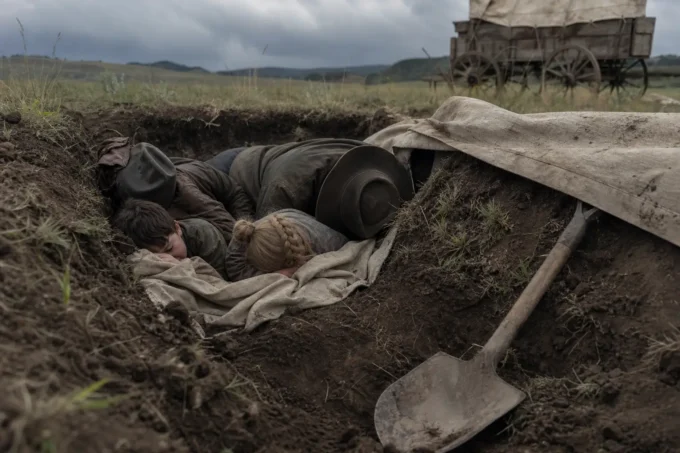
Then you make the call nobody wants to make. You do not stay in the wagon. A wagon is a sail in a windstorm, and in a lightning storm it is a tall dry box on a river flat. You dig. You grab the spade and cut a trench three feet wide and two feet deep in the slumped bank of the draw, down below the lip, and you pull the canvas and the oilcloth over it. You put Hannah and Thomas and Morrison down first, flat in the bottom, and you and Sam lie on top of the cloth with your backs to the sky, tucking the edges under your bodies. The last thing you do is shove the boy’s head under your arm and tell him that the thunder is only the sky clearing its throat.
The Storm
The first gust arrives as a wall of dirt you can taste, grit in your teeth and sand under your eyelids. Then the hail. The first stones are the size of your thumb and they sting through the oilcloth. Then they come bigger, and every strike is a rifle butt on your back. One stone the size of a hen’s egg splits the oilcloth over your shoulder and you hear Hannah’s sharp breath under you. The oxen scream once, a sound you have never heard an ox make, and then they go silent. You do not raise your head to look. You count the seconds between the flash and the thunder to keep yourself from doing it: the storm is close enough that you get to two before the sky cracks, and the hair on your neck stands straight up from the lightning charging the ground around you.
Morrison starts to pray, and it is the wrong kind of praying, the kind a man does when he has already decided the ending. You reach over and press his shoulder down and tell him to keep his mouth shut and his body flat. Hannah is pulling Thomas against her chest, and the boy is crying without sound, the way children cry when the fear has gone past noise. You think about the oxen and you push the thought away, because there will be time to count losses when the sky finishes.
The next sound is the wind turning, a roar that moves around you like a living thing deciding where to go, and in the middle of it you hear a sound like a rope being pulled tight through a man’s throat. The wagon. The chain on the wheels holds, but one of the canvas bows snaps clean and the loose canvas whips out flat and tears away. You watch what you cannot help watching, and then you put your face down in the dirt and wait.
The Aftermath
It passes the way these storms pass, sudden and complete, and then there is nothing but the hiss of hail melting on the hot ground and the drip of water off the grass. You stand up and your knees nearly give. Your back is a map of bruises. The draw is full of mud and hailstones still the size of a child’s fist, and the whole stretch of prairie is white with them, like a frost in June that you do not believe until you pick one up and feel it burn your palm.
The wagon is still upright, which is more than you expected. One bow is broken and the canvas is gone and water stands half an inch deep in the box. But the axle held and the wheels are on and the spare iron is where you chained it. The oxen did not fare so well. Two of them are dead where they stood in the draw, struck down and cold, and the third is on its side with a gash along one shoulder from a hailstone you do not want to look at too long. You have four oxen for a wagon that needs a full yoke, and the nearest thing you can trade for a replacement is two days west at Fort Laramie, if the trail is still passable, if the next storm holds off.
Hannah walks over without a word and starts picking hailstones out of the wet canvas, laying them in a row to melt. Thomas stands beside her with his mouth open, staring at the dead oxen. Morrison crouches by the draw and is sick, which at least means he is alive to be sick. None of it feels like a victory. You just want to sit down on the riverbank and not think about tomorrow.
Sam is the one who says it, finally, when the sun comes back out low and orange through the mud and the steam. He looks at the dead oxen and the torn wagon and the white ground, and he says what you are all thinking. “Least we weren’t in the wagon.”
You do not answer. You start picking up what is left, because that is all there ever is to do after the sky has had its turn, and the light is going, and there is still a fire to start on the wet wood.
What Was Real
Prairie thunderstorms on the Great Plains were a genuine and deadly hazard for emigrants traveling the Oregon Trail between 1841 and 1869, when roughly 400,000 people made the 2,000-mile crossing. The flat, treeless country of the Platte and North Platte valleys offered almost no cover, which is why travelers described storms there with a particular helplessness.
The green-black color of an approaching thunderstorm is real and well documented. It comes from the storm’s interior scattering light through enormous quantities of water and hail, and it has long been read by plains people as a warning sign of hail or a tornado.
Hail storms were among the most feared events on the trail. Surviving diaries and letters routinely describe hailstones as large as a man’s fist, and there are credible period accounts of hail killing livestock outright, breaking wagon bows and canvas, and injuring people who had nowhere to take shelter. In open country, emigrants hunkered in low ground, under wagons, or wrapped in buffalo robes and bedding, since a wagon itself offered no protection against large hail and was a risk in strong wind.
Lightning was another constant danger, and frightened or injured oxen and livestock were common storm casualties even when the people escaped harm. Losing a draft animal far from a trading post was a serious economic and survival event, because a wagon could only move as fast and as far as its team could pull it.
The practice of chaining or roping down wagon wheels and lashing loose cargo before a high wind was standard frontier routine. Wagon boxes and tarps acted as sails, and broadside gusts were known to roll wagons and scatter possessions across the prairie.
Tornadoes occurred on the plains then as now, and the Oregon Trail region sits within what would later be called Tornado Alley. Period accounts and newspapers recorded tornadoes on the frontier, and the storms terrorized travelers precisely because the landscape offered no cellar, no stone wall, and no substantial tree line to hide behind.
The term “hail” is old English in origin, and “blizzard” would only be applied to a snowstorm on the American plains later, in the 1870s, drawing on an earlier sense of a sharp volley or blow. The emigrants had no such tidy word for what they faced out on the open ground. They described it in letters and diaries the same way people out there describe it still: the air goes still, the western sky turns green, and then everything you own and everyone you love is standing out in the open when the world decides to fall on you.