
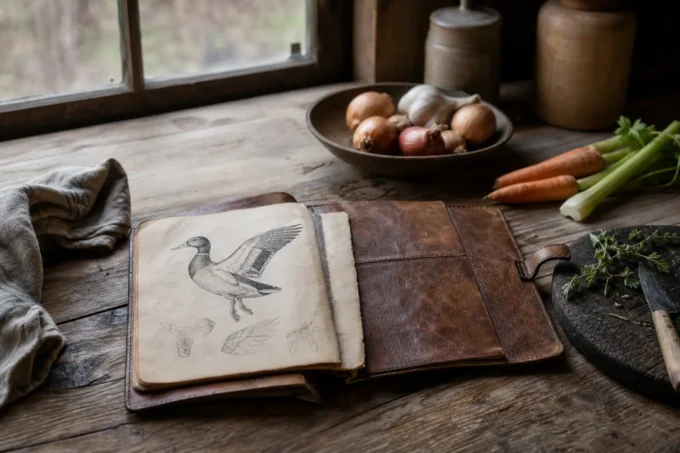
The page after the softshell is chipped on one edge, and the corner itself is gone, torn away years back like somebody needed a clean place to wipe a knife. What’s left of the word at the top is drawn in heavy ink, pressed deep enough that it near cut the paper, and all I can make out is the last half of it. Under that, in the same hard hand, is a drawing of a bird stretched out full length, head pulled back, and what I’d swear is a wing held open so you can see every quill. It isn’t the coot. There’s no talk of mud or ponds anywhere on the page. This one is a duck, a wild one, and Amos wrote the whole thing like a man settling an old argument about which bird is worth the powder and which one you let the dogs have.
Amos’s note in the margin, underlined hard: “a duck aint all the same bird. the white man pays money to the market for what a man with a shotgun can jest walk out and git. but you got to know which duck you shot and how long ago, or you’ll cook him wrong and blame the bird.”
Recipe No. 15: Wild Duck (Or, How Not to Ruin a Good Bird)
The Bird
Amos shot mallards mostly, the green-headed kind that come in over the river at first light, because they’re the biggest and the easiest to pick clean for the pot. A duck’s trouble was never the shooting. It was the fat and the blood and the hundred little feathers that hide under the skin and come loose the second you think you’re done plucking. His page opens on the bird itself, whole, the drawing’s wing held flat so you can count the primary feathers, and the first instruction is the same one he wrote under his coot page: know what you’re cooking. A duck that’s been lying a day in warm weather ain’t the same meal as one cleaned at the water’s edge.
- Pluck while the bird is still warm if you can, then singe the pinfeathers over a low flame
- Strip every bit of fat from inside the cavity, because duck fat holds whatever the bird was eating
- Cut out the oil gland at the base of the tail first, before you do anything else
- Wash the cavity cold and let the bird hang in a cool place overnight, not in the sun
That oil gland is the secret the market cooks don’t tell you. A duck carries a hard little button at the top of its tail that holds the oil it spreads over its own feathers, and if you leave it and cook the bird whole, the whole pot turns rank. Cut it out clean with the point of a knife, take the fat from inside, and half the work of making a wild duck taste wild is already done.
Amos’s second note, under the picture of the wing: “cut that knot off his hind end fore you do anythin else. leave it and you’ll swear the bird aint fit to eat when he was the best thing that crossed that river all week.”
Cooking It
A wild duck is lean and dense, nothing like the fat farm bird from the store, and Amos cooked his slow and covered so the meat would give up easy and not dry to leather. His page keeps it simple, the way a man feeding six kids keeps things simple:
- Brown a whole duck, breast down, in bacon grease in a heavy pot
- Turn it and brown the back, then pour off the grease
- Add an onion cut in quarters, a carrot, a stalk of celery, salt, and black pepper
- Pour in water to come halfway up the bird, cover, and let it go low and slow for two to three hours
- When the leg wiggles loose at the joint, the bird is done
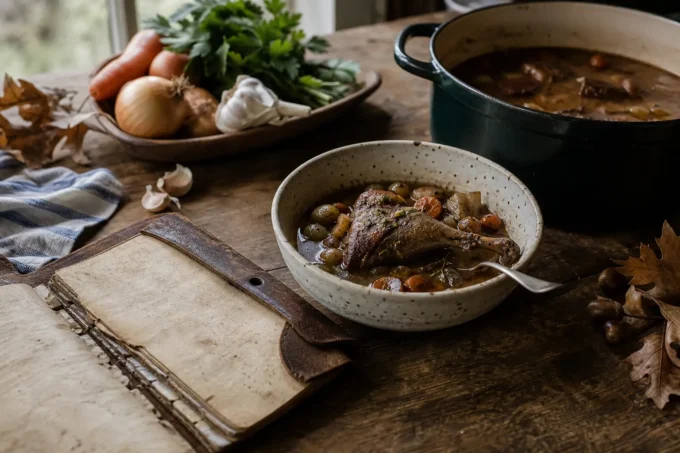
Serve it whole on a platter with the pot juice spooned over top, or pull the meat and put it back in the gravy over cornbread. The breast will be dark and tender from the slow cook, not pink the way the fancy cooks serve a duck, because Amos’s people wanted the meat to fall off the bone and fill a bowl, not sit pretty on a plate for a man to fight with a knife.
What It Actually Tastes Like
A wild duck done this way tastes like the place it came from, and that’s the whole point and the whole warning at once. A mallard off a river bottom is rich and dark and earthy, a little sweet if he’s been eating pin oak acorns in the fall. The slow pot calms it down and turns it soft, and the gravy carries whatever he fed on. It’s the opposite of a fried softshell or a white-boiled gar, and it’s a meal that wants cold weather and a full table, not a quick lunch off the truck tailgate.
Practical Notes
- Know your bird and your bag limit. Duck season, species, and daily numbers are all written plain, and the game warden that meets you at the boat ramp has read them close.
- Take the oil gland and the cavity fat out cold, before the bird ever sees the pot. This single step is the difference between a good duck and a rank one.
- Pluck it warm and singe the rest. Pinfeathers go loose when the bird sits, and chasing them is a half hour you’ll never get back.
- Slow and covered beats hot and fast on a wild duck every time. Lean wild meat needs time and steam, not a hard fry.
Amos’s last line, written in pencil at the bottom of the page, small and steady: “a man that throws out the duck fat and says the bird aint worth cookin jest dont know what his own pot can do. render that fat to a spoonful and you’ll keep it in a jar all winter and eat better than the man that paid cash for a chicken.”
Next from the folder: the next page is stained in the shape of a wide shallow pot, and through the smudge I can make out the tail end of a word drawn in the same hard ink, and a long line that runs off the edge of the paper like somebody started drawing something with a fin on it.
