The Horse Hasn’t Passed Water in a Day and the Next Grass Is a Hundred Miles West
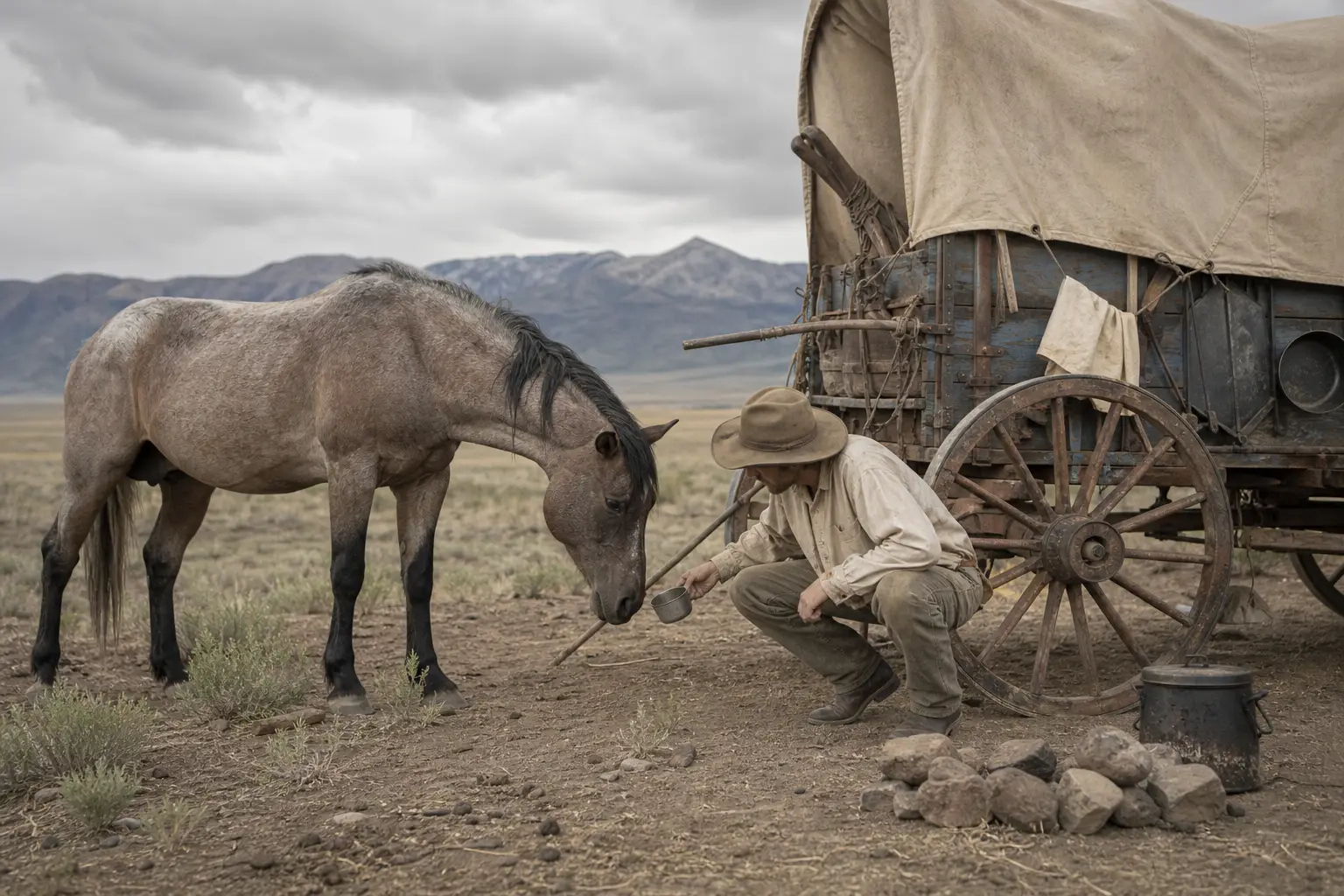
Late June, 1849. Two camps east of the Sweetwater crossing, where the grass runs thin and gray and the wind never quite stops smelling like dust. You wake because the sound you have slept beside for a thousand miles has gone wrong. It is not the rattle of the halter chain or the wet pull of a horse cropping grass. It is silence, and then a low, wet groan from the roan gelding tied to the wagon wheel.
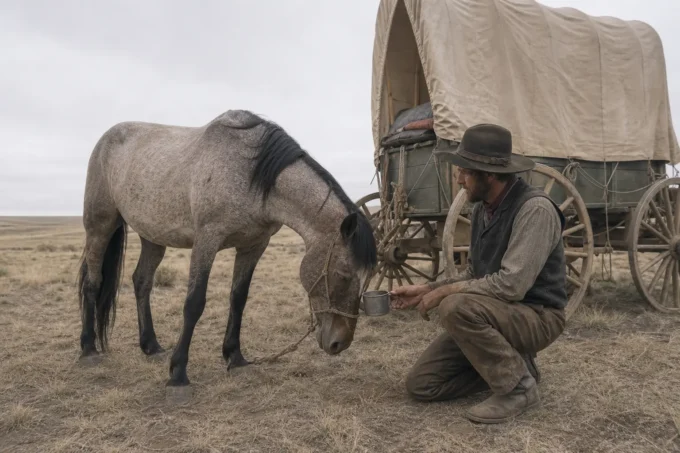
He stands with his head down and his lips pulled back, staring at the ground the way a man stares at a wall. Sam is already up, holding a tin cup of water under the horse’s nose. The horse looks at it and turns his head away. That is the worst sign you have learned to read, and it took weeks of ignoring smaller ones to learn it. A horse that will not drink is not tired. A horse that will not drink is in trouble, and on this ground, trouble is a thing you carry alone.
Morrison, three weeks in the ground now, once told you the only livestock doctrine worth keeping: a horse is not cattle. Cattle you can starve a day and they forgive you. A horse has a gut like a fine fiddle, and it breaks over things a steer would eat and forget. You did not believe him until this morning. Now the roan groans again, and you hear the word colic in Sam’s mouth before he even says it, and you both know what it means out here where the nearest veterinarian is a man who is not here.
You do not want to end up like Morrison, who rode a horse that foundered on the alkali flats and kept pushing it because the fort was only twenty miles. The horse went down at fifteen. Morrison walked the rest and drank bad water and the flux took him while you were still learning his name for certain. Every decision on this trail runs on that same arithmetic: the animal is the engine, and there is no spare.
The Problem Rises While You Watch
The roan kicks once at his own belly, a soft, terrible thing, and then stands shivering. Colic on the trail comes from the same three places every time: too much green feed after too little, water that is wrong in some way you cannot always see, or work on a gut that never fully got empty. The horse has been eating the coarse dry grass of these high flats, and yesterday you let him graze too long on a patch of new green shoots along a seep, thinking fresh grass was a gift. Now his gut is a knot, and you are a hundred miles from the next decent pasture and further from any man who could help.
You drop to one knee and put your ear against his flank, below the last rib. The gut should be a quiet, wet, moving country. What you hear is silence, and beneath the silence a tight, high pressure, like a barrel straining. A horse’s gut can twist, and when it twists, the only mercy is fast. So the first rule is to know what you are looking at, and the first thing you do is walk him.
Because movement is the oldest medicine there is, and it costs nothing, and right now nothing is the only thing you own in abundance. You untie the roan and start walking him in a slow circle, and Sam walks beside you with the watch that Morrison left him, because Morrison said a man measures a sick horse in hours and minutes, not in hope.
The Work, Step by Step
You walk the horse for a full hour, a slow ring in the gray dawn light, and every few minutes you stop and press your ear to his flank again. It is not heroic work. It is the dull, patient work of a man keeping an engine alive by not doing the thing that would feel good, which is to hurry. After twenty minutes the gut gives one wet, promising sound, like water turning over in a deep jug.
You do not let him eat. That is the hardest part, because the horse keeps trying to pull you toward the short grass, and your hands want to let him, because letting him eat feels like kindness. It is the exact kindness that kills him. Green feed on a blocked gut is fuel on a fire that has already started, so you lead him in a figure that never gets near a bite of green, and Sam walks the other side carrying the halter rope loose, and neither of you speaks.
Water comes next, and you make it particular. You do not offer the standing water from the barrel, because the barrel has sat through a day of wind and dust and holds the warm, flat taste that makes a sick gut worse. You send Hannah for a fresh bucket from the creek, and while she is gone you wet a rag and wipe the roan’s muzzle and let him lick the moisture from your palm first, the small way, before any real drinking. A horse that drinks too much too fast on a colic gut will founder on top of the colic, and then you have two disasters for the price of one.
Hannah comes back with the bucket, and you offer it a mouthful at a time, pulling it away after each swallow. The horse drinks three small sips and stops. It is not much, but it is something, and out here something is the whole difference between a horse that lives and a horse that is buried before noon.
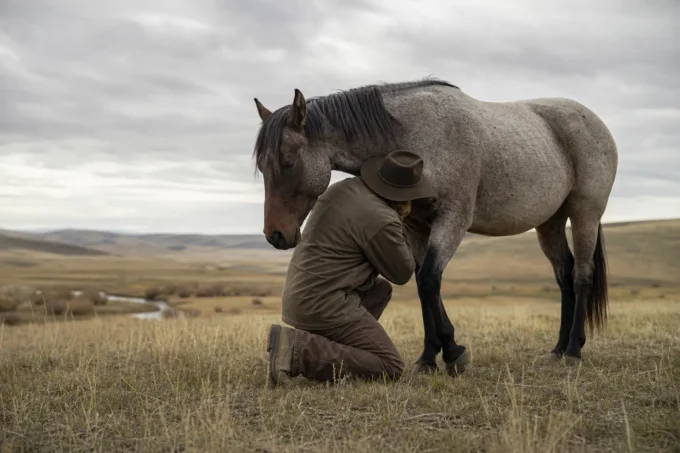
Then you do the thing Morrison told you to do and that you hoped you would never have to: you feel for the place. You run your hand along the roan’s side, and after the walking and the water, the taut, hard barrel has gone a little soft. The horse turns his head and nuzzles your shoulder, and that is the first good sign in a day, and you let out a breath you did not know you were holding.
The Human Dimension
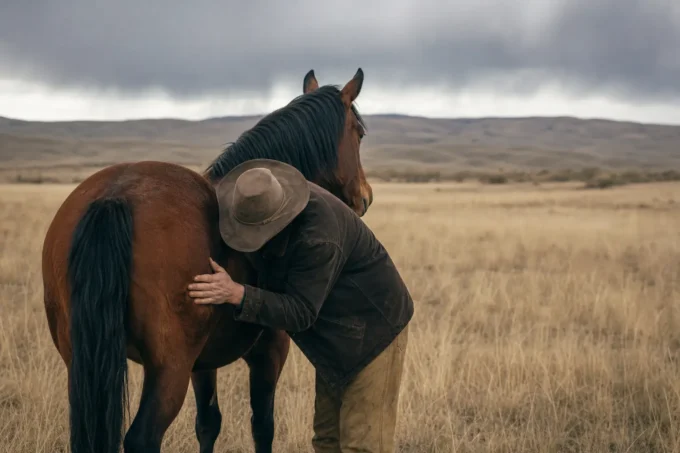
While you work, the rest of the camp does the small, unasked things that keep a trail family from coming apart. Hannah has the two boys sorting the gear that does not need to be on the wagon, because if the horse does not travel today, something else has to be left, and deciding that is quieter when done ahead. The youngest boy keeps glancing at the roan and then at you, and finally asks, in the careful voice he uses when he is afraid of the answer, whether the horse will be able to carry them. You say yes, because you have to, and because in this moment you are not lying so much as promising a thing you have no right to promise.
Sam walks over with two dry strips of jerky and hands you one. He does not say anything about what you are doing with the horse, because there is nothing to say, and because Sam is the kind of man who tells you he agrees with you by standing next to you and saying nothing at all. The dog lies down in the dust with his head on his paws and watches the roan the way dogs watch things that are about to decide something.
You think, briefly, about people back east eating breakfast out of clean bowls, with a stable around the corner and a man whose whole trade is horses. It is not envy. It is just the odd, dizzying fact of how big the country is, and how much of a horse’s life is carried by the hands of whoever happens to be standing there when the gut knots.
The Complication That Is Not the Worst But Is Real
The colic turns just before light fails, and it turns in the direction of a different kind of trouble. The horse passes water at last, a long, painful, relieving stream, and you feel the gut go slack under your hand. But he has been off his feed for most of a day, and a horse that missed a day of grass on this country is a horse that is now short a day of strength you cannot give back. The load has to lose something.
So you stand with Sam and Hannah in the failing light and do the arithmetic of what comes off the wagon. A barrel of salt, half a sack of flour, the good iron skillet that has cooked every meal since the Missouri. You bury the skillet under a flat stone not because you want to, but because iron can be left and a horse cannot, and out here every pound is a decision between the animal and the rest of your life. In the morning the roan walks, slower than before and with his ears forward, and that is enough, and it is also not enough, and you know both things are true at once.
You are not victorious. You just want to sit down.
What Was Real
Colic was, and remains, one of the most feared conditions a horse owner could face, and on the overland trails it was a quiet killer hidden inside the larger death toll. Roughly four hundred thousand people crossed the Oregon, California, and Mormon trails between 1841 and 1869, and their wagons and lives ran on horses, mules, and oxen. Horses were the most fragile of the three, prized for speed and often ridden rather than merely driven, and their digestive systems were built for continuous grazing on high-fiber forage, not for the sudden green feeds, coarse dry grass, alkali water, and heavy work the trail forced on them.
Colic is not one disease but a symptom meaning abdominal pain, and it has three broad causes a trail traveler would have recognized in practice: impaction, where dried or coarse feed blocks the gut; gas or spasmodic colic from irregular feeding or bad water; and the fatal torsion or twist, where a loop of gut winds on itself and cuts off its own blood supply. The first two could sometimes be walked off, exactly as the story shows, because gentle, steady walking stimulates the gut and can move a blockage or release gas. The twist could not, and a twisted gut meant death without a surgeon, which on the trail meant death.
The daily arithmetic of horse care was unforgiving. A working horse needed roughly twenty to thirty pounds of good forage a day and ten to fifteen gallons of water, more in heat or under a load. Feeding too much green grass after a fast, or watering too much too soon after hard work, were well-known ways to founder a horse or set off colic, and trail guides of the period repeated the warning that a horse should be cooled and given water slowly, in small draughts, after hard travel. The practice of walking a colicked horse, withholding feed, and offering water in small amounts is exactly what emigrant-era horsemanship prescribed, and it survives in modern veterinary first aid because the underlying principle, keep the gut moving without overloading it, has not changed.
The word colic comes from the Greek kolikos, meaning suffering in the colon, passing through Latin colica into English. Foundered, the term used for the laminitis that followed overheating, overwork, or cold water on a hot horse, is an old and painful word for a horse that has gone lame in its feet. Morrison’s warning that a horse is not cattle carries a real truth: oxen were the preferred draft animals of the emigrant trains precisely because they were cheaper, hardier, ate rougher forage, and could be eaten if they failed, while a horse was a more valuable, more tender, and harder-to-replace animal whose loss cost both money and, very often, heart.