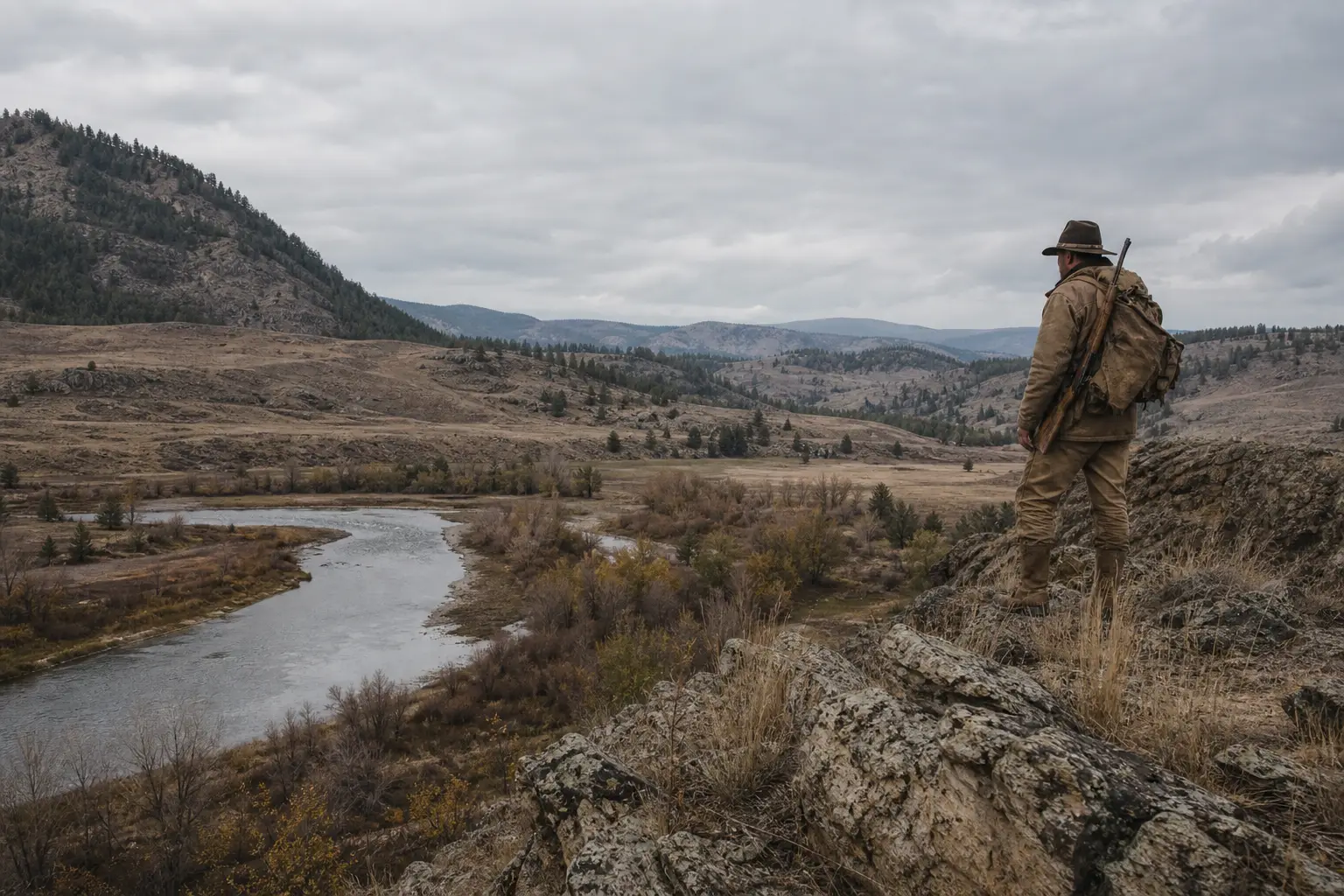
When the first humans walked into North America roughly 15,000 years ago, they walked into a continent absolutely stacked with game. Mammoths, mastodons, giant bison, saber-toothed cats, camels, horses, ground sloths the size of a small car. If you could throw a spear, dinner was basically everywhere. And for a while, that’s exactly what happened.
Then most of the megafauna disappeared. Nobody is entirely sure why — climate shift, human hunting pressure, or some combination of the two. What’s left is a continent full of animals that learned to be fast enough, mean enough, or smart enough to survive. And hunting them became the story of America.
The Original Stewards
For thousands of years before any European showed up with a musket, Native Americans hunted in ways that make modern hunters look like amateurs. Not because they had better gear — because they had no other choice. Hunting wasn’t a hobby or a weekend activity. It was food, clothing, tools, shelter, trade goods, and spiritual practice all rolled into one.
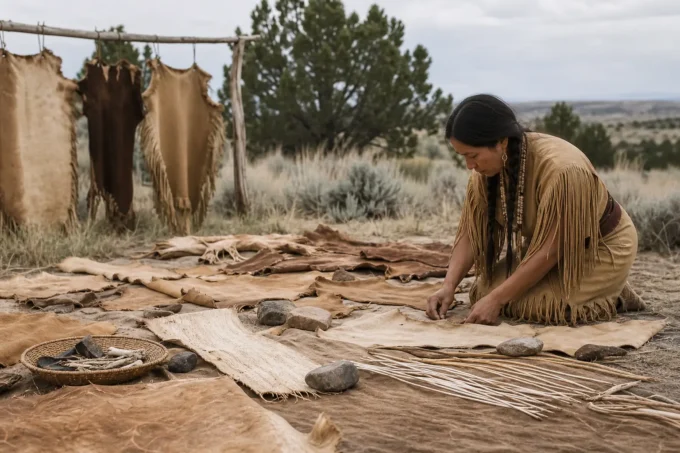
On the Great Plains, the Lakota and Cheyenne ran buffalo jumps — herding bison toward cliffs at a full gallop, using every part of the animal. Meat for months. Hides for tipis. Bones carved into tools. Sinew into bowstrings. Nothing went to waste because nothing could afford to.
In the Eastern Woodlands, the Iroquois stalked deer and bear with bows made from hickory, taking maybe 10 to 20 deer per hunter per year. On the Pacific coast, the Makah paddled cedar canoes into open ocean to harpoon gray whales weighing up to 60,000 pounds — a single whale feeding a village for months. In the Southwest, the Ancestral Puebloans caught rabbits by the dozen using nets woven from yucca fiber.
Here’s something most people don’t realize: many tribes practiced what we’d now call wildlife management. The Nez Perce timed their salmon harvests so precisely that runs stayed strong for centuries. Some tribes used controlled burns to create edge habitat — the same thing state wildlife agencies do today with a prescribed fire crew and a budget meeting. They were doing this before anyone had written down the word “conservation.”
The Colonial Hustle
When Europeans arrived, everything changed — fast. The relationship between hunter and animal shifted from survival to commerce, and the scale was staggering.
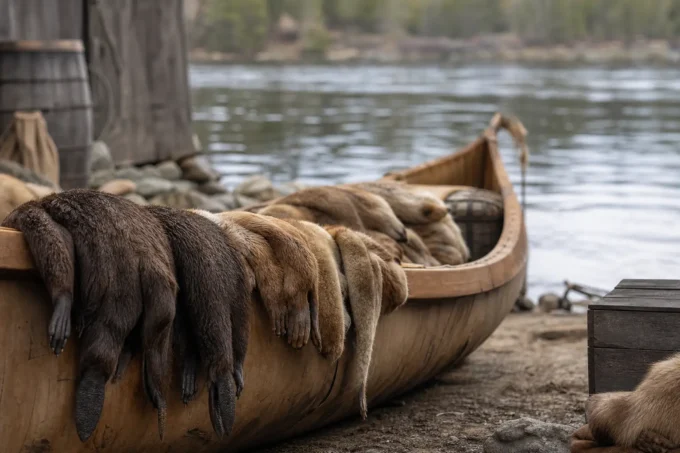
Beaver felt hats became the fashion rage in Europe, and suddenly the humble beaver was the hottest commodity in North America. By the mid-1700s, 20,000 to 40,000 beaver pelts were shipped across the Atlantic every single year. Massachusetts actually had to ban beaver exports in 1650 just to save the last few animals in the colony. Imagine a state government today banning the sale of something because it was about to disappear — that’s how bad it got.
Deer didn’t fare much better. Virginia alone shipped 30,000 deerskins annually by 1700. Maryland had a law letting people pay debts with 200 pounds of deer hides. That’s right — deer skins were literally currency. A guy could settle his tab with a stack of hides.
The deerskin trade also created an unexpected dynamic: Native Americans became some of the most prolific commercial hunters of the era. They weren’t just hunting for themselves anymore — they were supplying a global market, trading skins for European goods including guns, which in turn made them even more efficient hunters. It was a feedback loop that nobody really controlled.
The Passenger Pigeon: Billions to Zero
If you want to understand how fast things can go wrong, the passenger pigeon is the story.
In the early 1800s, the passenger pigeon was likely the most numerous bird on Earth. Estimates range from 3 to 5 billion individuals. Flocks were so massive they literally darkened the sky for hours — sometimes days — as they passed overhead. Witnesses described the sound as a continuous roar, like a waterfall. When a flock settled to roost, the weight of birds would snap tree branches clean off.
People said it was impossible to hunt them to extinction. The numbers were simply too vast. And for a while, the market treated them accordingly. In Philadelphia, passenger pigeons sold for a penny each. In 1878, professional hunters in Michigan netted 7.5 million birds from a single nesting site. Chicago received 1.8 million pigeons in 1871 alone, shipped in by rail and sold as cheap protein.
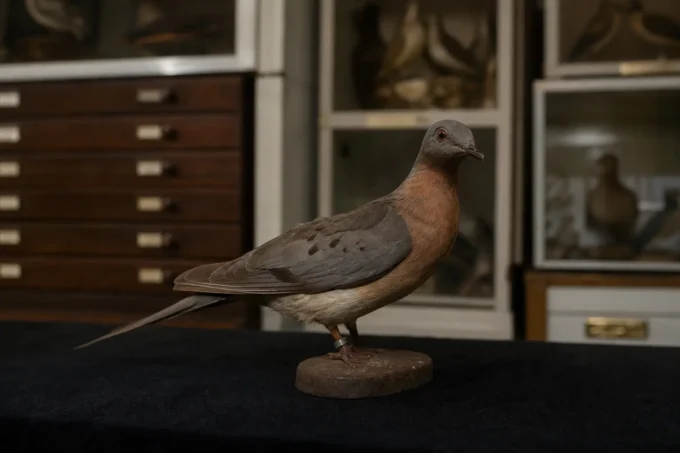
But the combination of relentless market hunting, railroad expansion (which let hunters reach every nesting colony), and deforestation (which destroyed their breeding habitat) was more than even billions could survive. By the 1890s, the massive flocks were gone. The last wild passenger pigeon was shot in Ohio in 1900 by a kid who didn’t even know what he’d hit. The very last one, a female named Martha, died in the Cincinnati Zoo on September 1, 1914, at 1:00 PM.
A species that went from being the most abundant bird on the continent to completely extinct in roughly 50 years. Martha’s stuffed body is still at the Smithsonian. There’s a small plaque next to her that says simply: “Extinct.”
The Bison: 30 Million Down to 23
If the passenger pigeon is the cautionary tale nobody saw coming, the American bison is the one people watched happen in real time.
In 1800, an estimated 30 to 60 million bison roamed North America. Their herds stretched from horizon to horizon on the Great Plains. Native tribes had hunted them sustainably for thousands of years, using every part of the animal.
Then came the railroads. The transcontinental railroad didn’t just open the West to settlement — it opened it to market hunting on an industrial scale. Trains would stop to let passengers shoot bison from the windows. Not for food. For sport. The carcasses were left to rot in the sun.
Professional hide hunters took it even further. A guy named Buffalo Bill Cody — yes, that Buffalo Bill — personally killed 4,282 bison in 18 months while working for the Kansas Pacific Railroad. In 1872 alone, 1.5 million bison hides were shipped out of Kansas. The army encouraged the slaughter as a strategy to starve Plains tribes into submission, since bison were their primary food source. It worked on both fronts.
By 1889, there were fewer than 1,000 bison left in all of North America. By the early 1900s, the wild population bottomed out at 23 animals in Yellowstone National Park — the last wild herd on the continent. Twenty-three. That’s not a typo.
What saved them was a weird mix of private ranchers who’d captured small herds, a handful of conservationists, and the U.S. Army patrolling Yellowstone. Today there are about 500,000 bison in North America, though most are on private ranches and only about 20,000 are considered truly wild and free-ranging. The Yellowstone herd now numbers around 5,000, which is genuinely miraculous considering the 23 they started from.
The Sportsmen Who Saved What Was Left
Here’s where the story takes a turn that surprises a lot of people. The same community that had been killing wildlife at an industrial pace — hunters — became the driving force behind saving it.
In 1887, a young Theodore Roosevelt went to Montana to hunt bison. What he found instead were piles of bones and skinned carcasses. The experience radicalized him. He came back to New York and co-founded the Boone and Crockett Club, which pushed for what they called “fair chase” — the idea that hunting should involve actual effort, actual skill, and actual respect for the animal. No market hunting. No shooting from trains. No dynamiting streams for fish. (Yes, people used dynamite.)
In 1900, they got the Lacey Act passed — the first federal wildlife protection law in American history. It banned the interstate transport of illegally killed game. This was a big deal. Before the Lacey Act, a guy could poach deer in one state, sell the meat in another, and nobody could touch him. The law cut off the market.
Then came the Migratory Bird Treaty Act of 1918. This one banned the hunting of migratory birds without a federal permit and protected over 800 species. It was a direct response to the passenger pigeon disaster, and it’s still one of the strongest wildlife protection laws in the country.
The 11% Tax That Saved Everything
In 1937, hunters did something that sounds completely insane if you think about it: they asked the federal government to tax them. Specifically, an 11% excise tax on all firearms, ammunition, and archery equipment. The money would go directly to state wildlife agencies for conservation.
The Pittman-Robertson Act — also called the Federal Aid in Wildlife Restoration Act — passed with overwhelming support from hunters themselves. Since 1937, this single law has generated roughly $25.5 billion for wildlife conservation in the United States. Every box of ammo you buy, every rifle, every bow — 11% goes back into habitat, research, and species recovery.
Here’s a fact that makes anti-hunters uncomfortable: without hunters taxing themselves, most state wildlife agencies would barely function. In many states, Pittman-Robertson money plus hunting license fees make up over 75% of the wildlife agency’s entire annual budget. The animals that benefit most from this funding — white-tailed deer, wild turkeys, elk, waterfowl — are the same ones that hunters pay to chase. But the funding also protects hundreds of non-game species that share the same habitat.
Species That Came Back From the Edge
The white-tailed deer is the poster child for everything that worked. In 1900, there were roughly 500,000 whitetails left in the entire United States. Unregulated market hunting and habitat loss had pushed them to the brink. Today? An estimated 30 million. That’s a 60-fold increase. Some suburbs now have more deer than the entire country had in 1900. Whether that’s a success or a nuisance depends on how recently a deer ate your rose bushes, but from a conservation standpoint, it’s staggering.
The wild turkey tells a similar story. By the 1930s, wild turkeys had vanished from most of their original range — down to maybe 30,000 birds nationwide. Now there are over 7 million, in every state except Alaska. The recovery was largely funded by hunting license sales and Pittman-Robertson dollars.
Elk were once found across most of North America. By the late 1800s, they’d been wiped out east of the Mississippi and reduced to scattered pockets in the West. Today, thanks to hunter-funded reintroduction programs, there are over 1 million elk across the continent — including thriving herds in Kentucky, Pennsylvania, and Michigan, places where elk hadn’t been seen since before the Civil War.
Things You Could Do Then That You Definitely Cannot Do Now
Here’s the fun part — or the horrifying part, depending on how you look at it.
Shooting bison from a moving train. This was an actual marketed tourist activity in the 1870s. Railroads advertised “hunting excursions” where passengers could lean out the window and blast away at whatever moved. They didn’t even stop the train. The animals rotted where they fell.
Market hunting as a legitimate profession. From roughly 1700 to 1900, you could make a living by killing wildlife and selling it. Deer meat, duck meat, pigeon meat, bison tongues (a delicacy in eastern restaurants) — it all had a price. Professional market hunters were basically wildlife liquidation agents. They’d set up camp at a nesting site or migration route and kill everything they could until there was nothing left, then move on.
No bag limits, no seasons, no nothing. For most of American history, there were no hunting seasons. No tags. No limits. If you saw it and could kill it, it was yours. You could shoot deer in July. You could shoot does with fawns. You could shoot 50 ducks in a morning with a punt gun — basically a shotgun the size of a cannon mounted on a boat — and sell them all by lunch. Nobody stopped you because nobody had the legal authority to stop you.
Hunting for bounties. Many states and territories paid cash for killing predators — wolves, mountain lions, coyotes, even hawks and eagles. The idea was to protect livestock and game populations, but the result was the near-total elimination of wolves from the lower 48 states by the 1930s. Grey wolves were functionally extinct outside of northern Minnesota and a sliver of Montana. It took until 1995 — with the Yellowstone wolf reintroduction — for that to even begin reversing.
Sunday hunting bans. Here’s a weird one that still exists in a handful of states: you couldn’t hunt on Sundays. These “blue laws” date back to colonial-era religious restrictions, and they had nothing to do with wildlife management. Some states — Maine, Massachusetts, Connecticut — still have partial Sunday hunting bans on the books today. Not because of wildlife science. Because of church schedules in 1690.
How It Actually Works Today
Modern American hunting is one of the most regulated activities on the planet. Every state has its own wildlife agency that sets seasons, bag limits, permitted weapons, and harvest reporting requirements. These decisions are made by biologists, not politicians — at least in theory — and they’re based on population surveys, habitat assessments, and mortality data.
The system isn’t perfect. Chronic wasting disease in deer. Declining hunter numbers nationwide — from about 17 million in 1982 to around 15 million today, in a country with 100 million more people. Public access shrinking as private land gets posted. And the awkward reality that hunter-funded conservation needs hunters, but the broader culture is increasingly disconnected from where meat actually comes from.
But compared to where things were in 1900 — with whitetails almost gone, bison reduced to 23 animals, and passenger pigeons extinct — the North American system is the most successful wildlife conservation model on the planet. It’s funded by the very people pulling the trigger.
The guy who shot his last bison from a train window in 1883 probably didn’t think he was doing anything wrong. The guy buying his deer tag at Walmart today is funding the recovery of species that same era almost wiped out. History has a way of making things look simple in hindsight. The reality, as always, is messier — and a lot more interesting.