The Man Who Thought Fuel Was Fuel
Here is the thing I did not understand until a small fireball told me so. A Coleman stove and the little green canister stove in my garage are both called stoves. That is where the resemblance ends, and I spent twenty minutes learning the difference with my eyebrows in danger. I am the kind of man who reads the word “white gas” on a fuel can and thinks, gas is gas. I filled the tank from a jug of unleaded I keep for the mower, because an old man at the yard sale told me it would work, and because I wanted it to be true. It runs on unleaded, he said. He was technically right. He was also, in the way of old men who sell you things, leaving out the part where being right requires knowing what you are doing.
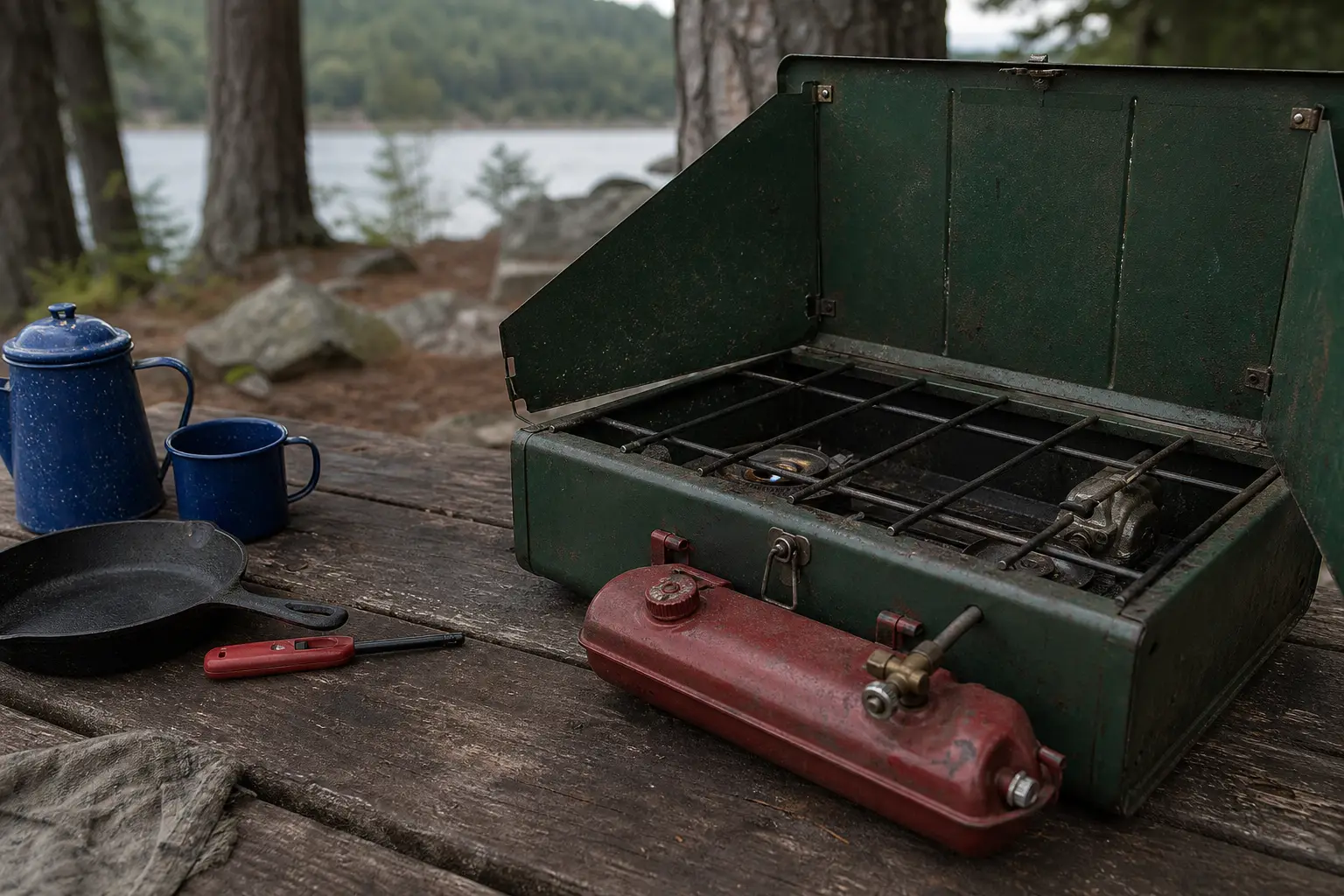
The stove was a gift to myself. A vintage Coleman two burner, the green suitcase kind, dented in three places and heavy like a toaster full of lead. I paid forty dollars for it. I felt like I had stolen it, the way you feel winning something you do not understand. A man at the sale said these last forever, you cannot kill them. I heard “you cannot break it” and I believed it, because buying a thing that does not break is easier than learning how the thing works. That belief is what put my hand over a burner while it went whoosh in a hard yellow wall.
The Pump That Does Not Pump Gas
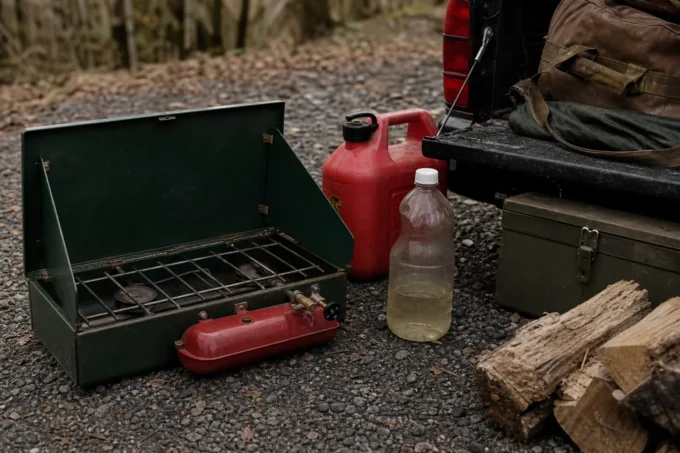
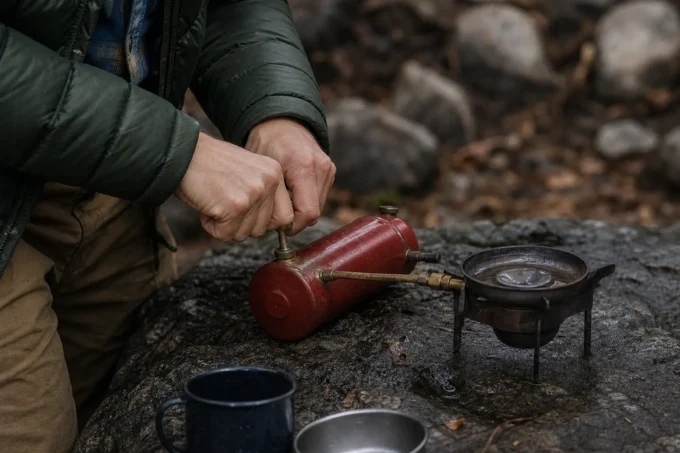
Here is what a real man would have done. Read the paper. Watched one video. Noticed that the little brass pump on the side of the tank is not filling anything and is not decorative. The pump builds air pressure on top of the fuel. Liquid fuel does not spray itself out of a tank like a lighter. It waits down at the bottom, and you hand pump twenty or thirty strokes to shove compressed air in there so the fuel climbs up to the burner. I did pump it. I gave it maybe six lazy strokes, because six feels like a number that matters, and then I opened the valve and flicked a lighter at the burner and waited for the pretty blue ring.
What came out was a weak brown dribble that smelled like the gas station. No blue ring. Just a wet sputter and a ring of raw fuel pooling in the burner bowl. So I did what an idiot does when the fire does not show up. I gave it more fuel. Open the valve a little further. Pump a little more. Flick the lighter again. In my head I was troubleshooting. In reality I was pouring gasoline onto a metal bowl and inviting it. The longer nothing lit, the more convinced I got that it needed more, and the more I poured.
The Part Where It Fired
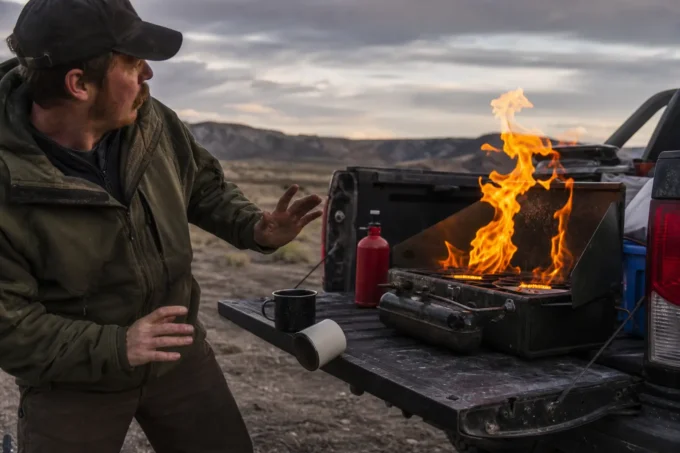
It finally lit all at once, the way a thing lights when it has been waiting. A fat yellow whoosh that came up and sideways and tried to climb my sleeve. I threw my hand back and knocked a coffee cup off the tailgate. The fireball rolled up and then settled down into a licking orange flame that did not look like any camp stove I had ever seen. It looked like a small angry grill that was mad at me specifically. The generator was still cold and flooding raw fuel, so the flame burned dirty and yellow and tall, and it was loud, and for a second I just stood there admiring the size of my own mistake while the enamel around the burner went black with soot.
Then it died back down to that weak dribble again, which was worse. A canister stove gives you a steady flame because the propane is already a gas pushing itself. A liquid fuel stove has to warm up first. There is a little tube called a generator that gets hot and turns the liquid into vapor, and until that tube is hot, the stove coughs and flares and acts like it is out to get you. I did not know a generator existed. I thought the thing was broken and I kept feeding it, and every time I fed it, it flared again, and every flare I read as proof the stove was a piece of junk and not, you know, me.
The Old Man Who Had Seen This Before
My neighbor Gary walked over about the third flare, holding a beer, watching me fight a stove like it was a raccoon. He did not say anything for a minute. Then he said the stove is fine, you primed it wrong, which is a polite way of saying you poured gas on your own good time. He showed me the little cup under the generator, the one I had thought was just a drip tray. You put a few drops of fuel in that cup and light it, he said, and you let it burn itself out. That small flame is what heats the generator up so the fuel arrives as vapor instead of a puddle. The whole trick is patience. You light the little priming fire, you wait, and only then do you open the valve and get the steady blue ring.
It made every mistake I had just made sound like one single mistake wearing three different hats. I had skipped the priming entirely. I had under pumped because I was lazy. I had over fed because I was scared and in a hurry, which is how scared and in a hurry always work. Gary lit the primer cup for me, and it made a clean little blue flame, and when he opened the valve the burners came up steady and hissing calm, two perfect rings of blue. No fireball. No drama. The stove did exactly what it was built to do once a man who knew what he was doing touched it.
What the Fireball Taught Me Besides Not Flinching
The stove was never broken. It was never hard to use. It was a forty dollar lesson in the difference between buying something and knowing something. I wanted the stove to be simple the way a canister is simple, light it and cook, no thinking. But the stove is from an era of gear that assumes you will read the instructions, and I am from an era that assumes gear will save me from reading. The thing runs on unleaded, sure, and the fact that it will eat whatever gasoline you pour in it is half the appeal and half the danger. It is a bomb you light on purpose, and it forgives a lot, but it does not forgive a man who treats a roaring gasoline vapor tube like a butane burner.
Here is the honest part I carried home. I bought the stove because a man told me it was unkillable and I heard it as permission to be careless. Careless is the one thing liquid fuel gear does not forgive. I wanted the reputation of the stove without the skill of the stove. I have done this with a lot of gear. I want the thing that lasts forever and I want to treat it like it is disposable. The Coleman will outlive me. That was never the question. The question was always whether I would learn to run it before I burned my own moustache off, and I almost did not.
Now I prime it every time. I pump until the handle gets firm and count the strokes like a man who respects a pump. I light the little cup, I wait for it to burn out, and only then do I open the valve. The blue rings come up clean and steady and quiet, and every time they do I think about the yellow wall and how close I got to blaming a stove that was trying to work. The stove is fine. It was always fine. The man holding the lighter was the loose part, and the fireball was just the stove’s way of saying slow down, prime me, and stop pretending fuel is fuel.