
The first time I walked into the deer woods by myself, I carried 42 pounds of gear. I know this because I weighed my pack afterward, out of pure self-loathing. I was 24 years old, hunting a patch of public land in Missouri, and I was prepared for every scenario known to man except the one where I actually had to walk more than eight hundred yards without dying.
I had two knives. Two. A fixed blade on my belt and a folding saw in the pack, plus a multi-tool somewhere in my pocket that I forgot was there. I had a first aid kit the size of a shoebox. Enough paracord to rappel off a water tower. A backup flashlight with backup batteries for the backup flashlight. A handheld GPS, a compass, and a paper map of the area, because apparently I thought the GPS was going to lie to me and the compass would backstab me and only the paper map could be trusted. I had a full rain suit despite the forecast calling for clear skies and 48 degrees.
I had twenty rounds of .30-06 in a plastic box. For a three-hour evening sit.
My stand was a steel climber that weighed 19 pounds by itself. Hoisting that thing up a hickory tree in the dark was like wrestling a shopping cart up a flight of stairs. By the time I was finally sitting, I had sweat through my base layer, my heart rate was somewhere around “about to meet Jesus,” and I was making enough noise to alert every deer in a half-mile radius. I sat there for three hours, saw three squirrels and an owl, climbed back down, hauled everything out, and drove home with the heater on full blast.
I did not see a deer that day. Not one. Not a tail flick, not a snort, nothing. The deer were probably watching me from a ridge somewhere, placing bets on which piece of equipment I’d drop next.
That was twelve years ago. The pack I carry now for an evening whitetail sit weighs under ten pounds including the platform and sticks. I’m not bragging. I’m telling you this because I was the idiot, and you might be too.
The Three-Pocket Rule
After a few seasons of hauling a small REI up every tree I climbed, I made myself a rule. If it doesn’t fit in three pockets — pants left, pants right, and a small waist pack or the smallest daypack I can find — it doesn’t come. That’s it. If I have to add a fourth container, I’m bringing too much.
This rule has forced more good decisions than any gear list ever did. You have to actually look at each item and ask: has this ever, even once, been the difference between a dead deer and an empty freezer? If the answer is no, it stays in the truck.
Let me walk you through what I stopped carrying, and what replaced it — if anything did.

The Backup Knife
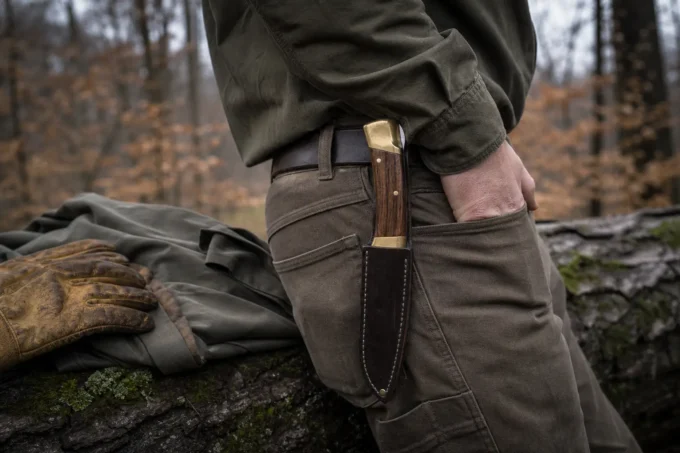
I carried two knives for years because somewhere I’d read that you should have a backup blade in case you lose your primary. I have never lost a knife in the woods. I’ve lost truck keys, a glove, my phone twice, and my dignity more times than I can count, but never a knife. The knife is strapped to my belt. It stays there. It’s the last thing I take off before bed.
I still carry one fixed blade — a cheap Buck 110 knockoff pattern that I’ve had for six years. It opens deer. It opens packages. It opens stubborn beer bottles if I’m being honest. That’s it. No saw, no multi-tool, no neck knife, no gut hook that’s been sitting in a sheath since the Obama administration.
If I’m hunting elk or hiking miles into the backcountry to quarter something, sure, I’ll pack a bone saw. But for a whitetail sit where my truck is 400 yards away? The saw stays in the glove box. I can walk back and get it if I actually put something down. Which, most days, I don’t.
Twenty Rounds of Ammo
This one is embarrassing. I carried a full 20-round box of .30-06 in my pack for years. Twenty rounds. For a hunt where I’d be happy to fire once. Twenty rounds is enough to start a small war. It’s enough to re-zero the scope three times. It’s enough to miss the same deer fourteen times and still have a full magazine.
Now I carry what the rifle holds — four in the magazine, nothing in the chamber until I’m in the stand, and one spare in my pocket. That’s five rounds total. If I need more than five rounds to kill a deer, I should not be hunting. I should be at a range, with a coach, possibly in tears.
There’s a side benefit here that nobody mentions: when you only carry five rounds, you suddenly become a lot more careful about shot placement. Funny how that works.

The Sidearm
I carried a .357 revolver on my hip for three seasons. Big hunk of steel. Looked cool. Made me feel like a serious person doing serious things in serious woods. I was hunting whitetail in central Missouri. The most dangerous animal I ever encountered was an angry raccoon who wanted my granola bar.
I am not saying a sidearm is stupid. If I hunted in grizzly country — Alaska, Montana backcountry, northern Wyoming — I’d carry one and I’d carry a big one. But I don’t live there and I don’t hunt there, and three pounds of steel on my belt in whitetail country was costume jewelry. The rifle is the primary weapon. The rifle is already in my hands. If something happens that the rifle can’t solve, the difference probably isn’t a .357.
I stopped carrying it. I did not get eaten. The raccoon and I eventually worked things out diplomatically.
The Full Rain Suit on a Clear Day
I grew up in a household where “better to have it and not need it” was basically a religion. My dad packed for a weekend fishing trip like we were evacuating a war zone. I inherited this instinct completely.
The rain suit was the worst offender. A full set of Grundens — jacket and bibs — stuffed into my pack on a day when the sky was the color of a bluebird’s back and the weather report said zero percent chance. Zero. I lugged three pounds of rubberized fabric through the woods so I could feel responsible about it.
Now I check the weather before I leave, and if the forecast is clear, I bring a fifteen-dollar emergency poncho that weighs two ounces and lives crumpled in the bottom of the pack like a forgotten napkin. If the forecast says rain, I dress for rain before I walk out the door and I don’t bring a spare. The deer don’t care if I’m wet, and neither do I, as long as I can sit still for three hours.
The “Just In Case” Food
I used to pack enough food for a 48-hour survival scenario on a four-hour sit. Two Clif Bars, a bag of trail mix, a sandwich wrapped in foil, an apple, beef jerky, and a thermos of coffee so big it had its own gravitational pull. This was not hunting preparation. This was meal planning for a small wedding.
The thing about packing food is that you eat it because it’s there, not because you’re hungry. I’d be two hours into a sit, bored, and suddenly that Clif Bar was the most interesting thing in the world. Crinkling a wrapper in the deer woods is not subtle. I may as well have stood up and shouted “hey deer, it’s snack time.”
Now I bring water and sometimes a granola bar in a quiet pocket — the kind you can open with your teeth and minimal noise. That’s it. If I’m hungry the rest of the time, good. Hunger keeps you awake and it keeps you sharp. The deer aren’t snacking, why should I be?
The Heavy Climber
This was the single biggest change I made, and it took me way too long to make it. That 19-pound steel climber was a relic from a time when I thought hunting meant suffering. I’d strap it to my back, hike in, and by the time I got up the tree I was a puddle of sweat and regret. Then I’d sit there shivering as the sweat cooled, wondering why I wasn’t seeing deer. Real mystery.
I switched to a lightweight hang-on stand with climbing sticks — total weight around 12 pounds — and then eventually to a saddle setup for public land. The saddle plus three sticks and a platform runs me about 9 pounds, fits in my pack, and I don’t arrive at the tree looking like I just ran a 5K in a sauna.
The other thing nobody told me about light gear: you hunt further. When your setup weighs nothing, you’re willing to walk an extra mile to that ridge nobody touches. The best buck I ever shot came from a spot I would have never reached with a 19-pound climber on my back. I would have looked at the map, looked at the elevation, and said “nah, that’s too far.” And that deer would still be walking around eating my neighbor’s soybeans.
What Stayed
Just to be clear — I’m not some ultralight fanatic who hunts naked with a sharp stick. There’s stuff I will never leave the truck without, and every single one of these items has earned its place through actual use, not gear-forum fantasy.
- Water. Always water. Dehydration makes you dumb, and dumb hunters make dumb decisions.
- A small headlamp with fresh batteries. I’ve used mine twice on actual deer — once to field-dress in the dark, once to follow a blood trail that ran into the evening. Both times it paid for every ounce it weighed.
- A drag rope. Six feet of cheap nylon webbing with a loop on one end. Weighs nothing, makes dragging a deer four hundred yards roughly four hundred percent less miserable.
- License and tags. You laugh, but I’ve turned around at the gate twice because I forgot them in the truck. Now I check before I put the truck in park.
- A foam sit pad. The kind that costs eight dollars at Walmart. Weighs four ounces. It’s the difference between sitting comfortably for three hours and shifting your weight every thirty seconds like you’ve got ants in your pants. Also works as a kneeling pad for field dressing.
The Real Lesson
Here’s the honest truth: packing light is not about the weight. It’s about what the weight makes you do.
When your pack is heavy, you hunt close to the truck. You pick the easy tree, not the right tree. You skip the ridge that looks promising because you don’t want to climb it. You rush your setup because you’re tired before you even start. You make noise because you’re carrying too much crap that rattles and clicks and catches on branches. You sweat through your clothes, you get cold, you leave early.
Every pound you drop from your pack is a pound of decision you get back. You can walk further, sit longer, climb higher, and most importantly, you can be still. Not fake-still where you’re constantly adjusting. Actually still — the kind of still where a squirrel walks across your boot and you don’t flinch because there’s nothing digging into your back and you’re not overheating and your mind is clear.
I killed my biggest whitetail from a spot I found because I wasn’t tired. I had walked two miles in, sat four hours, and was about to head back when he stepped out. If I’d been carrying that 42-pound pack from ten years ago, I would have been back at the truck eating a sandwich two hours earlier. I would have told myself “nobody’s moving in this heat anyway” and missed the best buck of my life.
The deer don’t care what gear you brought. They care if you’re there, and if you’re quiet, and if you’re patient. The less you carry, the better you are at all three.
Next season, before opening day, dump your pack out on the living room floor. Pick up every item and ask yourself one question: has this ever actually helped me kill a deer? If the answer is no, or the answer is “well there was this one time in 2018,” leave it home. Your legs will thank you. The deer won’t notice. And you might finally walk far enough to find the one nobody else is finding.