
I’ve been shooting rifles since I was twelve. I know how to find deer, how to read sign, how to sit still when my ass is frozen to a tree and my toes stopped feeling things an hour ago. I figured bowhunting would be the same thing, just closer. Same skills, different tool. First season with a compound bow, and I figured wrong about everything.
The Morning I Left My Brain in the Truck
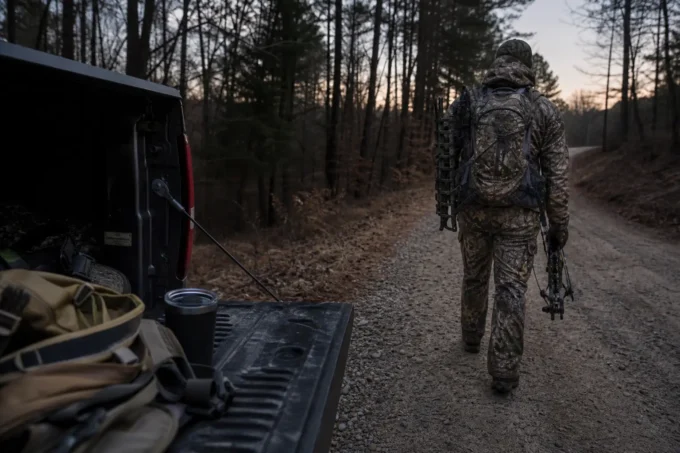
Opening day. Up at four. Drove 45 minutes. Parked at the trailhead, grabbed my pack, grabbed my bow, walked half a mile in the dark. Got to my tree, set up the climbing sticks, hauled my stand up, strapped in, hung my bow on the hook. Sat down. Pulled off my gloves. Reached for my release.
Which was still in the center console of my truck.
Forty-five minutes from the parking lot. Half a mile of dark woods between me and that release. And somewhere in the timber behind me, I could already hear the woods waking up — squirrels barking, crows doing their morning gossip. I sat up in that tree, strapped to a stand, bow hanging six inches from my right hand, and I was about as dangerous to a deer as a houseplant.
I climbed down. Walked back. Fetched the damn release. Walked back in. Set up again. By then it was full daylight and every deer in the county had already finished breakfast and gone to bed. I didn’t see a single hair that morning. Learned a lesson that cost me zero dollars and one opener: put the release in your pack the night before. Don’t just check that you have it — physically put it in the pack. Your 4 AM brain is not the same brain that packed the truck. That guy’s an idiot. Don’t trust him.
The Coat That Ate My Season
Two weeks later. Late October, temperature had dropped hard. I had a buck coming in — not a giant, but a solid eight-point, the kind you don’t pass on public land. I’d practiced all summer with that bow. At the range, in a t-shirt, I could stack arrows at 30 yards with my eyes closed.
The buck walked out at 22 yards. Perfect broadside. I could see his breath in the cold air. I started my draw and the bow didn’t budge.
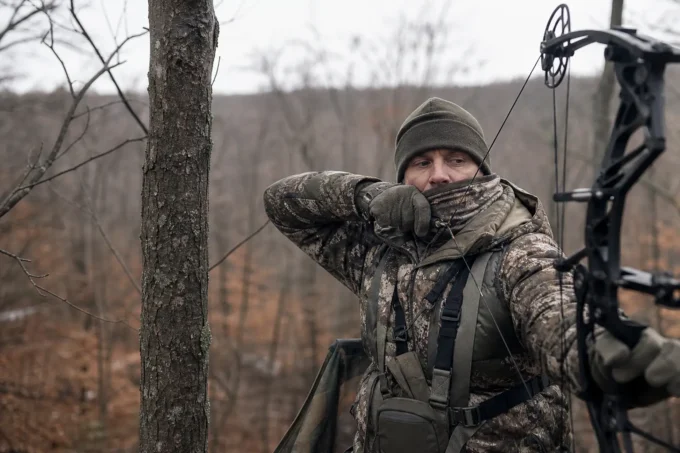
I’d been practicing in a t-shirt and shorts. Today I was wearing a heavy coat, a vest, a neck gaiter, and gloves. The coat sleeve was bunching up in the string path. The vest was binding my shoulder. I couldn’t pull that 65-pound bow back to save my life. I grunted, repositioned, tried again — and the buck heard the whole performance. He was gone like someone had fired a starter pistol.
I sat there for ten minutes with my pulse hammering in my ears, bow half-drawn like an idiot, and realized I’d spent all that range time in conditions that didn’t exist in the actual woods. Not once had I put on my hunting layers and shot from a sitting position. Not once had I practiced drawing with cold hands. I’d trained for the golf course and showed up to a hockey game.
The Open Spot Problem
Third lesson came from a guy named Marcus who let me hunt his private land a few times. First sit on his property, I picked what I thought was the perfect tree — big shooting lane to the east, clear view of a food plot, could see everything. I was proud of myself. I sat there four times and got busted every single time.
I’d see deer coming, they’d get about 60 yards out, and they’d just stop. Not spooked — they didn’t blow or flag or run. They’d just… look at me. Then turn. Then walk the other way. Couldn’t figure it out.
Marcus came out with me on the fifth sit. Walked to my tree, looked up at me, looked at the deer trail, and goes, “Dude, you’re basically sitting in a picture window with your name on it.”
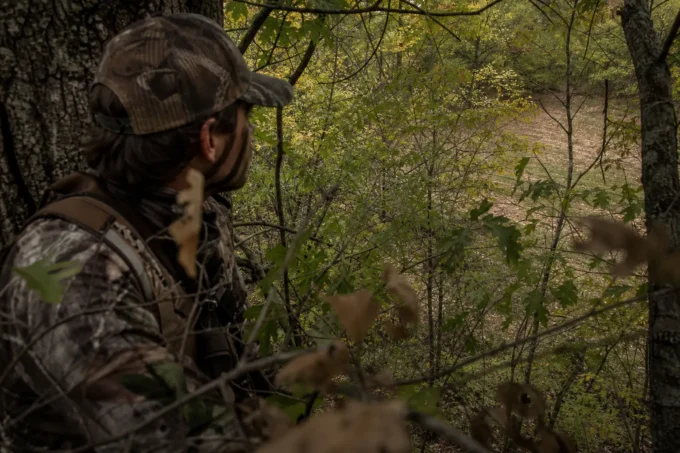
With a rifle, you can get away with that. You’re shooting at 100 or 200 yards. You can be in a ladder stand with a clear view and the deer might never know you’re there. With a bow, you’re at 25 yards. At that distance, a deer can see you blink. I was prioritizing shooting lanes over cover, the exact opposite of what you should do. Marcus moved me to a tree thirty yards deeper into some brush, hung the stand lower — maybe 12 feet instead of 20 — and tucked me into a mess of branches and leaves that made it impossible to see more than 30 yards in any direction.
I killed a doe from that tree three days later. She walked right under me, never looked up, never had a clue. Not because I was higher or quieter. Because I was hidden.
What Actually Matters
None of this is complicated. You don’t need a $2,000 bow or a $400 sight. You need to practice in your actual hunting clothes, from the positions you’ll actually be in, at the distances you’ll actually shoot. You need to pick cover over shooting lanes every single time. And you need to accept that your first season — maybe your first two — you’re going to screw up in ways you can’t predict on the range.
Rifle hunting taught me how to find deer. Bowhunting taught me how to get close enough to matter. They’re not the same thing. Not even close.
And for God’s sake, put the release in your pack the night before.