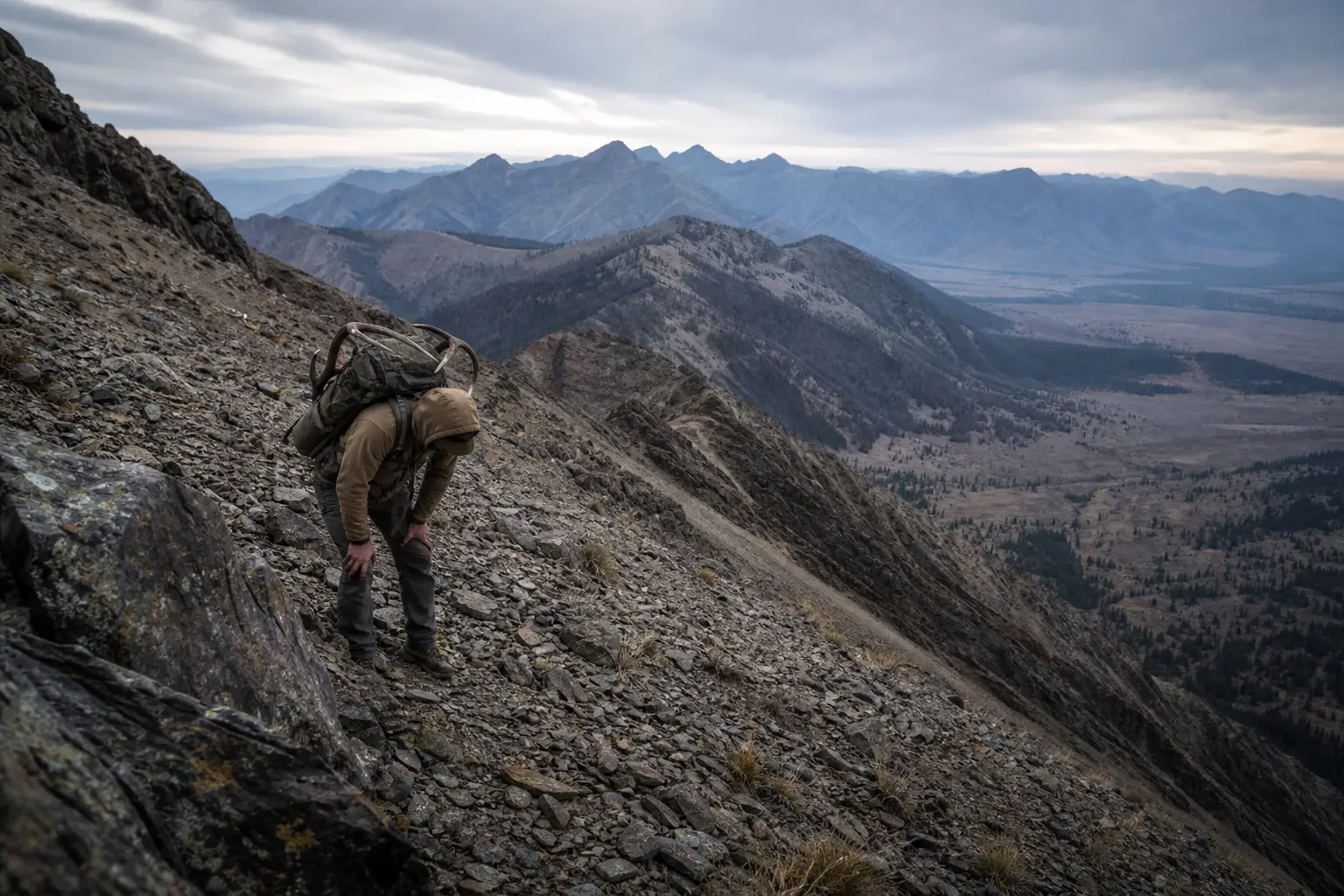
I walked into the mountains out west thinking I was ready because I could bench two plates and run a seven minute mile on a treadmill. I came home knowing I wasn’t. The mountain didn’t care what I could lift. It only cared how long I could keep putting one boot in front of the other while my lungs burned and my legs screamed at me to sit down and quit.
Here’s the part I need to admit up front, because you’ll see it coming if I don’t. I grew up hunting flat ground. Whitetail woods in Missouri, where the farthest you walk is four hundred yards from the truck to a shooting house, and you sit in a stand with a heater and a thermos of coffee and you wait. I killed deer that way for ten years and I thought that’s what hunting was. Twenty minutes of walking, six hours of sitting, ten seconds of shooting. I genuinely believed I was a hunter.
Then my buddy Dale called and said he’d drawn a mule deer tag in Montana and had room in the truck and an extra pack frame, and I said yes before he finished the sentence, because I had watched too many elk hunting videos and I wanted to be that guy. I bought new boots three days before we left and I never wore them around the block. I packed my gym confidence and a pile of gear I’d never carried more than a hundred yards and I told myself the hard part was just making the shot.
The first morning, we parked the truck in the dark at the bottom of a draw and Dale pointed at a ridge line that looked like a postcard, and he said we’d be on top of it by first light. I looked up at it and did the math wrong. From a truck seat, a ridge looks like a hill. From the bottom of it, walking, it feels like a wall that hates you personally.
We made it two hundred yards before I was bent over with my hands on my knees, sucking air that didn’t want to come. Elevation, right. I’d read about elevation. I knew climbing at nine thousand feet was harder than my driveway. What I didn’t know was that knowing it don’t help one bit when your chest is tight and your legs are already asking you what the hell you were thinking.
Dale didn’t say a word. He just slowed down, which is the kind of mercy that should’ve shamed me more than it did. I remember thinking, if I can just get my heart rate down I’ll be fine. So I stopped. I stood there with my pack cutting into my shoulders and I watched the first gray light start to leak over the ridge, and I did the thing every flatlander does. I stopped to rest, and the whole mountain passed me by.
That’s the thing nobody tells you about hunting that kind of country. You cannot stop. You cannot catch your breath the way you do on a treadmill, because the minute you stop, you get cold, and your legs lock up, and you’ve lost the light, and the elk are already gone. The mountain rewards the guy who keeps moving slow and steady, and it punishes the guy who sprints two hundred yards and then collapses for five minutes. I was that guy. I did it over and over for three days.
By day two, my new boots had eaten a hot spot into my heel the size of a quarter. I’d bought them because they looked like the ones the YouTube guys wore, not because they fit my foot, and I never broke them in, so the leather was stiff as a board and every stride was a little argument. I duct taped my heel and I kept walking and I told Dale it was fine, and I believed it until I peeled my sock off that night and saw the blister had already burst under the tape in the cold.
Day three, we finally glassed a buck. A decent one, four points on one side that caught the morning light about half a mile across a canyon. And here’s the punchline, the part I’m still not proud of. I couldn’t hold the rifle steady. Not because of buck fever, though there was some of that too, but because my arms were shot from three days of death-marching with that overstuffed pack, and my legs were shaking so bad from the climb in that my crosshairs did laps around his shoulder. I laid there on my elbows trying to find a rest and my whole body wouldn’t hold still, and the buck fed out of sight while I watched it through a spotting scope I could’ve dropped in the sagebrush.
Dale didn’t patch me up. He didn’t tell me it was okay. We walked back down in the dark and he was quiet for most of it, and then he said the only thing that’s ever stuck with me from that trip. He said, “A man who’s strong can pull a trigger. A man who can walk all day is the one who gets to.”
I didn’t kill a deer that year. I flew home with a heel that looked like raw hamburger, a backpack I never should’ve bought, and a completely different idea of what getting ready for a hunt means. Here’s what I changed, and I wish somebody had told me flat out before I learned it the expensive way.
The Mountain Don’t Care How Much You Bench
Every pound on your back is a pound your legs carry ten thousand times over a week. I cut my pack weight almost in half, and the single best thing I did was stop packing for every disaster I’d ever watched on a video. One knife, not four. One jacket that layers, not three. Water, a kill kit, a headlamp, and a small first aid pouch. That’s it. The “what if” pile is the heaviest thing a man straps on, and I’d been carrying about forty pounds of it across Montana like a fool.
Boots, I learned, are not boots. I spent a season walking in mine on pavement and gravel and hills before I ever took them up high, and I bought the ones that fit my foot, not the ones the influencer had on. The heel blister was a hundred percent my own dumb fault for rolling out of the truck in brand new leather. Break your boots in. It’s boring and it saves your season.
And then there’s the conditioning. The treadmill mile was useless. What I needed was to walk uphill with a loaded pack until my calves burned and then keep walking, not fall off the machine gasping. Slow. Steady. All damn day. I started carrying a pack with forty pounds of water bottles up and down the closest hill I could find, three days a week, and I’d walk until I was tired, and then I’d walk another mile, because that last mile is the only one that ever mattered out there.
The Point
The shot is the easy part. Anybody can be strong enough to pull a trigger. The hunt is won in the two miles before you ever see the animal, in the pace you keep when nobody’s watching, in the boots you can wear from dark to dark without limping. Montana doesn’t care how strong you are. It cares how long you can keep moving.
I went back two years later with a lighter pack, broken in boots, and legs that had learned the only pace that works. I walked all day for four days and I didn’t once feel like the mountain was about to beat me. I shot a buck at the very end of the last evening, a few hundred yards from where I’d collapsed the first time, and I gutted it in the dark with hands that were finally steady enough to work.
It wasn’t that I’d gotten strong. It was that I’d finally learned you don’t beat that country by being strong. You beat it by keeping your boots moving until the mountain gives up first.