Four O’clock and the Last Ox Gone Down
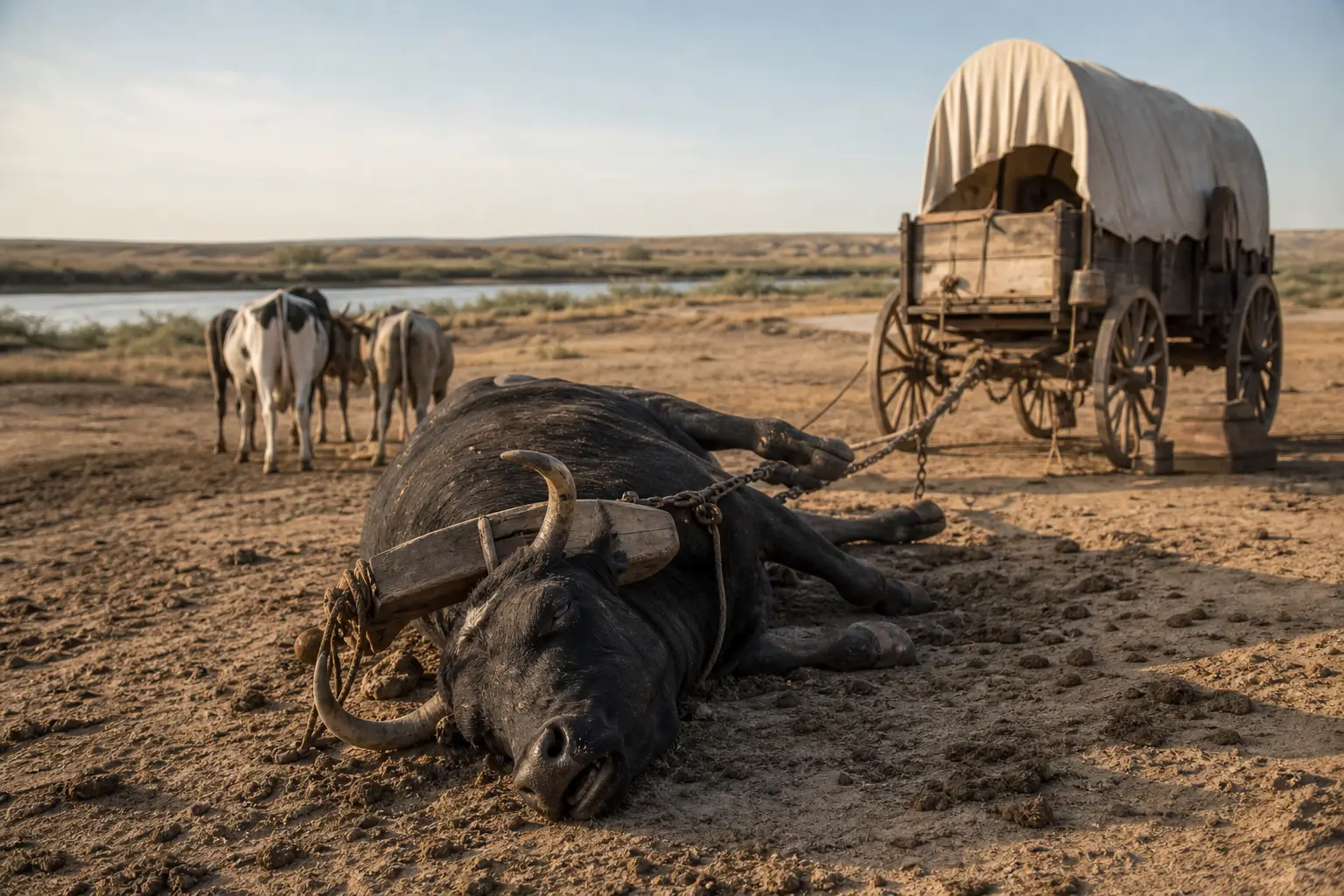
You wake because the canvas above you is too hot to touch and the air under it has gone still enough to stand in. Late July, 1847. South bank of the Platte, two days east of Fort Laramie. The sun has been up an hour and already the sand through the floorboards of the wagon is warm against your back. Beside you Sam is asleep with his mouth open and his shirt soaked through, and outside you can hear one of the oxen breathing in a way you do not like, a wet sawing sound that comes and goes.
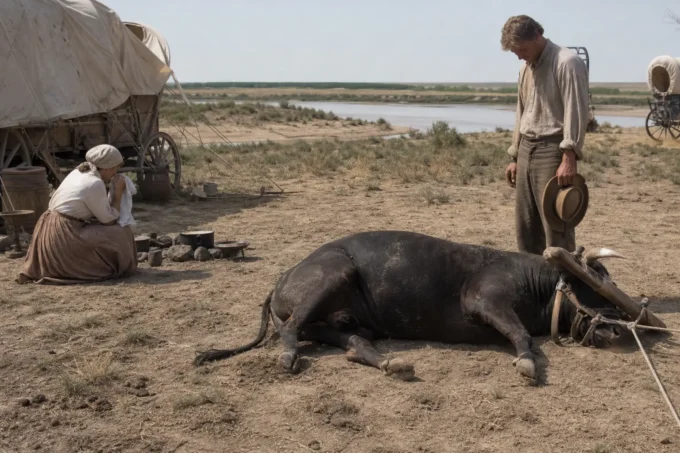
You crawl out into a heat that pushes back. The river is a quarter mile off and you can smell it, warm mud and old water, but the walk to it already feels like a decision. Hannah is kneeling by the fire with no fire in it, wiping her face with the corner of her apron. She does not look up. She says, “The black one is down.”
You look. The black ox is on its side in the trace, legs still moving slowly, and its eyes are half shut and filmed over. Morrison is standing over it with his hat in his hand. He has been sick since the Sweetwater, and in this heat a sick man does not sweat the way a well man does, which is the first thing that should worry you but does not yet.
Heat Kills Quietly Until It Stops Being Quiet
You have crossed alkali flats and forded rivers and sat through hail, and every one of those announced itself. Heat does not. It builds behind you like a man following too close, and by the time you notice him he has his hand on your shoulder. The ox went down the way they all do, standing and wobbling and then folding, because you pushed the party too late into the afternoon the day before, trying to make miles, and did not let them drink long enough at noon. You knew better. You wanted the miles.
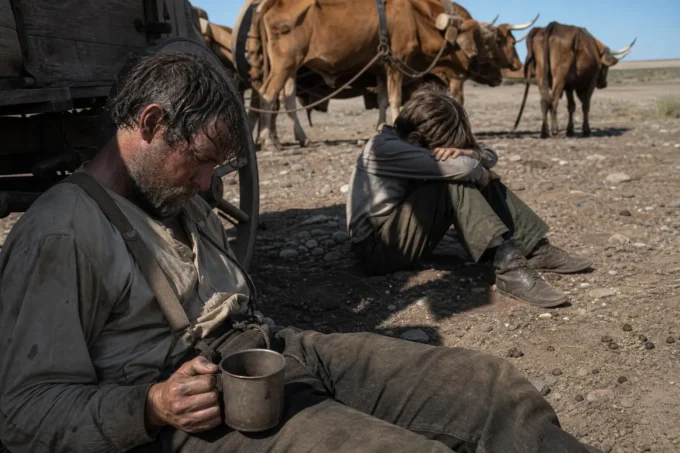
You do not want to end up like Morrison, who is the wrong color now, gray at the ears, sweating in big patches down his back one minute and dry the next. He coughs and does not drink, and when you hand him the cup he looks at it like it has asked him a question he cannot answer. A dry sick man in this country is a dead man with a schedule, and his schedule is written in the way his tongue has gone pale.
The boy Thomas is squatting in the shade of the wagon with his head on his knees. He has stopped asking questions, which is the thing that finally gets you moving, more than the ox, more than Morrison. A quiet child in the heat is a child already half in it.
Water First, Then Shade, Then Wait
You do not fight the heat. You get out in front of it.
First you kill the plan. You have been walking the stock from first light to noon and then resting through the worst of it, but the worst of it is here now, so you stop. You tell Sam to unharness the lot, and you do not pretend you will make any miles today. The miles are already lost. What you are deciding now is whether you lose anything else.
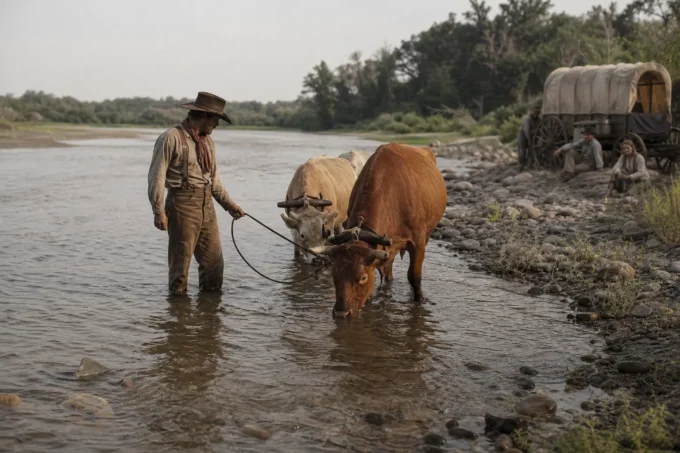
Then you water in the right order. You and Sam walk the oxen to the shallow edge of the Platte two at a time, forehead ropes and quiet voices, and you let them take their fill slow, no more than a few minutes at a shot, so a panicked animal does not founder itself. The black one is beyond that now. You leave it in the trace to die, and you turn your back on it because there is nothing in that animal but weight now, and the weight belongs to the day, not to you.
For the people, small drinks, often. You make Hannah sit in the wagon shade with a wet cloth on the back of her neck and you hand her the cup every quarter hour whether she wants it or not. You tell Thomas to drink from the barrel, a swallow now, another in a while, and you watch him until he does it. Morrison you make sit down, and you pour water over his head and down the back of his shirt, and he shivers once which is a good sign and then goes still, which is worse.
You wet the canvas and the ground under Thomas and hang a wet shirt over the wagon side to catch what little air moves near the river after dark. It is not much. It is the difference between a man and a man who stops sweating, and in the afternoon it is the only difference there is.
People Are Kind in Small Ways While the Big Thing Takes Its Time
Hannah has stopped asking you to save the ox. She watches the black one with a flat face and keeps wiping her hands on her apron as if the hands were the part that might go wrong. Later you see her tear the hem of her dress into strips and tie one around Morrison’s head, and she does not say a word while she does it. It is the same steady silence she has carried since Missouri, the one that means she has decided the whole party is her business now.
Sam counts the water barrels the way other men say prayers, one, two, three, touching each lid. He knows the barrels are not full. You have been crossing the same country the whole way and the water has never once been glad to see you, and now it is down to one barrel and a half and the nearest good water is a day away at the fort if you push, which you cannot push, because the oxen will not push and neither will Morrison, and neither, you are beginning to understand, will the heat.
You think, for a stretch, about people back east who drink water straight from a well that is never warm and never tastes of old mud, and you think it without envy, which is the only kind of thinking you can afford. Envy is a thing a man does when his body is still his own. In this heat your body is a loan, and the terms are drinking and rest and shade, and you pay them or you stop being the one holding the note.
The dog lies flat in the wagon shadow with its tongue long and pink and does not move for the whole middle of the day, and somehow that stillness, more than anything, tells you the sun has won today, and the trick is to admit it and wait.
The Wind Shifts and the Water Tastes of Ash
In the late afternoon the wind turns, and it comes off the prairie grass hot and dry instead of off the river, and it carries the smell of dust and of the dead ox, and for a while you cannot get the taste of it out of your mouth. The black ox is still moving, one leg now, slow, and Morrison gets up without being told and walks toward it with a knife, and Sam stops him, and Morrison looks at the knife in his own hand as if someone else had put it there.
The wells are what hurt you. You had planned to water at a spring Sam swore he remembered, and when you reach it in the evening it is dry, a flat clay pan with a crack in it and a few dead flies. You stand there with the empty bucket and you do not say anything, because there is nothing to say that Sam has not already said against himself in the look on his face. One barrel and a half. One day to Fort Laramie at a sick man’s pace. You walk back with the empty bucket and you start dividing water that is already divided.
By dark the heat has loosened a little, and the damp canvas you hung actually moves, and Morrrison takes his first real drink and keeps it down, and you sit against the wheel with your boots off and watch the first stars come. You are not saved. You are not even ahead. You are just still here, thirsty and tired and short one ox and one dry spring, and you want very much to sit down, and you do, and you do not get up again until the fire needs wood, which in this heat it does not.
What Was Real
Heat was one of the most undercounted killers on the overland trails. Contemporaries wrote rivers of pages about cholera and drownings and Indian alarms, but the hot weeks between the Missouri and the mountains, especially across the Platte valley and the alkali country of present-day Wyoming, killed quietly through heat exhaustion, heatstroke, and dehydration. Emigrant diaries from the 1840s and 1850s return again and again to the same details: noon halts, wet cloths, small drinks, and oxen that dropped in the traces.
The numbers are real but thin. Roughly four hundred thousand people crossed to Oregon and California between the 1840s and the 1860s, and mortality estimates for the whole journey commonly run from four to ten percent depending on route and year. Cholera sits at the top of the known causes. But heat acting on top of dehydration, on bodies already exhausted by walking two thousand miles at fifteen miles a day, did steady, unspectacular work that rarely made it into the counting. A man who staggered, stopped sweating, and died face-down in the grass had died of “exposure,” a word that fit a lot of things.
The physiology is plain. The body cools itself by sweating, and in a dry, hot, windy place the sweat evaporates so fast a man does not feel how much water he is losing. The first failure is mild, thirst and headache and a dark stream of urine. Then muscle cramps, then dizziness and nausea, then the dangerous turn, heatstroke, where sweat stops and the core temperature climbs out of control and the skin goes hot and dry and the mind slips. It is a medical emergency, and on the open trail in 1847 the only treatment was shade, water, and time, exactly what a party short of water could not spare.
Oxen, the engine of the whole migration, were also the weakest link in hot weather. Dragging a loaded wagon across dry, gritty ground in July, they needed water more often than emigrants remembered to give it, and an overheated ox, watered too fast, could founder and die where it stood. Losing a draft animal late in the season was not a nuisance; it was arithmetic, one more load redistributed among fewer animals that were already tired. Parties timed their crossings, rested through the worst hours, and counted water barrels the way farmers counted seed, because a dry spring two days from the next post could spend a day’s ration in a single afternoon.
The Platte itself was the saving and the curse of the hot country. Emigrants called it “a mile wide and an inch deep” and “too thick to drink and too thin to plow,” but in the burning weeks it was the only water for hundreds of miles, warm and full of sand and never quite enough, and men drank it anyway, boiled or not, and were glad of it.