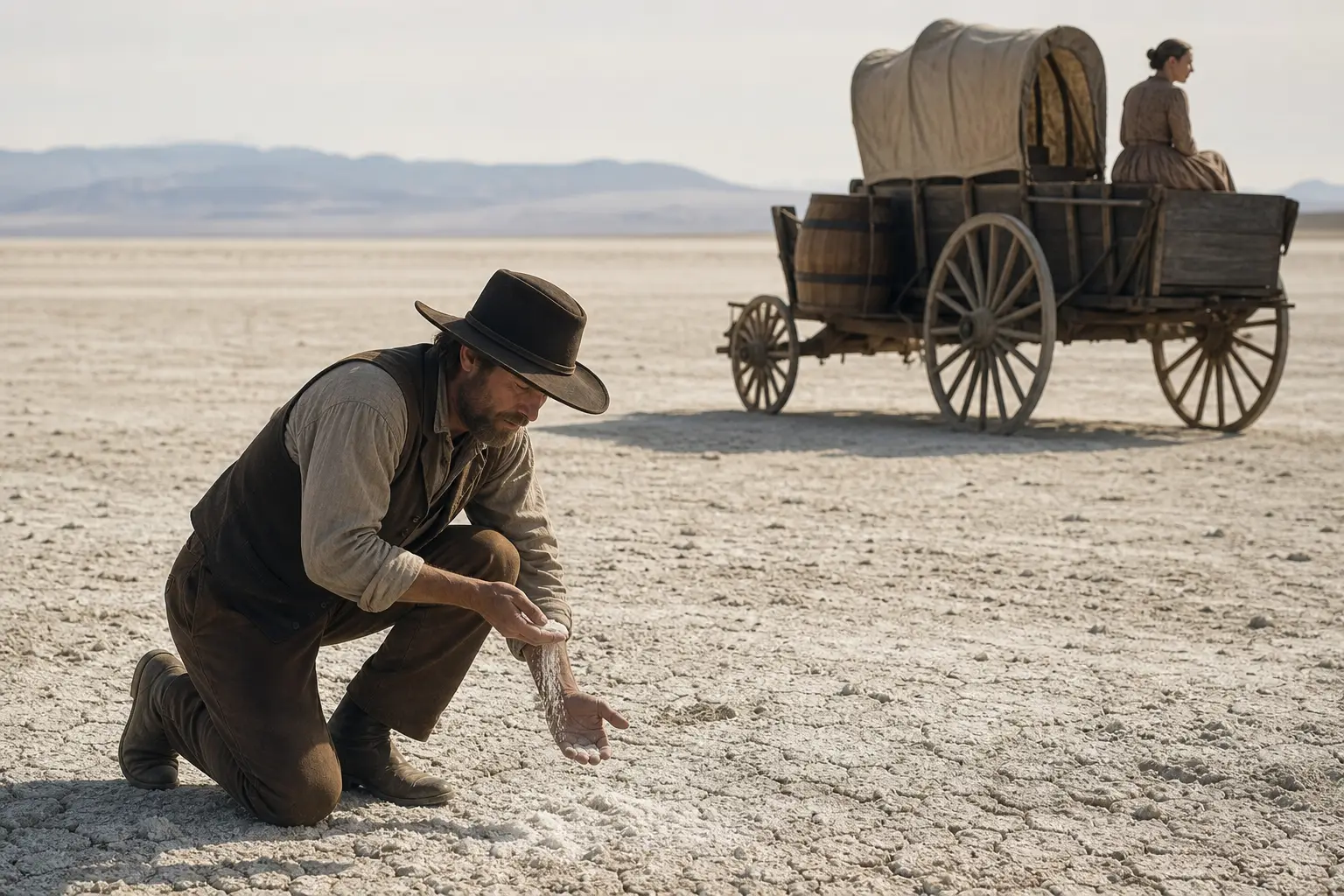
You wake because your tongue has gone thick and your head is splitting behind the eyes. It is late July, 1849, somewhere on the alkali flats west of the Sweetwater, and the water barrel under the wagon has been empty since yesterday noon. The sun is a white hammer. Your wife Hannah is already out on the tongue of the wagon, looking the way she looks now every morning, quiet, with cracked lips, and your brother-in-law Sam is down on one knee beside a bright white crust of ground, rubbing it between his fingers the way a man tests flour.
“Alkali,” Sam says, and spits dry, the way a man spits when there is not enough spit to make it worth the effort.
Morrison is still alive, which surprises nobody more than Morrison. The flux has had him for three weeks, and he sits under the wagon in his own shadow, breathing shallow, his eyes half closed. He will not drink much water even when you find it. The flux makes a man afraid of water in a country that will kill you without it, and that, you think, is a bitter kind of joke, though you do not have the spit left to laugh at it.
You are the one who walks, because you still can. Somebody else always has the fever or the child or the sick ox, and so it falls to you to go out across the white, shimmering flats and find something that will not poison your family. The temperature is probably past a hundred degrees, though you cannot be sure, because the thermometer broke two weeks back and nobody has bothered to replace it, and anyway a number would not change what the sun is doing to the back of your neck.
The Country That Is Poisoned
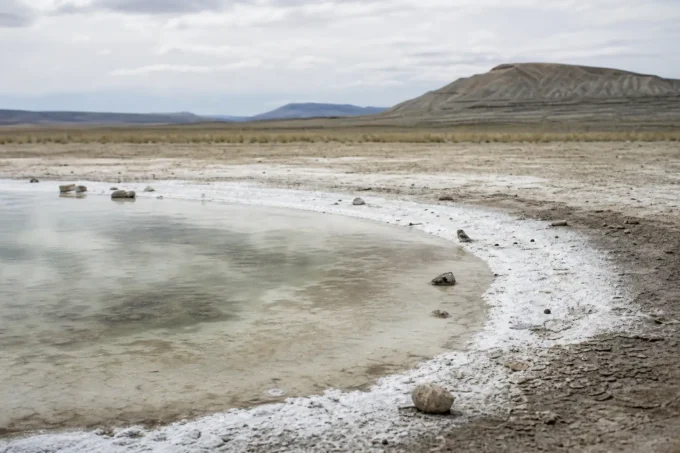
Here is the thing about this ground, and you have learned it the hard way so nobody else has to. In the dry basins and flats west of the Sweetwater, and again on the desert stretches beyond the Green River, the water is often not water. It is alkaline water, heavy with dissolved minerals, mostly sodium carbonate and sodium sulfate and borax, left behind where old lakes and seas evaporated a long time ago. It is white like flour around the edges of a pond, it is soapy to the touch, and it tastes the way lye water tastes, bitter and flat and somehow greasy at the same time.
Drink enough of it and it will give you the alkali bends. It will burn your mouth and your throat. It will cramp your stomach and send you running, or crawling, to squat in the sagebrush, and every drop you lose from your gut is a drop of the good water you do not have. Mild cases are just misery. Bad cases turn the inside of a man into a running, burning knot, and a body already short on water cannot afford to lose more. The trick, the only trick, is to know which water is bad before you drink it.
You learn the signs. A pond lined with a white crust, or a creekbed where the rocks are powdered and the edges of the water look like a dirty froth, that is alkali, and you leave it. A smell like stale soap or ammonia, you leave it. You taste only with the tip of your tongue, and you spit, and if it is slick and bitter and stings the corners of your mouth, you walk on. There is no second taste. One taste is the whole report.
How You Find the Good Water
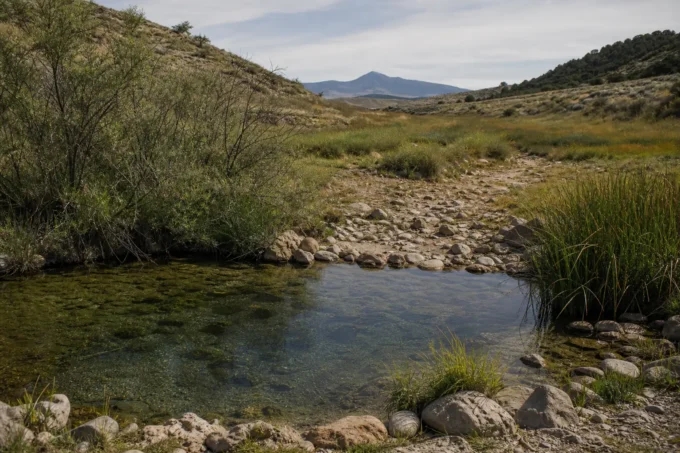
You have learned to read the ground the way a man reads a familiar face. The good water on this trail is moving water, and moving water runs downhill and gathers in the low places where the green holds on. So you walk the washouts and the draws, and you look for the dark green line of willows and cottonwood and rushes that means a live spring is leaking out somewhere. Springs are the answer. A spring comes up out of the rock already clean, or clean enough, and it is cold on your hands, and it is the best water on the whole continent when you find it.
The rivers are the backbone of it all. The Platte, the Sweetwater, the Green, the Snake, and later the Columbia, they are the highway the wagons follow, and they are the reason the trail goes where it goes. But a man cannot drink a river in the middle of summer and call it safe, because other wagons have crossed it upstream and their oxen have stood in it and their dead have sometimes gone into it, and cholera rides in river water. So you drink the river only when you must, and even then you are careful about where.
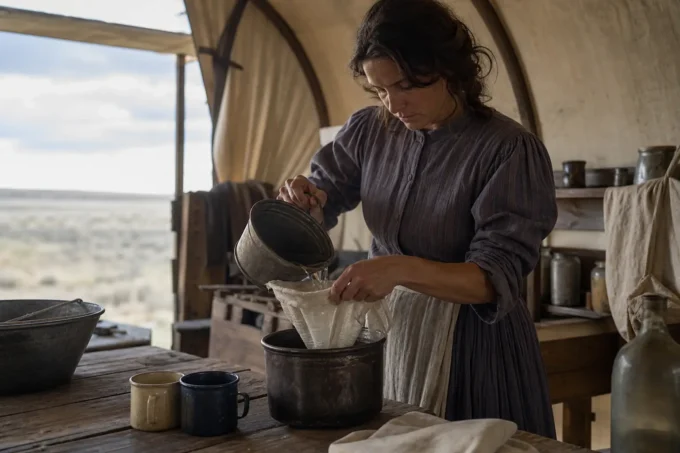
That is where the making-do comes in, and it is uglier than anybody writes down. You strain water through a folded cloth, which takes out the mud and the wigglers and the little swimming things, and then you boil it, because boiling kills the sickness. That is the whole trick, and it costs you fuel, and fuel is scarce on the flats, and so you spend the afternoon splitting your attention between finding water and finding enough dry brush to make the water safe. Two chores that hate each other. You do them both, because the alternative is a dead child.
Some nights you let the water sit in a bucket and you skim the top with a cup and you drink it warm and it tastes of mud and old wagon wood and faintly of the goat skin you hauled it in. That is good water. You have drunk worse and called it worse names, and you will again.
Hannah and the Quiet Work
When you come back with a sloshing bucket and the blisters on your hands, Hannah does not say anything. She just takes the bucket and pours the water through her good cloth into the iron kettle, and she keeps one cup back, muddy and warm, and she makes the children drink it slowly, in little sips, the way you have taught them, because a body dried out too long will cramp if you pour water into it all at once.
Sam waters the oxen first, and you watch him, and you do not complain, because the oxen are the reason the wagon moves, and a dead ox means a wagon full of everything you own burned or abandoned on the side of the trail. Morrison drinks two small sips and then he is done, and he leans back and stares at the sky, and then he does something small and strange: he reaches out and squeezes your forearm once, like a man thanking you for a thing he cannot keep down. You do not know what to do with it, so you just nod.
You sit down in the dust with your cup, and you think briefly about people back east drinking water out of a pump into a glass, clear and cold and free, and you think about how they will never know what it costs to earn a single swallow out here, and then you stop thinking about them, because it does not help. The cup is warm. The water tastes of cloth and leather. It is the best thing you have ever tasted.
The Alkali Spring You Almost Trusted
The complication comes the next afternoon, and it comes because you are tired. You find a pool in a rock basin, clear as glass, so clear you can see the white stone at the bottom, and for a long moment you almost lower your whole face into it, because clear water is good water, that is the rule, that has always been the rule.
But there are no reeds around it. No willows, no green, no tracks going into it except the pale marks of insects, and the edges of the basin are crusted white where the water has dried. You stop. You touch two fingers to the surface and touch them to your tongue, and it stings like soap and household lye, and you spit, and your mouth burns for an hour afterward.
The pool is death wearing clean water for a face. You carry the empty bucket away from it and you are glad you still have the space in your dry head to have known better. That night around the fire Hannah looks at you and says, in a voice cracked like the flats, “You wouldn’t have made it to the Green if you’d drunk it.” You know she is right. The whole family knows it. Nobody brings it up again, because out here the narrow scrape is not a story worth telling, it is just Tuesday.
You do not sleep well. You just want to sit down and drink one long pull of water that does not have to be earned, like the men back east who will never know that out here a man’s whole life can come down to whether he smells the soap before he drinks the poison. The fire burns low. Morrison coughs in his sleep. The bucket stands in the shadow of the wagon, and you check it three times before dawn, the way a man checks a locked door, because water is the only treasure you own now.
What Was Real
Water was the central daily problem of the overland migration, and the search for drinkable water dictated the route itself. The wagon trains followed the rivers, specifically the Platte, the Sweetwater, the Green, the Snake, and the Columbia, because moving water was the reliable anchor in a dry and foreign landscape. Losing that anchor, or running dry between reliable sources, was one of the most common ways a trip went wrong.
Alkaline water was a real and well-documented hazard, especially across the high plains and arid basins of present-day Wyoming, Utah, and Nevada, where ancient lakes and seas had evaporated and left the ground charged with soluble mineral salts. The dissolved minerals were largely sodium carbonate, sodium sulfate, sodium chloride, and borax. Such water had a bitter, soapy, or lye-like taste and produced a distinctive white crust along the edges of ponds and wet ground.
Drinking alkaline water caused what emigrants called the alkali sickness or alkali poisoning. It burned the mouth and throat, produced violent gastrointestinal upset, cramps, and diarrhea, and critically, the resulting fluid loss made dehydration much worse. In mild amounts it was a painful nuisance. In serious cases, especially for those already weakened by dysentery or cholera, it could be fatal. Travelers learned to recognize the white crusts, the bitter taste, and the absence of surrounding vegetation as warning signs, and many diary accounts describe the discipline of tasting a single drop on the tongue before committing a family to a water source.
Good water was most reliably found at live springs and in the moving rivers and streams that drained the high country. Springs that emerged cold and clean from rock were prized, and their locations were traded from one party to another as hard, valuable information. Standing water in the flats was treated with deep suspicion except where green vegetation, reeds, and animal tracks marked it as a genuine seep.
River water, even from the major streams, was itself not trusted, because cholera, the single greatest cause of death on the Oregon Trail, traveled in contaminated water. Emigrants strained water through cloth to remove mud and larger particles, let it settle, and boiled what they could, though boiling was always constrained by the scarcity of fuel on the treeless plains. The tension between needing water and needing fuel to make it safe was a standing, daily burden that every family on the trail understood.
Dehydration itself killed and weakened steadily. A person who went without water in the summer heat of the high plains moved from thirst and headache into dizziness, confusion, and collapse. Rehydration had to be done gradually, because drinking too much too fast after severe dehydration could cause stomach cramps. Families rationed water by the cup, watered their livestock, which were essential to the survival of the whole group, before themselves at times, and treated every full barrel as a temporary and fragile asset.