The Water Tastes Fine Until the Man Buckles
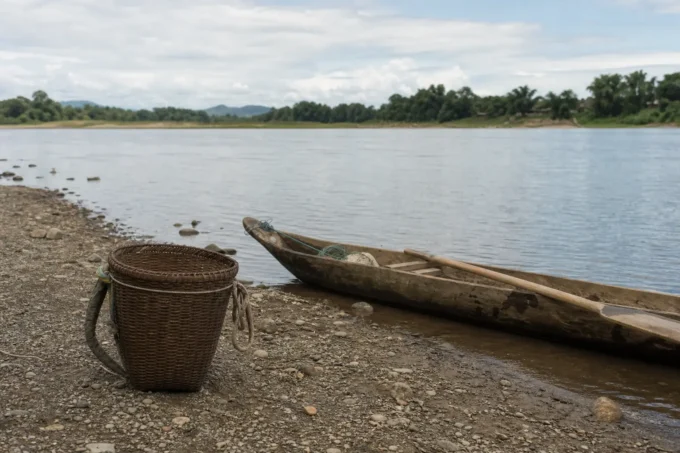
Late June, 1849. You wake to the smell of the Platte, mud and green slime, and to a sound you have learned to dread: a man retching into the dark. This time it is not Morrison. It is Sam, your brother-in-law, doubled over the wagon wheel with both hands shaking on the spokes, and the water he brings up is not water at all. It is thin and gray and it smells like a flooded cellar.
Hannah is already up. She has been up for an hour, you can tell by the way the fire is laid and the kettle sits at half a boil, and by the way she will not look at Sam. She knows what this is. Everyone on the trail knows what this is, the fastest death out here, the one that does not come from a wagon tongue or a river or a storm. It comes from a cup of water, and it takes a strong man from breakfast to a slack gray corpse by sundown.
You do not want to end up like the man three wagons back. Three days ago he was singing. This morning his family is digging a hole in ground too hard to call dirt, and his boots are standing in a row beside the grave because nobody had the heart to bury good boots.
The Arithmetic of Cholera
Cholera moves faster than a rumor. The first sign is rice water stool, a thin milky discharge that does not look like sickness until you understand it is everything the body owns pouring out at once. Then the cramps start, deep in the calves and the belly, curling a man up like a drying fish. Thirst follows, a thirst that drinking only makes worse, because the gut has stopped doing its one job and takes the water in and pushes it straight back out. Then the skin goes loose and the eyes sink into their sockets and the voice drops to a whisper. By the third day, if he lives that long, a man can lose half his water weight. Most men do not live that long.
The arithmetic is blunt. A healthy man is mostly water. Take a tenth of it and he feels it. Take two tenths and he is in real trouble. Take more and the blood thickens until the heart cannot push it, and the organs shut down one by one, and the man dies thirsty with a full canteen beside him because his own gut will not let the water in.
You have seen it enough times now to know the stages the way you know the miles. Day one: weakness and a soiled blanket. Day two: sunken eyes and a tongue like a dry sponge. Day three: the gravediggers. There is a lesson in every grave, and the lesson is always the same: stop drinking from the open river.
What You Do Instead
There is not a cure out here, so you work at the part you can control: what goes into the mouth. It is grubby, unglamorous work, and it is the only work that keeps your people alive.
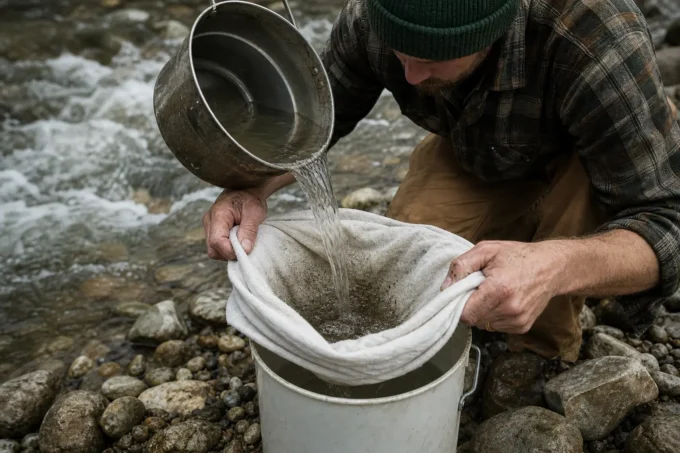
First you kill the water. You dip from the moving channel, the fastest water you can reach, because standing pools and still backwaters are where the filth collects. You pour it through cloth folded four times, held over the mouth of the bucket by two hands that never quite get clean. The cloth catches the leavings, the little clouds of mud and the things you would rather not name. What comes through still is not clean, so you boil it. A rolling boil, kept at it for as long as your fuel allows, because heat is the one thing out here that kills what is in the water. You let it cool in a covered pot and you do not share a cup, and you do not let the children dip their hands in the bucket, and you wash your hands in boiled water when you can spare it, which is almost never, which is why this keeps happening.
The digging is the part nobody talks about. You dig the latrine downhill and downstream from camp, a step no man wants to do at the end of a hard day but every man learns to do before his own gut turns on him. You do not wash in the drinking water. You do not let the oxen foul the same water you will need at dawn. You keep the sick man’s things burned and separate, and you tell yourself this is enough, even though you know it is a luck war you are fighting more than a clean one.
For the sick man himself there is almost nothing. You make him drink small, slow sips of boiled water, because the gut can take a little at a time even when it rejects the rest. You keep him warm and dry. Some men try a dose of laudanum to still the cramps, or a pinch of calomel, and you have seen enough of calomel to know it does more harm than the disease it pretends to fight. In the end you do what you can, which is hold a hand and hope the man’s own body wins the fight tonight.
The Small Things While Sam Sinks
Hannah goes about her work with a stillness that scares you more than crying would. She spoons the weak broth to Sam, one careful sip at a time, and she does not stop to wipe her own face. The two boys sit on the tailgate and watch their father, and the littlest one asks if Sam is going to be buried with the boots on, and you do not have an answer that is both honest and kind, so you say nothing and hand him the bucket and send him for water he must not drink from.
The dog, that useless yellow dog, lies with his head on Sam’s leg and whines once, soft, like he can smell what is leaving. Morrison is gone this summer, buried back at the Sweetwater, so there is no one to stomp around and complain that the whole camp has gone soft over a little flux. You think briefly about people back east drinking from pumps and wells that never touched a buffalo, and the thought does not comfort you the way it should.
Somewhere down the line a woman is singing a hymn in a language you do not know, over and over, and it rises and falls with the wind like another thing the prairie is swallowing.
The Night It Gets Worse
By midnight Sam is worse, and you know before you even look. His pulse is thin as a thread under your fingers, and his skin has gone the color of candle wax, and the water you spoon into him comes back up within the hour. The rain starts then, a hard prairie rain that flattens the fire and turns the ground to a sheet of brown, and there is thunder so close it makes the wagon seams ring. You spend the last of the boiled water reheating broth over the one coal you have managed to keep alive under the wagon, and Hannah holds Sam’s head up because he is too weak to lift it himself.
In the morning Sam is alive. Not well, not right, but alive, gray and shaking and so thin you can count the ribs through his shirt, and he opens his eyes and asks, in a voice like paper, whether the oxen got water. It is the most Sam thing he has ever said, and it is the first time in two days you let yourself breathe.
Two other families in the wagon train are digging that morning. You help with the first hole before the sun is high, and you keep your boots on, and you do not say anything clever, because there is nothing clever to say. The cholera did not skip your wagon because you were good. It skipped you by luck, and you know that luck turns without warning, and that the next cup of river water could be the one that ends the argument for good.
You just want to sit down. You sit down, on the tailgate, beside the boy, and you look at the river and think about how a thing that looks that clean could carry something that kills that fast. The dog jumps up and puts his head in your lap, and for a while neither of you moves.
What Was Real
Cholera was the single greatest killer on the Oregon and California overland trails during the great migration years, roughly 1841 to 1869, when some 400,000 people crossed. It struck in waves, and the worst of them hit in 1849 and 1850, the very years when the trail was most crowded and the camps along the Platte were most fouled.
The disease is caused by the bacterium Vibrio cholerae, and it spreads through water and food contaminated with human waste. Its signature symptoms are profuse watery diarrhea, often called rice water stool, vomiting, and violent muscle cramps, followed by a dehydration so rapid it can kill a healthy adult within hours. The treatment that works, then as now, is rehydration, replacing the water and salts the body is losing. Emigrants did not understand the mechanism, but they learned by hard experience to boil water, to bury waste downstream and downhill from camp, and to prefer moving water over stagnant pools.
Many travelers carried a medicine chest stocked with laudanum, a tincture of opium used to quiet cramps, and calomel, a mercury compound used as a purgative. Calomel was worse than useless against cholera, a poison applied on top of a disease, and it is one of the reasons the era’s medicine often did more harm than good.
The word cholera is ancient. It comes from the Greek kholē, meaning bile, a name born of an old theory that the disease was an overflow of bile. The name stuck long after the theory died. The bacterium itself was not identified until 1883, by Robert Koch, decades after the last wagons crossed the plains.
Graves along the trail were shallow and frequent, and the cholera of 1849 and 1850 left more of them than any other single cause. The survivors kept moving, because stopping meant standing in the same fouled ground that was killing them.