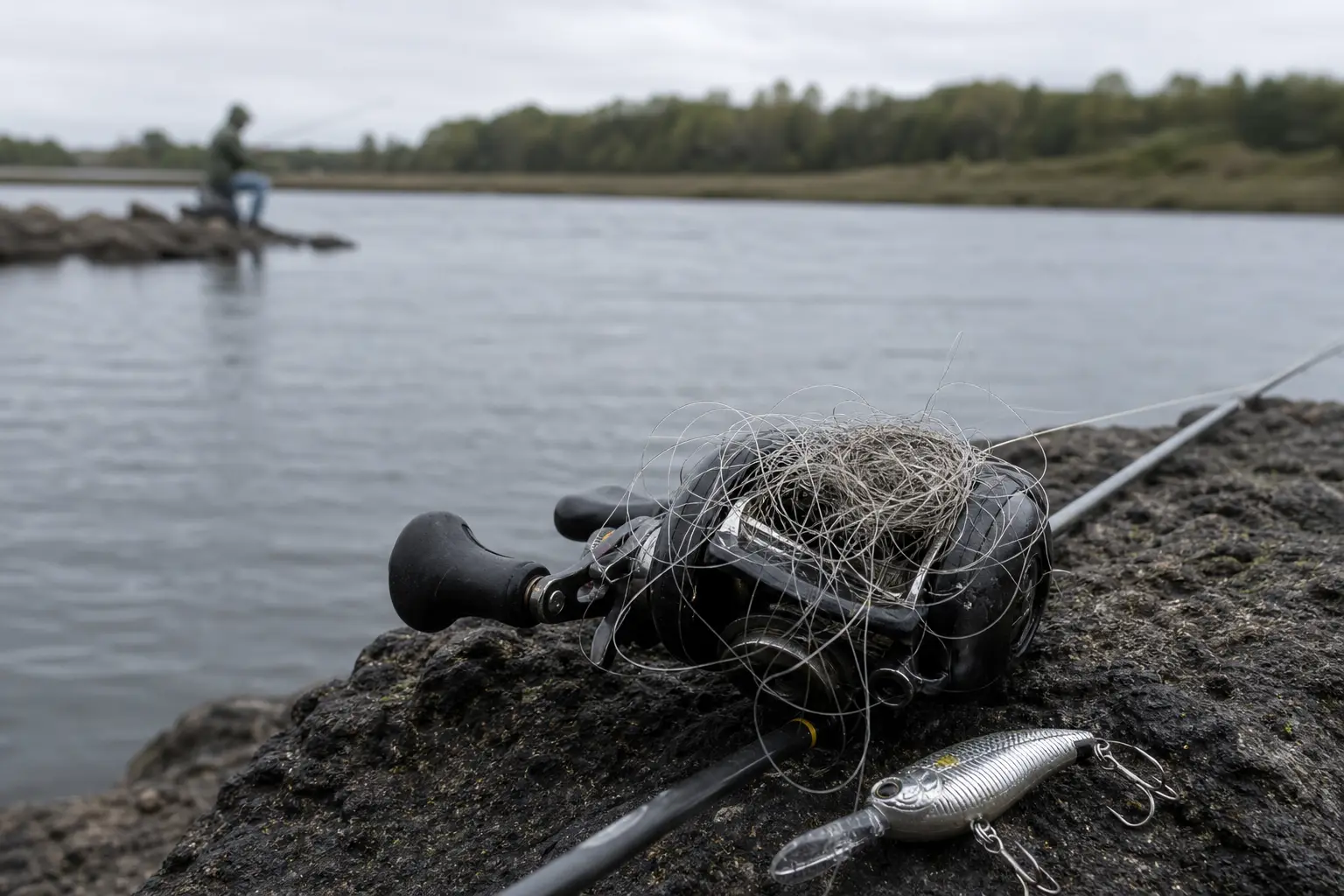
I bought my first baitcaster because I was tired of being looked at sideways. Every serious-looking man on the lake had one of those low-profile reels, the kind where the spool spins with your thumb on it like a man petting a dog, and every so often one of them would flip a short, tight pitch under a dock and the whole thing made a noise like it knew something I didn’t. My spinning rod had caught me more fish than I could count, but it looked like something a kid uses to catch bluegill off a pier. So I did what any grown man with a debit card and an ego does. I bought a baitcaster, read the manual twice, and walked down to the water expecting to have unlocked some higher tier of fishing.
Two hours later I was sitting on the bank with a reel full of what looked like a small gray bird’s nest, untangling it with a safety pin and a pocket knife, and a teenager on a Zebco had just pulled in his second bass of the afternoon twenty feet down from me. He didn’t even look up. That was the first time I understood that a baitcaster doesn’t make you a better fisherman. It makes you a worse one, on a schedule, until you pay the price in October nights and lost lures and a dented pride that takes two full seasons to straighten out.
The Gear I Mistook for a Badge
Here is the honest part, the part I didn’t say out loud for a long time. I didn’t buy that reel because spinning tackle was holding me back. I bought it because I wanted to look like the kind of man who had earned the right to carry one. A spinning reel is an honest machine. It casts the same for a seven-year-old and a tournament winner, and there’s no secret handshake in it. A baitcaster, the way I saw it, was proof. If you could run one, you were serious. If you couldn’t, you weren’t. I wanted the proof before I had done the work, and the reel knew it before I did. That thing punished me from the very first cast, and I deserved every single backlash it gave me.
I watched more fishing videos in my first month with that reel than I had in the previous ten years combined. Thumb control. Spool tension. Brakes. Magnetic resistance. I absorbed every term, wrote the settings down on an index card, and still managed to turn forty dollars worth of line into a gray wad twice a morning. The worst one happened on a calm Tuesday, no wind, a twenty-yard cast to open water, no reason for it. The instant my thumb lifted the spool kept spinning after the lure landed, and by the time I caught up with it the line had buried itself three layers deep. I cut it all out with my knife and walked to the truck with the reel still full of memory, the way a man walks away from an argument he lost to a machine.
The Bird’s Nest Era
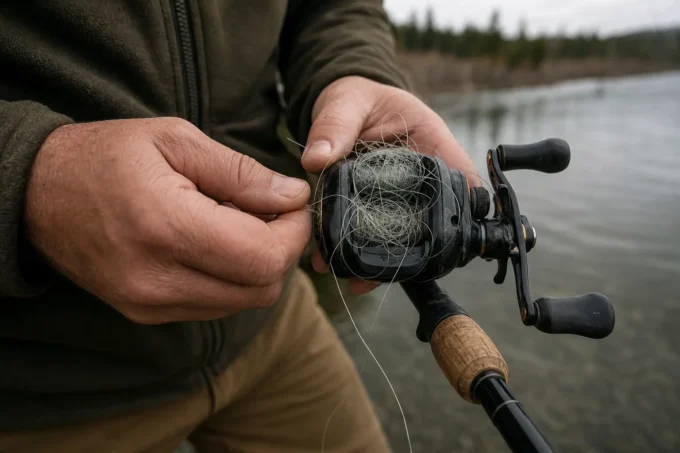
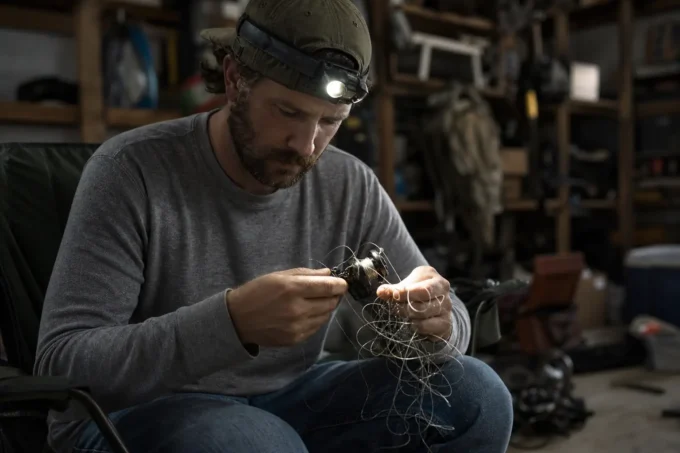
For two seasons I became known at the local ramp as the guy who would rather fight his reel than the fish. My buddy Ed called my bird’s nests “weather systems,” and he was being generous. I got so good at untangling that I started to think of it as a skill, a kind of patience exercise, and somewhere in that second year I had a real low moment. I was sitting in a folding chair in my garage, headlamp on, pulling line out of a backlash by the inch, and I caught myself feeling almost proud. Look at me, I thought, patient as a monk. Then I remembered I had driven two hours to that lake to catch fish and had caught precisely one all spring, and the thing I was proud of was the mess I kept making.
A baitcaster, when you misuse it, doesn’t just waste your line. It wastes your attention. Every cast becomes a gamble, so you cast less, and shorter, and safer, and the whole time you’re fishing scared instead of fishing curious. The fish were still there. The water hadn’t changed. The only thing standing between me and them was a hundred and ninety dollars of aluminum and a thumb I refused to train properly. I had convinced myself the reel was a tool for serious men, and so I used it seriously, which is to say badly, and I let my own picture of myself get between me and the fish for twenty-three straight months. The reel worked fine. I was the defect.
The Cast That Turned the Page
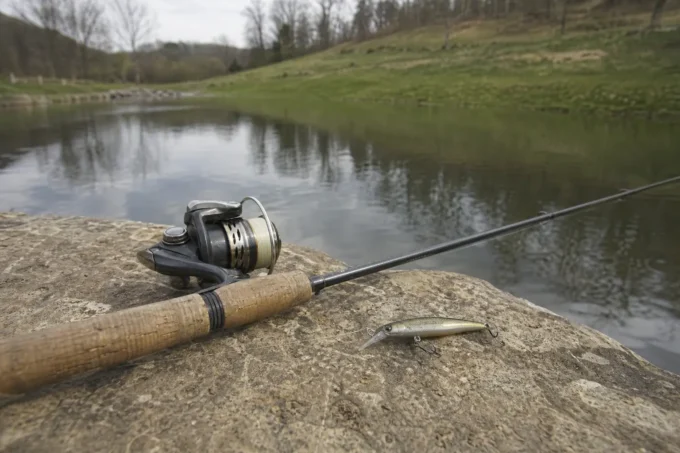
The thing that finally broke me wasn’t a fish. It was a favor. Ed took me to a farm pond one evening and handed me his old spinning rod because he wanted to borrow my jerkbait setup, and I spent the next two hours fishing a plain old spinning reel for the first time in two years. I’d forgotten how easy it was. I made three long casts in a row, each one landing where I wanted, no thumb, no prayer, no waiting for the backlash that was coming. I caught a smallmouth that evening, nothing enormous, a solid pound and a half, and the take was clean and the fight was clean, and I realized I had been working so hard to use the fancy tool that I’d forgotten why I was there in the first place. The fish doesn’t care what reel you brought. The fish doesn’t know what a backlash is. The fish only knows whether your lure got to where it needed to be, and on a spinning rod, mine always did.
So I did the disloyal thing. I put the baitcaster in the rod locker and finished out the season on my old spinning gear, and I caught more fish in those two months than I had in the previous two years combined. Then, in the winter, I did the thing I should have done on day one. I sat in the garage with the baitcaster, spool of cheap mono, and practiced. Not because I needed it. Because I’d finally stopped needing it as a badge, and once I stopped needing it, I could actually learn it. I learned that the backlash was never the reel’s fault and never the line’s fault. It was me, lifting my thumb too late, asking a machine to catch up to my inattention. Once I stopped pretending the reel owed me anything, it got a lot easier to run.
What Two Years of Tangles Taught Me
I still have that baitcaster. It sits in the bench now and it runs clean, most days, because I finally put in the hours on dry land that I had spent two seasons trying to skip out on the water. But I don’t carry it because it makes me look serious anymore. I carry it when the job calls for it, and I reach for the spinning rod when it doesn’t, and the difference between those two decisions is the whole lesson. The tool doesn’t confer anything. It only multiplies what you bring to it. Bought out of pride, it gave me two years of bird’s nests and a garage full of patience I never wanted. Bought out of need, it became just another way to put a lure where the fish are.
If you’re standing in a tackle shop right now with a baitcaster in one hand and a spinning reel in the other, trying to decide which one will make you a real fisherman, let me save you twenty-three months. Neither one will. The real fisherman is the one who stops worrying about the badge and starts worrying about the cast. A Zebco in the hands of a kid who pays attention will outfish a three-hundred-dollar low-profile in the hands of a man who’s too busy untangling to notice the water. Buy the reel you’ll actually practice with, and when you finally do pick up a baitcaster, bring a headlamp and learn to enjoy the mess. Because the mess isn’t the reel failing you. The mess is you learning, cast by cast, that the only thing standing between you and the fish was the story you kept telling yourself about what serious looks like.