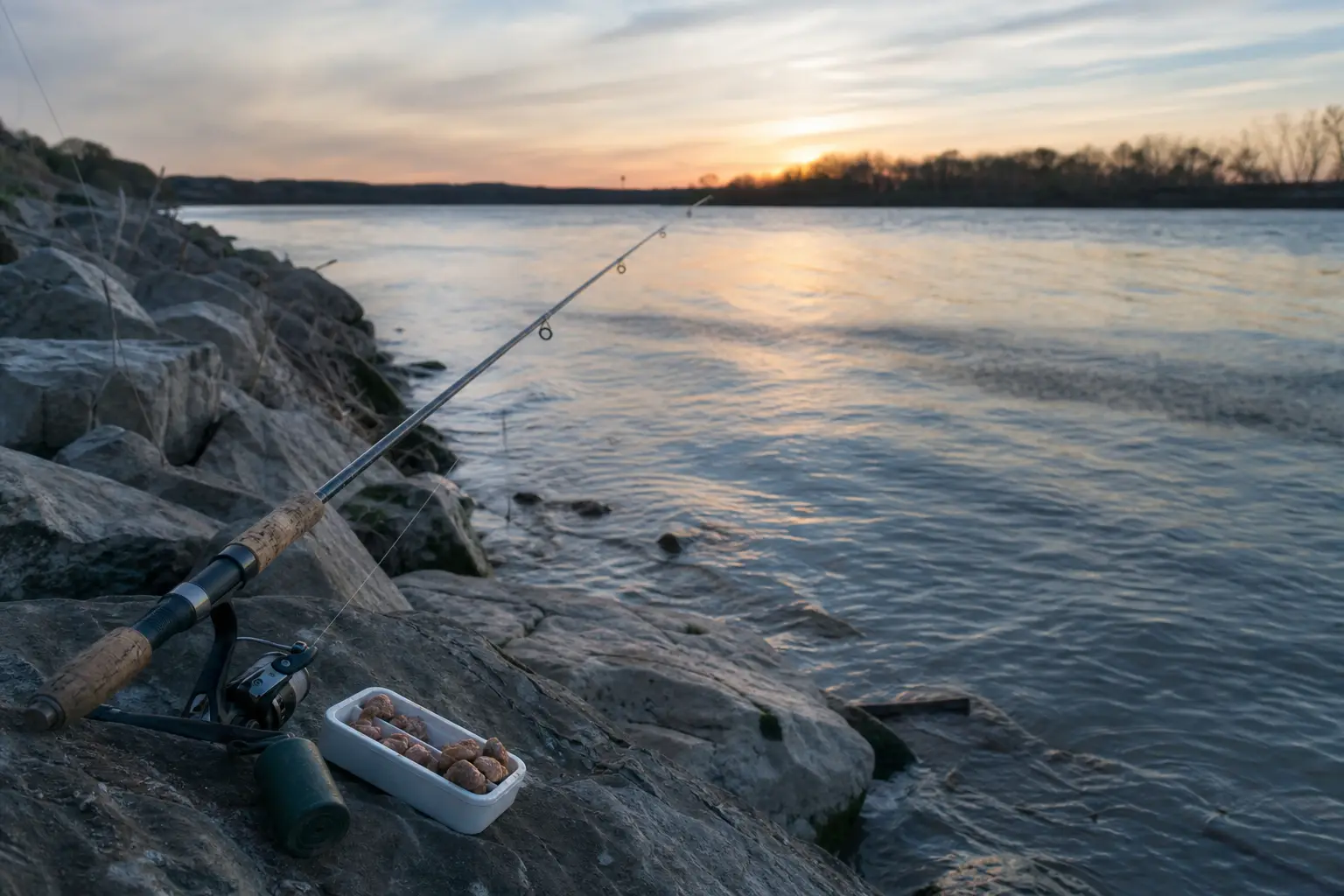
For twenty years I told anybody who would listen that a blue catfish was just a channel cat that ate better and got bigger. I said it on tailgates, at gas stations, in the checkout line next to a rack of blood worms. I said it with the kind of confidence you get when you’ve never once been wrong because you’ve never once tested the thing you’re wrong about. I caught channels by the bucket back home, chicken liver on a sinker rig, throw it out, wait, done. So when a work trip put me on the shore of a lake full of blue cats bigger than anything I’d ever pulled in, I did what any certified expert on a fish he’s never caught does. I fished it exactly the same way and expected a different fish.
The Dead Hours
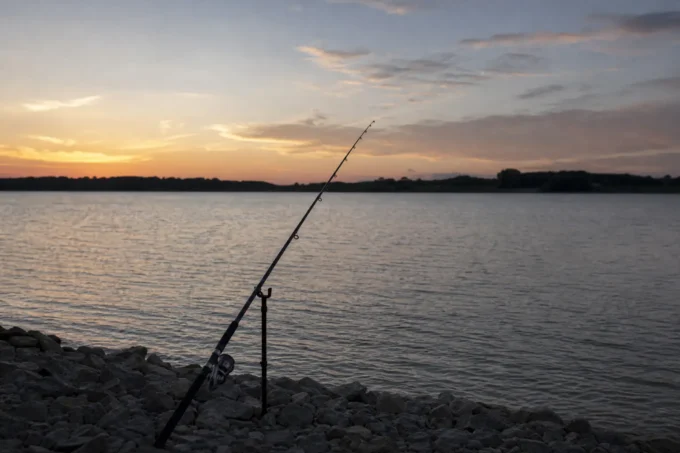
Three evenings in a row I parked on the bank, threaded a liver onto the hook I’ve used since I was nineteen, and chucked it out into water I didn’t understand. Three evenings I watched that rod tip sit there like a stick stuck in mud while the sun went down and the bugs found my neck. Other guys up and down the bank were bent over rods and swinging fish up onto the rocks, and I stood there doing the mental math of what I was owed for showing up. I did not once think the problem was me. The lake was wrong. The bait shop was wrong. The moon was maybe wrong. My liver had gone soft in the cooler. A blue catfish, I decided, was a myth packaged to sell me a lake house I couldn’t afford.
On the third night an old man named Pete, who had fished that lake since before it was a lake, watched me reel in a bare hook for the fourth time and finally said what nobody wants to hear from a stranger with a stringer full of fish. He said a blue isn’t a channel that got lucky. He said if I kept feeding it channel food I’d keep catching nothing and telling myself a story about it.
What a Blue Actually Is
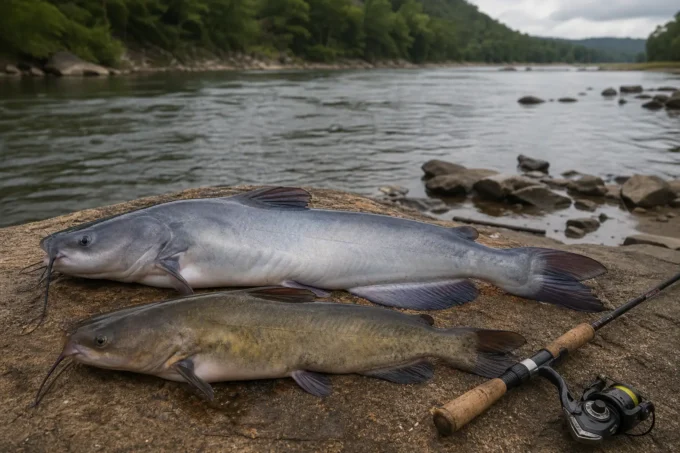
I went home that night mad, which is the cheapest emotion a man can buy, and then I did the thing I’d been too proud to do for twenty years. I looked at the two fish side by side like I was seeing them both for the first time. A blue catfish wants meat, real meat, not a glob of liver melting in the current. It eats other fish, and it eats a lot of them. A channel will root around the bottom and pick up whatever drops. A blue hunts. You can see it in the fish itself, the lean build and the forked tail and the way the whole thing is shaped for chasing down shad instead of nosing through silt. I had been fishing a pursuit predator like it was a bottom scavenger and then blaming the predator for not coming to me.
Pete’s other piece of advice, once my pride unclenched enough to hear it, was that blues don’t sit on the bottom waiting. He ran his cut bait suspended off the bottom, not laid flat on it, and he fished where the baitfish were schooling, because a blue cat doesn’t wander around hoping. It follows the groceries. Find the white perch schools, find the shad, and the blues are right there underneath them, not out in the deep empty saddles where I’d been lobbing liver at nothing.
The First One
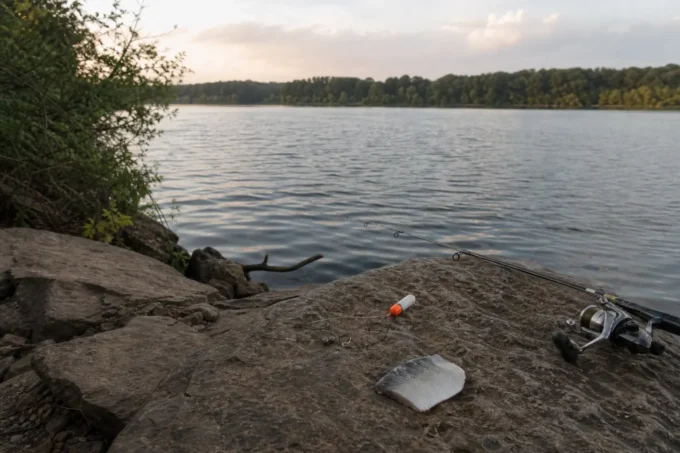
The next evening I stopped at the bait shop and did a humbling thing. I told the man behind the counter I didn’t know what I was doing, and I asked. He sold me a Santee Cooper rig, the kind with the float that suspends a fresh cut bait just off the bottom, and he told me to cut it fresh from shad or perch if I could get them, and that on that lake the blues hung near the perch schools. I bought fresh shad and cut it into thick steaks instead of the shriveled liver I’d been trusting, and I hiked to the stretch where the perch were dimpling the surface, and I cast out a bait that actually looked like something a hunter would want to eat.
It took maybe twenty minutes. The rod doubled over, and everything I knew about twenty years of channel cats fell away in the three seconds it took me to realize what I had hooked was not a bigger version of anything I’d caught before. It pulled like it owed the lake money. When I got it to the bank it was long and silvery-blue and slab-sided, and its tail was forked clean, and looking at it I understood that I had spent two decades calling a wolf a bigger dog because they both had teeth.
I turned it back. It was a big one and I had no business keeping a fish I’d just learned to catch, so I held it in the current until it kicked and watched it disappear. Then I sat on the rocks in the dark and felt something pass through me that wasn’t the cold, and it took me a minute to name it. It was the feeling of being wrong. Not the fake wrong you perform so people stop talking. The real kind, where you look back down a twenty year road and see every confident sentence you ever said sitting there like a bare hook in your own mouth.
Stop Fishing the Fish You Already Know
Here is the part I’d have rolled my eyes at a week before, so I’ll keep it short and you can roll yours. If you’ve caught one kind of fish your whole life and you step up to a new one, check your assumptions before you check the moon. A blue cat is not a channel cat. A new lake is not your home lake. When a local tells you how they fish the water they’ve fished for forty years, the correct response is not to explain your resume. It’s to shut up and listen, because the man with the stringer full of fish isn’t guessing and you are.
Cut the bait fresh and keep it off the bottom. Fish where the baitfish are, because that’s where the predator is. And when you finally feel that first one pull, let yourself be wrong about everything that came before it. You didn’t deserve it by showing up. You earned it the hard way, the only way that ever actually teaches a man anything.