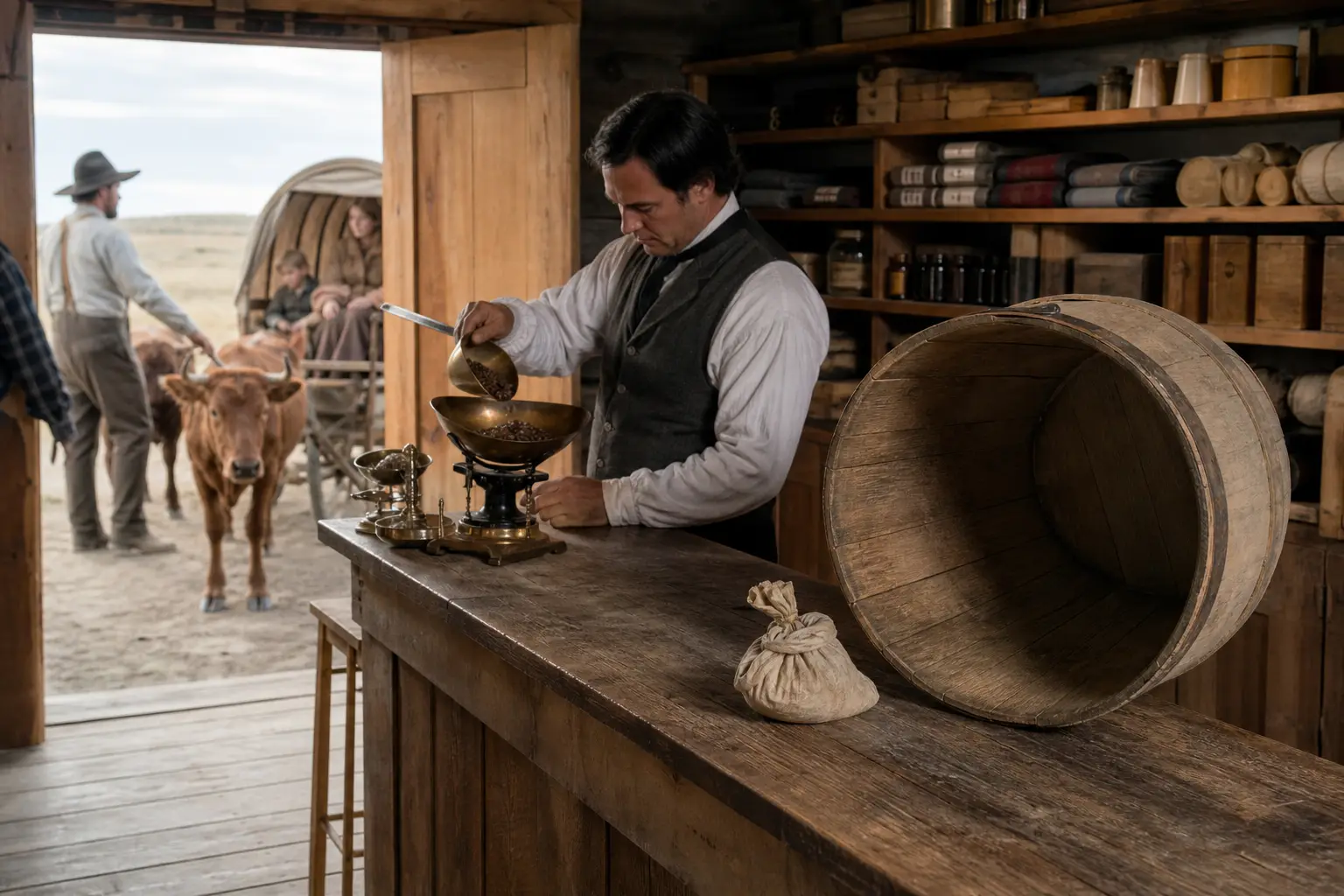
Early September, 1846. Fort Laramie waits behind you and the next post is two hundred miles ahead.
You stand in the door of the trading room with seven dollars and eleven cents knotted into a rag and a flour barrel that has been empty for four days. The clerk behind the counter does not look up. He is weighing coffee on a brass scale, tipping the beans from a scoop with the care of a man handling shot, and the smell of it fills the room like a promise you cannot afford. Your brother-in-law Sam is outside holding the oxen. Hannah is in the wagon with the two boys, and her hands have stopped shaking since you told her there was no bread left, which is worse than the shaking was.
Everything in this room costs more than it cost a thousand miles back east, and you have to buy it anyway, because the next trading post is Fort Bridger, and Fort Bridger is two hundred miles of alkali and dust and three river crossings away. You have eleven cents and a barrel of nothing, and the clerk is still weighing coffee.
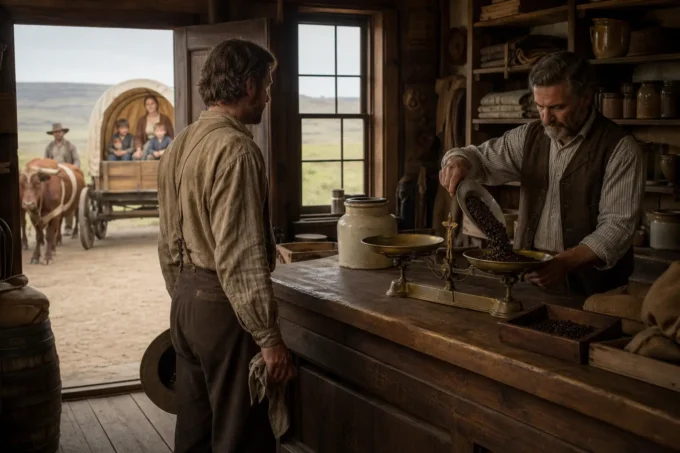
The problem is arithmetic, and the arithmetic does not care how tired you are.
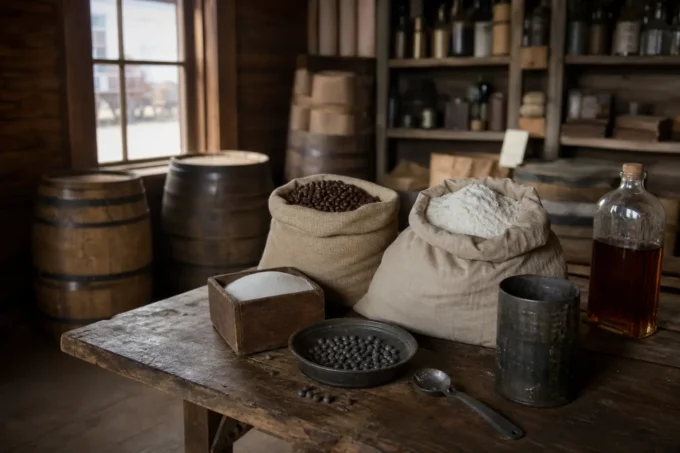
Here is what a dollar buys at a trading post on the trails in the middle of the road. A pound of coffee can run you a dollar to a dollar fifty. A pound of sugar, fifty cents to a dollar. Flour, when there is flour, goes for anywhere from ten to twenty-five dollars a barrel, and a barrel weighs just under two hundred pounds, so you do more than pay for it. You haul it across a country that eats wheels. Powder costs two to four dollars a pound. Lead, the soft grey metal you have been melting into balls by the fire, is close to a dollar a pound when you can get it. Whiskey, when they have it and they often do, costs whatever the clerk thinks you will pay, because a thirsty man is easy arithmetic.
You have seven dollars and eleven cents, and you do not have enough for any of the good answers. That is the frontier. Morrison used to say the difference between a man who makes Fort Laramie and a man who does not is whether he reads a price list before it reads him. Morrison is fifty miles behind you now, dead of the flux, and it turns out the dead leave you with advice and no money.
So you barter, because barter is the only currency that does not run out.
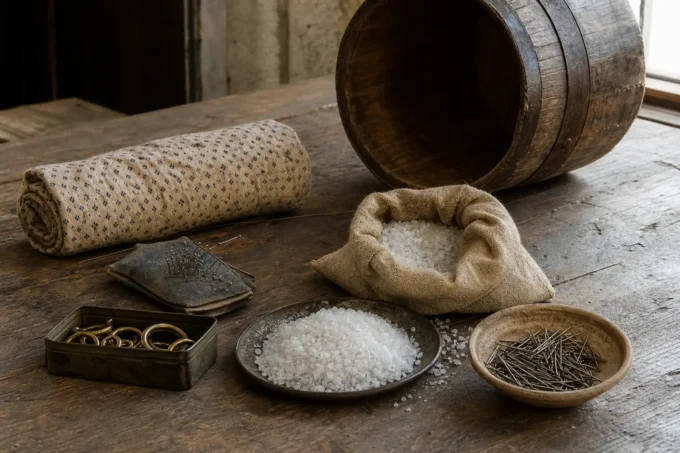
You go back to the wagon and you take stock like a man counting a debt. What travels with you that you can spare. A bolt of calico Hannah has been saving, two dozen sewing needles she bought cheap in St. Joseph, a handful of brass rings. Salt, and salt is the quiet king of the whole road. A pound of salt in the settlements is a few cents. Out here, where meat rots by afternoon and every man is trying to keep a carcass, salt trades like silver. You can get flour for salt. You can get powder for salt. You can get a man to walk your wagon out of a mudhole for a cup of salt, and he will think he got the better of you.
The clerk knows this better than you do, and you both stand there pretending it is a fair fight. You lay the calico down. He does not look at it. You lay the needles down. He picks one up, holds it to the light, sets it back. You say salt and he finally lifts his eyes, and now you are bargaining and it is the only honest conversation the two of you will have.
What actually has value in the middle of nowhere is not what you brought.
Nails. A man with nails can hold a wagon together through a hundred miles of bad road, and there are no nails for sale at Fort Laramie because every man who reaches it has already spent his. Twine. A spool of good twine is a fortune to a man whose harness is falling off his team. Needles. Needles are the smallest thing on your wagon and the hardest to replace, and half the families on this road would trade a day of labor for three of them. Coffee, even a handful, because coffee after three weeks of pine tea can cajole a woman off the edge of quitting. But the real king is salt, and you knew that, and that is why you carried more than you needed.
You make your trade in small, ugly parts. A cup of salt for a twist of tobacco. The calico for ten pounds of flour and a side of bacon that has seen better days but is not green yet. The needles and the brass rings go toward a half-sack of corn meal and a small tin of sugar, and the whole thing takes an hour because the clerk drives every price hard and you drive back harder, and Sam comes in at one point and leans against the door and shakes his head at you like a man who knows you are going to lose.
Losing is part of it, and so is the small mercy of a fair cheat.
The clerk weighs your salt on his scale and you both know the scale is his. He pours the coffee and you both know the scoop is light. You do not get a fair price from a trading post in 1846, because the trading post is the only store within two hundred miles and the clerk is not running a charity, he is running the one thing between you and starving, and he prices that knowledge into every ounce. What you get is a price you can survive, and survival is the only ledger that matters out here.
Hannah takes the flour from you without a word and starts building dough before the sun is down, and the two boys watch her hands the way they watch a fire, and you sit on the wagon tongue and count the rag. There is four dollars and sixty cents left in it, and a long way to Fort Bridger, and you do not feel like a man who won. You feel like a man who slowed down the losing for a few more days.
What Was Real
The trading posts on the westward trails were the only reliable stores for hundreds of miles, and their prices reflected a brutal fact: freight was the real cost. A barrel of flour that cost five dollars in St. Louis could run twenty-five dollars or more at Fort Laramie, and every extra mile past the jumping-off towns stacked money onto it. Coffee, sugar, and flour were luxury goods in the middle of the road, and emigrants who had not packed enough learned to treat them that way.
Salt was the single most negotiable commodity on the trail. In the settlements it was cheap; on the road, where fresh meat spoiled within a day or two and preservation was life and death, it traded like money. Emigrants routinely bartered salt for flour, powder, lead, fresh meat, and labor, and a man who had over-packed salt was richer than a man with hard cash and nothing to spend it on.
The famous posts anchored the road. Fort Laramie, a fur-trading outpost first built in 1834 and purchased by the military in 1849, sat where the Oregon, California, and Mormon trails converged and became the great resupply and repair point of the middle crossing. Fort Bridger, founded by Jim Bridger and Louis Vasquez in 1843, served the mountain crossing. Fort Hall, an old Hudson’s Bay Company post on the Snake River, was the last major stop before the dry interior of the Oregon country. Between them lay two hundred miles or more of ground with nothing for sale at any price.
Black powder and lead were never cheap and never optional. Powder ran two to four dollars a pound and lead close to a dollar a pound at the posts, so emigrants who could cast their own balls and spent their shots carefully watched their hoards the way a gambler watches a shrinking stake. Whiskey, the great frontier lubricant and occasional anesthetic, was priced to whatever the traffic would bear, because a man two hundred miles from the next drink is an easy customer.
The westward migration of the 1840s and 1850s moved roughly 400,000 people across the trails between 1841 and 1869, most of them on the Oregon Trail and its branches, and the trading post was where the arithmetic of the whole journey came due: what you brought, what you spent, and what you were willing to give up to keep moving.