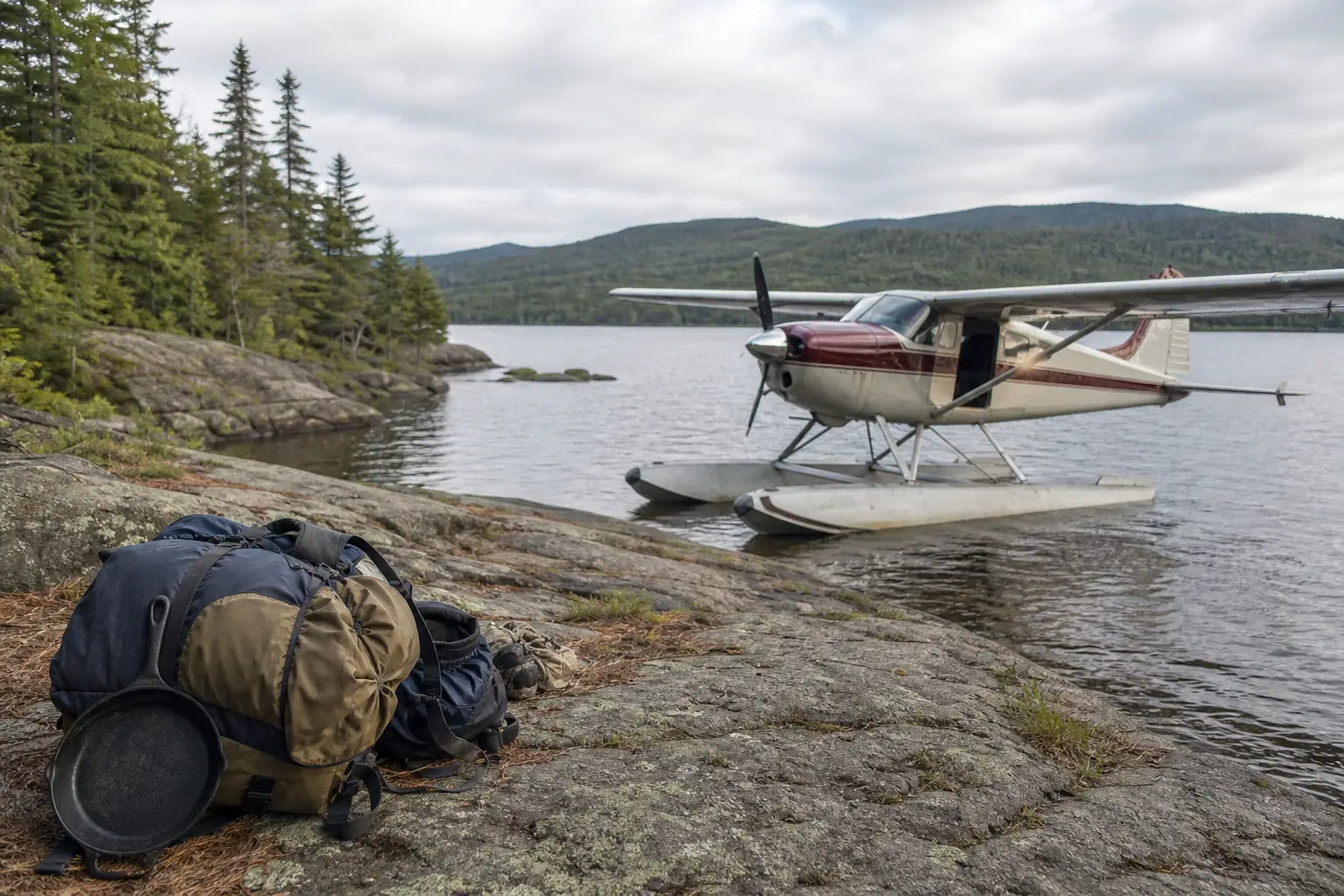
My buddy Dave has this thing where he describes terrible ideas like they’re facts. “We’re gonna fly into the Adirondacks,” he said over a beer in March. “Remote pond. Brook trout the size of your leg. Nobody’s fished it in years.” He said it the way you’d say “the grocery store is on Main Street.” Like it was already done.
I said yes, because Dave is convincing and I am not smart enough to ask follow-up questions. The kind of follow-up questions that might lead to phrases like “one-man float plane” and “no cell service” and “you’re carrying your own water for five days.” I asked none of them. That’s on me.
The Pilot Looked at Our Packs and Laughed
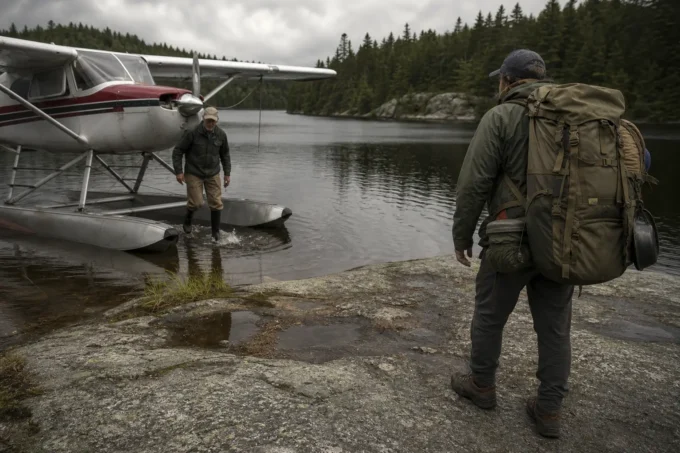
We met the pilot at a tiny airstrip outside Saranac Lake in late June. He was maybe seventy, leather-faced, the kind of guy who’s seen enough idiots to recognize two more walking toward him. He looked at my pack — a 65-liter monstrosity I’d stuffed with a three-man tent, a cast iron skillet, and four pounds of potatoes — and just shook his head.
“You know you’re only there five days, right?” he said.
I did not adjust the pack. I was committed. The skillet was coming.
The float plane was a de Havilland Beaver that smelled like gasoline and old coffee. We strapped in, the engine coughed to life, and twenty minutes later we were banking over water I’d only ever seen on a DeLorme atlas — black, glassy, surrounded by nothing but spruce and silence. The pilot landed us on the pond like he was parking a car, taxied up to a granite ledge, and handed me my pack.
“Pickup’s Saturday at noon,” he said. “If you’re not here, I’m not waiting. Bears come through here.” Then he was gone, the buzz of the engine fading until there was nothing but wind and the slap of water on rock.
The Tent Pole I Didn’t Pack
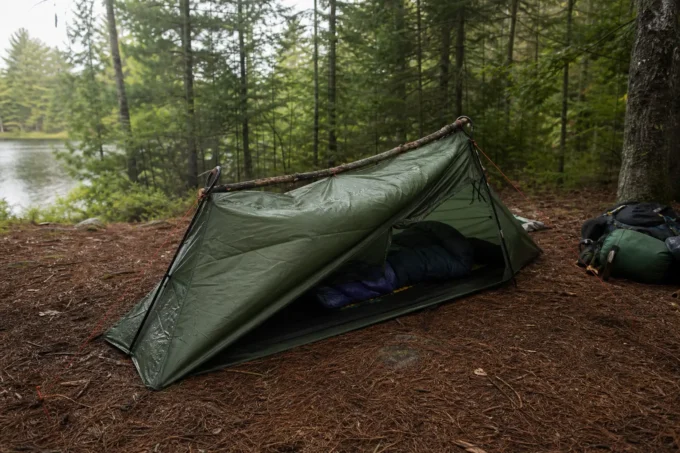
Here’s where I earn my idiot badge. I’d brought a three-man tent for two people — generous, spacious, plenty of room for gear. What I had not brought was the center pole. I’d taken it out three weeks earlier to dry the tent in the backyard and left it leaning against the shed. I didn’t realize this until Dave and I had the tent body laid out on a flat patch of pine needles, and Dave said, “Alright, hand me the poles.”
I handed him the two end poles. He waited. I waited. The mosquitoes did not wait.
“Lena,” he said. He calls me by my last name when he’s disappointed.
We spent the next hour lashing a dead spruce branch between the two end poles with paracord and prayer. The tent sagged in the middle like a collapsed lung. Every night for five nights, the roof was six inches from my face. Every morning, I woke up with condensation dripping onto my forehead. Dave slept diagonally in the other half and never complained once, which made it worse.
The Fish Were There. I Was Not Ready.
The pond was maybe forty acres, ringed with deadfalls and granite ledges. The water was so clear you could see bottom at fifteen feet. And there were fish. Big ones. Brook trout that cruised the drop-offs like submarines, dark-backed and spotted, some of them pushing four pounds. I’d never seen wild brook trout that size. I still haven’t caught one that size.
I fished the first afternoon like a man who’d forgotten everything he knew. I tied on a bright orange spinner — orange, in crystal-clear water — and cast it directly onto the fish like I was throwing a rock at them. They vanished. Every single one. I’d watch a trout the size of a football drift out from under a log, I’d cast three feet past it, and it would be gone before the lure hit the water. Spooky. Educated. Probably laughing at me in whatever language trout use.
Dave caught two in the first hour on a size 16 Adams. I caught a tree branch and a rock.
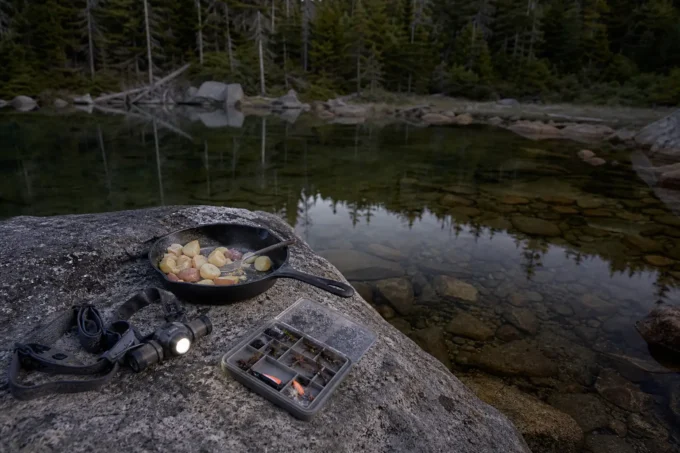
That night, I sat on the granite ledge in the dark, eating cold potatoes out of the cast iron skillet I’d hauled six miles round-trip from the drop point (the pilot had landed us a mile from the actual pond — another detail I hadn’t asked about), and I went through my tackle box by headlamp. I had exactly three things that might fool a smart brook trout in gin-clear water: a black Woolly Bugger, a muddler minnow that looked like it had been chewed by a dog, and a tiny gold Panther Martin I’d bought on clearance in 2018 and never used.
Day Three: The Gold Panther Martin
I woke up on day three with a stiff neck from the collapsed tent, a dozen new mosquito bites on my ankles, and a plan. I tied on the tiny gold Panther Martin, crimped the barb, and decided I was going to stop being a bass fisherman for five minutes and start thinking like a trout.
I walked the shoreline barefoot — my boots were still wet from a misstep the day before — and found a spot where a submerged log angled out from the bank into deeper water. There was a seam of current where a small feeder creek trickled in, pushing bugs toward the log. I crouched behind a granite boulder so my silhouette wouldn’t break the skyline, and I cast ten feet upstream of the log with a long, low sidearm flick that barely dimpled the surface.
The spinnerblade caught the current immediately. Gold flash. The rod tip twitched. I let it drift into the seam, right along the edge of the log.
The take was not dramatic. No explosion, no jump. Just a heavy, deliberate pull and then the rod bent double and the line started cutting across the pond. I still have no idea how big that fish actually was, but I know it was the biggest brook trout I have ever had on the end of a line. I know this because I fought it for maybe fifteen seconds before it ran under the log, wrapped the line around a branch, and broke me off like I wasn’t there.
I stood there in the water up to my knees, holding a slack line and a bent rod, barefoot on sharp granite, and I laughed. I laughed because it was the best fifteen seconds of fishing I’d ever had, and because I’d hiked a cast iron skillet six miles for cold potatoes, and because I was sleeping under a collapsed tent in bear country with a man who called me by my last name when I screwed up.
The Fish We Actually Ate
I didn’t catch the monster. But I caught fish that day. Three brookies, all between ten and fourteen inches, all on that same tiny gold Panther Martin. Dave caught seven. He always catches more than me. I’ve stopped caring.
We kept four, gutted them on the ledge, and cooked them in the cast iron skillet over a fire Dave built while I was still untangling my leader. Butter, salt, a lemon I’d remembered to pack (priorities). The skin crisped up golden, the meat flaked white, and we ate with our fingers while the sun dropped behind the spruce and the pond went glass-still. Best meal of my life. Not because the fish were special — brook trout always taste good — but because the skillet had earned its place. I’d carried the damn thing. It owed me.
What I Learned (Besides Don’t Forget the Tent Pole)
Here’s the thing about remote fishing trips: they strip away all the noise. No depth finders, no trolling motors, no bass boats with more horsepower than my first car. Just you, the water, and whatever you actually know — not what your electronics know, not what YouTube told you, just what’s in your head and your hands.
I learned that I’d been fishing lazy for years. I’d been relying on gear instead of observation. I’d been casting to water instead of casting to fish. I’d been packing cast iron skillets when I should have been packing tent poles.
The pilot picked us up Saturday at noon, right on time. He looked at the collapsed tent, the skillet, my barefoot tracks on the granite, and didn’t say a word. Just nodded. Like he’d seen it all before.
Next year, Dave wants to fly into northern Maine. There’s a pond up there, he says, with brook trout the size of your leg. Nobody’s fished it in years.
I’m going. But I’m leaving the skillet at home.