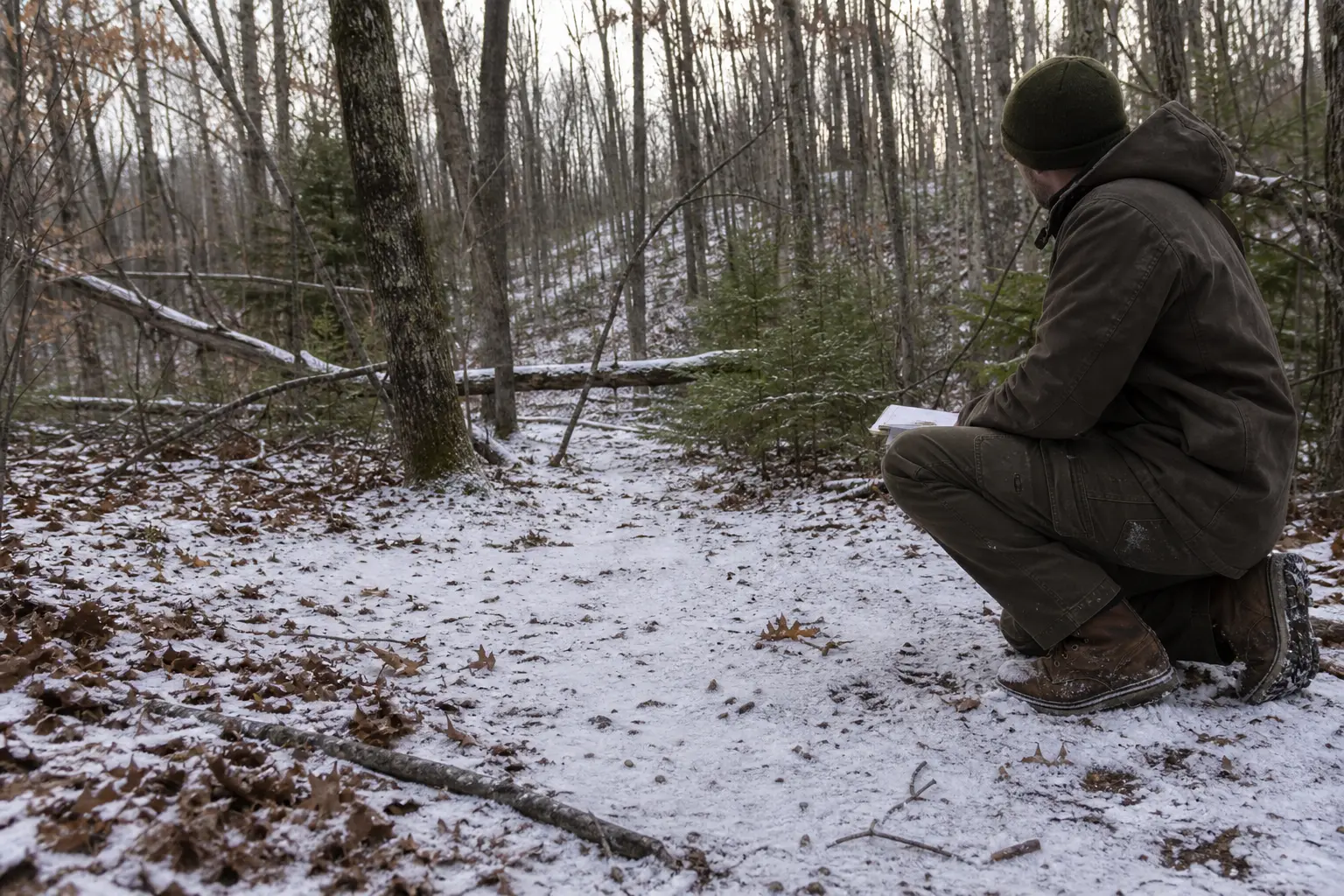
I spent my first three seasons hunting the same way: find a spot, sit down, stare at the woods, go home. Sometimes I saw deer. Usually I didn’t. I told myself it was bad luck. Wrong wind. Other hunters pushing them around. The deer just weren’t moving that day.
That’s the easy story to tell yourself. It requires zero work and zero self-examination. The harder truth — the one I avoided for three years — was that I had no damn idea where the deer actually were. I was hunting the woods I wished existed, not the woods in front of me.
The Morning I Watched Instead of Hunted
It was early November in northern Michigan, about 22 degrees with a dusting of snow from the night before. I’d been in my stand since 5:30 AM. By 9:00 I’d seen one squirrel and a blue jay that yelled at me for twenty minutes straight. I was cold, bored, and seriously considering whether Burger King had started serving lunch yet.
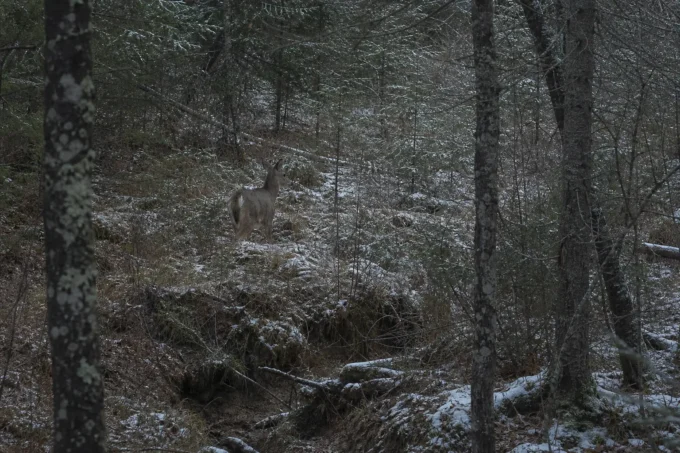
Then, around 9:30, a doe appeared. Not in front of me. Behind me. About 80 yards to my left, moving along a faint trail I’d never noticed before. She crossed a small drainage ditch I’d written off as too steep for deer, slipped through a gap in some scrubby pines, and vanished into a thicket I’d been ignoring for three years because it looked like a wall of tangled hell.
I didn’t get a shot. It was the wrong angle and anyway, the season was bucks only. But I sat there with my mouth slightly open, watching her move through terrain I’d convinced myself deer didn’t use. The deer, it turned out, had not read my mental map of the property. She was using a route I’d never considered because I’d never actually looked.
That was the morning I realized the problem. I’d been hunting the same way I watch football — sitting in one spot, hoping something interesting happens in front of me. But deer don’t work like a TV broadcast. They move on their own logic, through their own terrain, and if you don’t understand that logic, you’re just a guy freezing his ass off in the woods with a weapon in his lap.
Learning to Read Sign (Badly, at First)
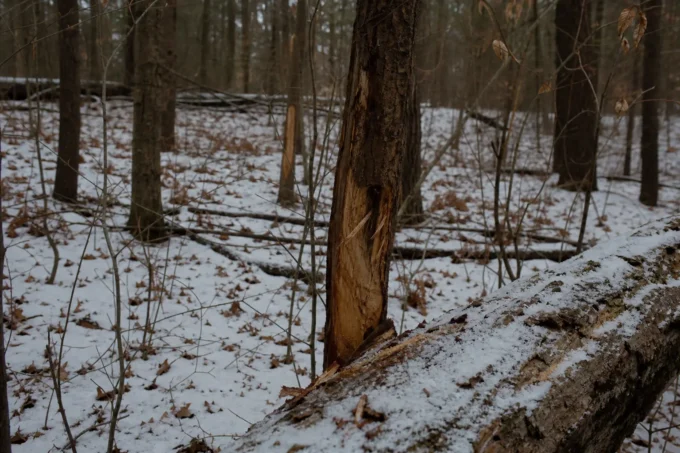
After that season I decided I was going to learn to read deer sign. Real sign, not just “here are some tracks in the snow.” I mean bedding areas, travel corridors, scrape lines, the whole thing.
My first attempt was a disaster. I drove out to public land in February with a notebook, a topo map I’d printed at the library, and a confidence level that was about eight notches above my actual ability. I found tracks. Lots of tracks. I followed them with the enthusiasm of a bloodhound and the navigational skill of a man who once got lost in a Walmart parking structure.
After two hours I had walked in a giant circle, spooked something that might have been a deer or a very large raccoon, and filled my notebook with observations that were, in retrospect, completely useless: “Deer walked here.” “More tracks.” “Cold.” “Hungry.” Real Sherlock Holmes material.
The problem was I didn’t know what I was looking at. I saw tracks but couldn’t tell fresh from old. I saw rubs but didn’t understand which direction the buck was traveling when he made them. I found a bedding area — I think — and promptly plowed through the middle of it like I was mowing a lawn. If there were deer within half a mile, they were in the next county by the time I finished my “scouting.”
I went home, thawed out, and admitted something that stung: I had been hunting for three years and I was still functionally illiterate in the woods.
The Old Man at the Gas Station
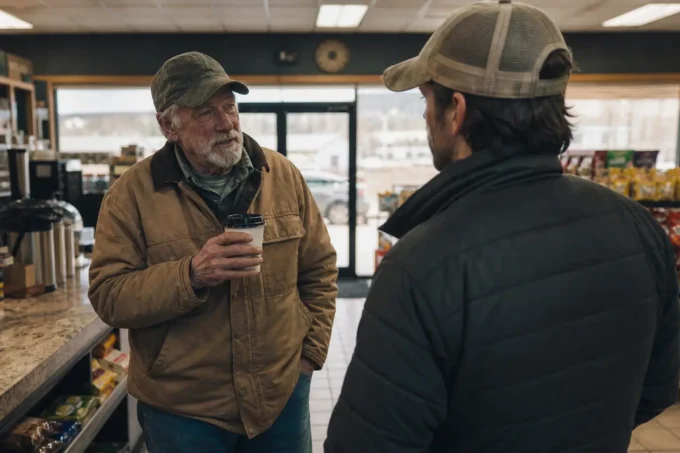
A few weeks later I stopped at a gas station near state land and got talking to an old guy buying coffee. He had that look — worn Carhartt jacket, boots that had seen actual miles, hands that looked like they’d spent more time outdoors than in. I mentioned I was trying to learn to scout better and he laughed. Not in a mean way. More like he recognized something.
“You walking around looking at tracks?” he asked.
I said yeah.
“Stop that,” he said. “Tracks tell you where a deer was three hours ago. You need to know where he’ll be tomorrow.”
Then he gave me the best piece of scouting advice I’ve ever received, and I’m giving it to you for the price of reading this far: don’t follow tracks, follow the terrain. Deer are lazy. They take the path of least resistance just like you do. They bed where the wind covers their back and their eyes cover the approach. They move from food to bed to water along routes that minimize effort and maximize safety.
“Find a saddle between two ridges,” he said. “Find a creek bottom with cover on both sides. Find where a field narrows to a pinch point. That’s where they’ll walk, every time, no matter what the tracks say today.”
He paid for his coffee, tipped his cap, and walked out. Never got his name. But that five-minute conversation changed my hunting more than any gear purchase I’ve ever made.
What I Actually Do Now
I still scout. But I scout terrain, not just sign. Here’s what I look for, and it’s not complicated:
Transition lines. Where thick cover meets open timber. Where pines become hardwoods. Deer edge along these lines. They’ll travel the thick side, a few yards in, where they’re invisible but can still see into the open.
Pinch points. Anywhere the terrain forces movement through a narrow corridor. A strip of woods between two fields. The narrow part of a ridge. A creek crossing with steep banks on both sides. Put yourself 30 yards downwind of a pinch point and wait.
Benches. Not the kind you sit on. The kind that form on hillsides — flat spots partway up a slope. Deer bed on benches because they can watch downhill with their eyes and smell uphill with the rising thermals. Approach from above if you can. If not, figure out the wind and don’t bother if it’s wrong.
The ugly stuff. Thickets nobody wants to walk through. Swamp edges. Overgrown clearcuts. The places that look miserable to human eyes are exactly where pressured deer spend their daylight hours. I’ve killed two of my best bucks within 40 yards of the nastiest, thorniest, most God-forsaken patches of cover on the property. The kind of spots where you have to crawl, not walk, and you come out bleeding from places you didn’t know could bleed.
The Hardest Lesson
The thing about learning to read terrain is that it forces you to admit something uncomfortable: most of the time, the deer aren’t where you are. They’re somewhere else. Somewhere smarter. And finding them means leaving your comfortable spot, your familiar tree, your proven sight line, and going to where they actually live.
I still catch myself falling into the old habit. Sit in the same stand because it’s easy. Tell myself the deer will show up eventually. But now I recognize the feeling — that nagging voice that says “you’re hunting a stand, not hunting deer” — and I get up and move.
The woods don’t care about your routine. The deer don’t care about your comfort. You either learn to read the terrain and meet them where they are, or you keep buying tags for scenery. I’ve done both. The tags taste better when you fill them.