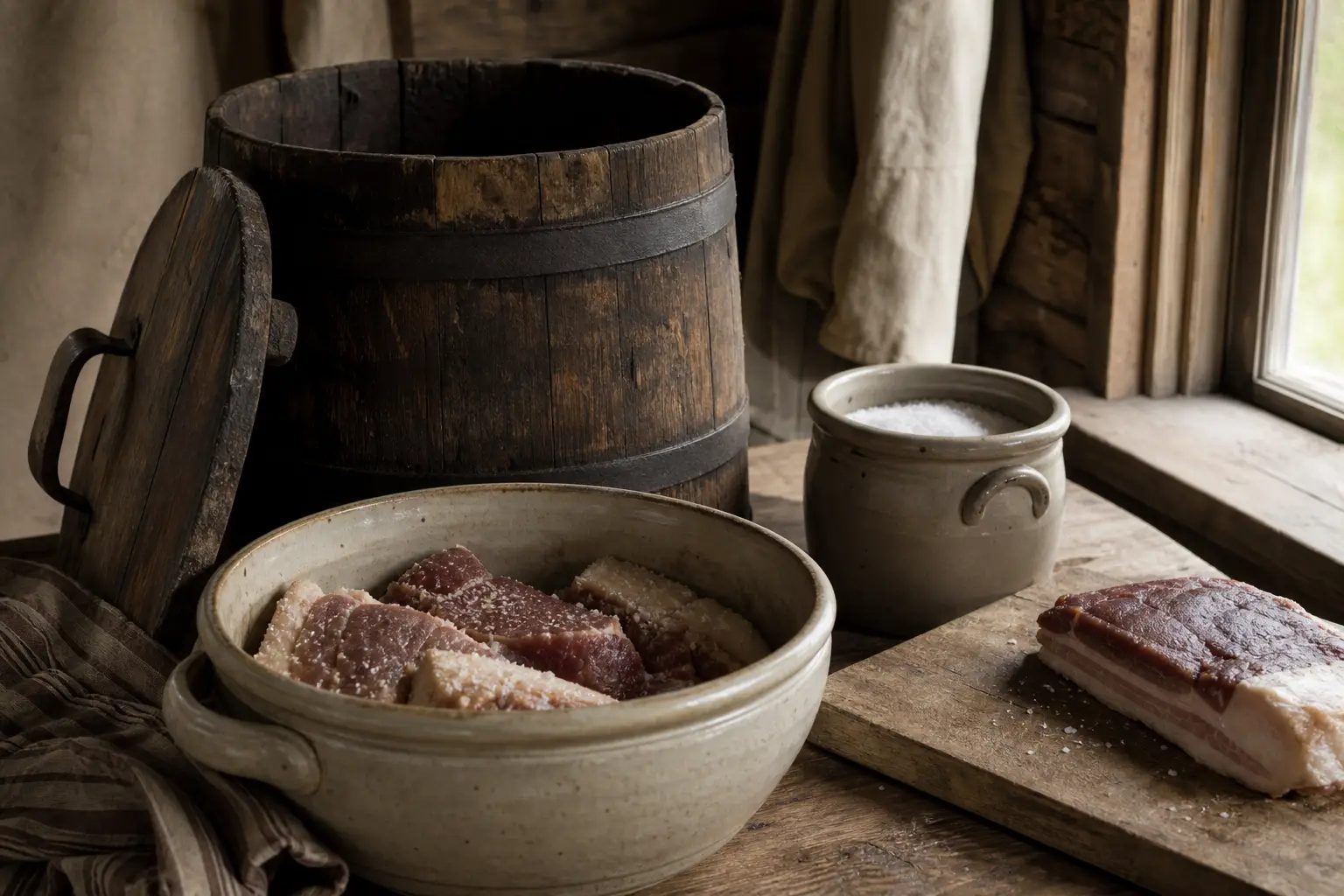
You wake because something is moving in the wagon, a low, wet sound like a man turning over in mud, and then the smell finds you. It is late September, 1847, and you are camped near the Sweetwater River, three weeks from the last trading post and a thousand miles from the nearest place that sells ice. You push the canvas back and the smell comes out of the wagon box like a thing with hands. The half barrel of pork you packed in Independence has turned. The brine has gone dark and ropey, and the smell is sweet in a way that makes your stomach climb into your throat.
Your brother-in-law Sam is already out of his blankets, and he does not need you to say it. Sam once butchered hogs back in Ohio, and he has been watching that barrel with a kind of quiet dread for three days. “Salt ran short,” he says, and it is not a question. Behind him, your wife Hannah is sitting up with the baby, and she knows what the smell means, because there are six people in this party and what is in that barrel was supposed to feed the children for the next month.
Old man Morrison is no help. He died two weeks back of the flux, and you buried him by the Platte with a piece of harness for a marker, and you try not to think about how the last thing he ate was a piece of that same pork. The world on this trail is built out of things that spoil, and meat is the worst of them, and nobody coming after you is going to hand you another barrel. It falls to you. It always falls to you.
The Salt You Do Not Have
Here is the whole problem in one sentence. Meat rots because the water inside it feeds the things that eat it. Salt stops the rot because salt pulls that water out. The trouble is the amount of salt, and how little of it you brought, and how far you are from getting more. Your grandfather out east salted his hogs with a measure you can still see him doing, a heavy hand, a fistful to the pound, salt so cheap and common back in Ohio he never once thought about the day it would be heavier than gold.
Out here salt is not common. It is the single most expensive thing in your wagon, more precious than the coffee and the lead and the medicine all put together. You bought it by the twenty-five pound sack in Independence, and you paid the storekeeper’s price without blinking because you knew, and now you are counting what is left by the handful, and the barrel of pork is not the only thing going bad. Every man on this trail is doing the same arithmetic, and every man has come up short.
You do not get to throw the pork away. That is the part nobody tells you when you read about the frontier in a warm parlor. You cannot bury it, because you will need it, and you cannot eat it rotten, because it will lay you down the way it laid down Morrison. So you do the only thing there is to do. You get up, and you start over, and you save what can be saved the way your grandfather would have, if your grandfather had been a thousand miles from a salt lick with winter coming.

How You Actually Save It
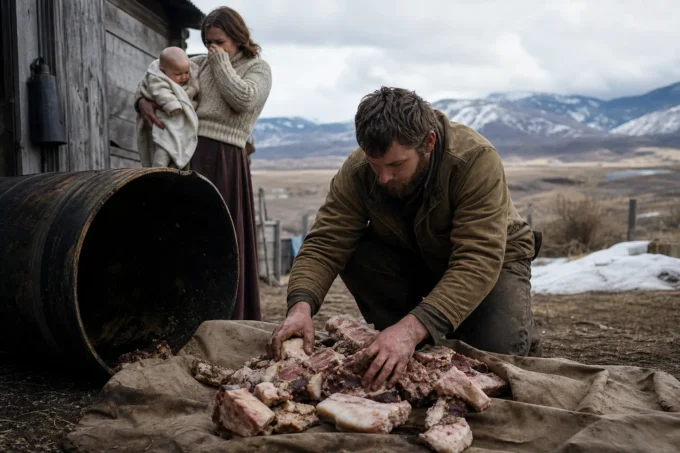
First you drag the barrel out into the light, and the stink rolls out of it so strong that Hannah turns away with the baby and Sam’s eyes water. You tip it over on a scrap of canvas and sort through what is there with your bare hands, and this is not a clean job and you do not pretend it is. The outer pieces, the ones that touched air, are gone, and they go to the dogs. The center pieces are still pink, and you take those. The rule your grandfather taught you was that salt only works if it can reach the whole piece of meat, and the pieces that have already begun to turn on the surface are not saved by adding more salt. They are saved only by cutting away until you reach meat that is still firm and clean.
You trim with the same knife you skin with, long and thin, and you cut thin and you cut wide, because a thick piece of meat will not take salt to the center before the center turns. You cut the good pink meat into strips as thick as your thumb, strips with as much surface as you can give them, because salt works on the surface first and slows its way inward. Then you lay the strips out on a clean board and you rub them, one by one, with a fistful of salt rubbed down into the grain the way a man works grease into a harness. You use more salt than you want to, because you only get one chance, and the smell of the barrel is still in your nose telling you exactly what happens if you are stingy.
The salt stings the raw places on your knuckles, the little cuts from a hundred days of trail work, and the meat bleeds clear juice that runs off pink and salty onto the board. That is the water leaving, and that is the whole trick, the water going out so the rot has nothing left to drink. You pack the salted strips down into a clean crock, your last clean crock, and you press them tight and you sprinkle salt between the layers the way a man lays stone, and you put a clean cloth over the top and a stone on the cloth to hold the meat down under the brine that will form on its own.
And then, because salt is not enough by itself this far from a smokehouse and this far into a hot autumn, you build a rack of green willow over a low smoky fire and you string the rest of the strips across it, and you let the smoke get into them. Not a cooking fire. A smudge, a low ghost of a fire, smoking more than burning, and you sit near it all afternoon flicking at the mosquitoes that land on your neck, turning the strips so the smoke hits every side.
What Sits in the Wagon With Everyone
The work is slow and the day is long and while you work the rest of the party goes about the small human business of being alive. Hannah nurses the baby in the shade of the wagon and sings a hymn half under her breath, the same one over and over, and you do not tell her to stop. The two Miller boys, Tom’s and Joe’s, squabble over a stick and then make up over the same stick, the way children do, and the whole time you are washing your hands in the river water and thinking about the people back east who will carve a roast on Sunday and never once count how many spoonfuls of salt they can afford before March.
You do not envy them, and you do not hate them. You think about them the way you think about a picture in a book of a place you are not going back to. Then Joe Miller comes over and looks at your salt sack and does not say anything, and that silence is worth more than any ten words, because Joe’s own meat turned a week ago and he threw it in the river rather than watch it go. You know, and he knows you know, and neither of you asks the other for a handful of salt, because that is not how the trail works. Everything is counted. Everything is someone’s winter.

Three Days Later, What the Rain Takes
Two days later you think you have won. The smoked strips are dark and dry and hard as shoe leather, and the crock of salted pork smells clean and salted and almost good, and you have let yourself believe the worst is over. Then the rain comes at night, a flat hard rain that turns the ground to soup and finds its way under the wagon where you stacked the last of the smoked meat to keep it out of the sun.
You wake to it, out of a dead sleep, and by the time you are on your feet with a lantern the rain has got into the stack, and half the strips are soaked through and already slimy to the touch where the smoke did not quite reach. You stand there in the dark with the rain running down your face and you do the math, and a third of what you saved is gone, and the loss sits in your chest like a stone. But the crock is dry, and the crock is what matters, and that is the frontier stripped to its real lesson. You do not get to save it all. You get to save what the sky lets you save, and you count that a victory you are too tired to feel.
In the morning you feed the soaked strips to the dogs and you say nothing, and Hannah does not ask, and you pack the crock back into the wagon under the bed and you start walking. The salted pork in that crock will carry you through three more weeks, if the nights stay cool and the salt holds, and that is a thing you know and do not say out loud, because saying it would be a kind of borrowing against luck, and you have stopped borrowing. The truth nobody writes on the side of a covered wagon is that a man can stand over a barrel of meat and know, with his whole body, what a handful of salt is worth, and still have to watch half of it wash into the dirt in the rain.
What Was Real
Salt was the most important and expensive preservative carried by emigrants on the overland trails. Before refrigeration, salting meat was one of the oldest and most reliable ways to keep it, and it worked through the same principle it always had. Meat spoils when bacteria and enzymes break it down, and salt kills or slows most of the spoilage microbes and draws water out of the tissue through osmosis. A dried, salted piece of meat is a hostile place for the things that cause rot, which is why salt-cured pork and beef could last for months without ice.
The two main techniques were dry salting and brining. In dry salting, salt was rubbed directly into cut meat and the pieces were packed in layers with salt between them, so that the salt drew out enough moisture to form its own brine and cure the meat through. In brining, meat sat submerged in a strong saltwater solution for days or weeks. Both methods needed a great deal of salt, and the rule of thumb of the era ran to roughly a pound of salt for every few pounds of meat, which is why salt was so costly on the frontier.
Salt was scarce and expensive on the Oregon Trail precisely because it had to be hauled or purchased. Emigrants bought it in bulk at outfitting towns like Independence and St. Joseph at the start of the journey, and it was among the heaviest and most closely guarded goods in any wagon. Prices rose sharply at the trading posts and forts far from the river towns, where a sack of salt could cost several times what it had sold for at the trailhead, because the trader had hauled it there and the buyer had no alternative.
Salt was also a form of currency and a staple of trade. It had value to Native peoples as well, and natural salt deposits and salt springs were known and worked in several parts of the West. But for most emigrants, the salt they carried was the salt they would live on, and running short meant losing food that could not be replaced. This is why so many accounts of the trail mention salt in the same breath as flour, bacon, and coffee, and why the smell of a barrel of meat turning in the back of a wagon was one of the genuine everyday catastrophes of the crossing.
The great migration along the Oregon Trail ran from about 1843 to 1869, with an estimated 400,000 people making the trip. For every one of them, the fight against spoilage was a daily, practical concern, and salt was the first and often the only weapon. Alongside salting, emigrants also smoked meat over low fires and dried it into jerky and pemmican, but it was the salt barrel that carried most families through the lean months when the hunting was poor and the next trading post was a week of hard walking away.