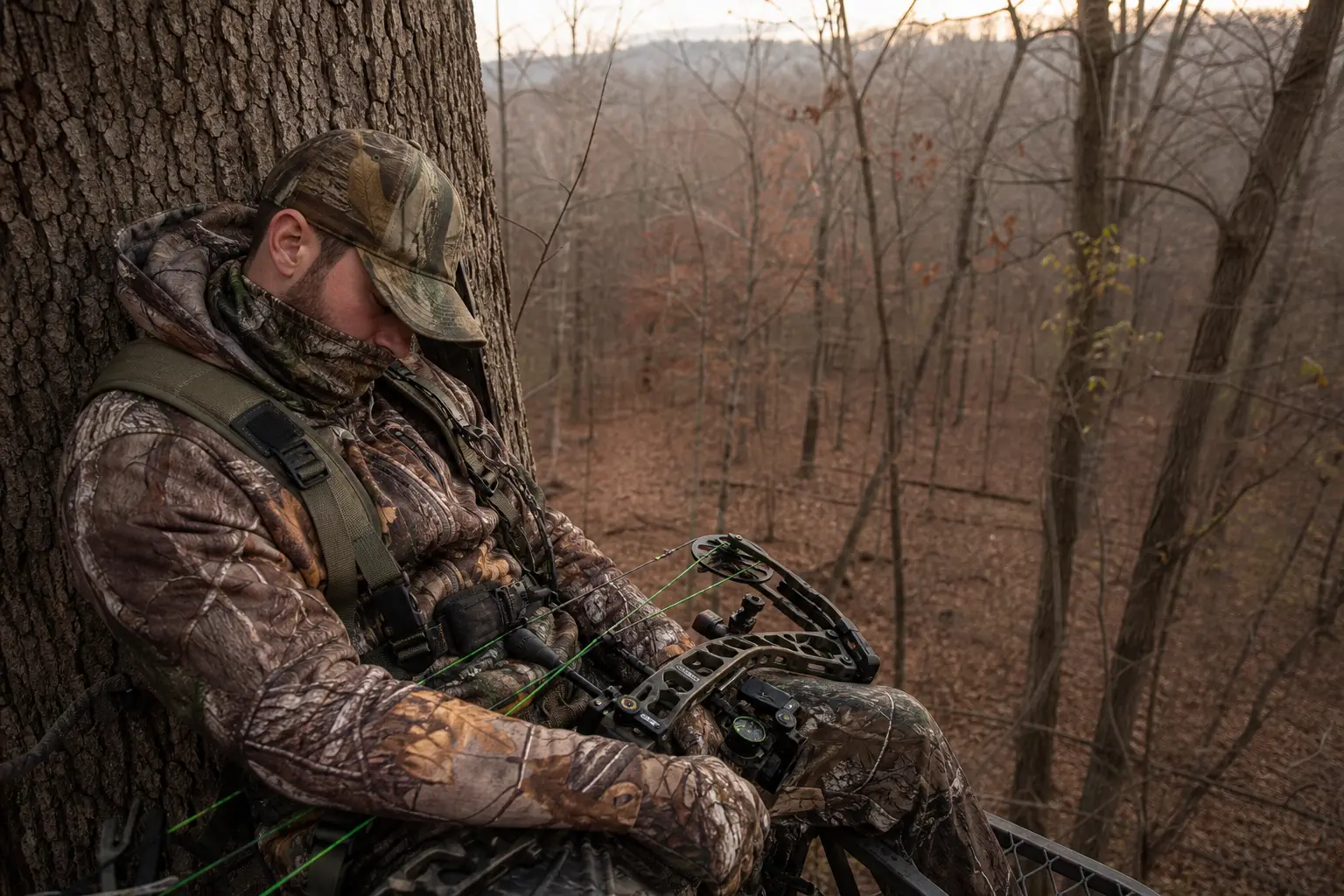
I didn’t plan to fall asleep. Nobody ever does. But there I was, 16 feet up a white oak in southern Ohio, chin on my chest, bow across my lap, drooling onto my release. It was November 4th. I’d been in that stand since 5:15 AM. It was now somewhere around noon. I had been awake for roughly 30 hours.
The night before, I’d worked a double shift at the warehouse. Got off at midnight. Drove two hours to the public land spot I’d been scouting since August. Slept in the cab of my truck — and by “slept” I mean I closed my eyes and shivered for three hours while my back seized up against the seatbelt buckle. At 4 AM I was hiking in, headlamp cutting through fog, feeling like a zombie with a tree stand on his back.
The morning sit was a bust. I watched squirrels. I watched crows. I watched a raccoon waddle through at 9 AM like he owned the place. By 10:30 the thermos was empty and my eyelids were getting heavy in a way that felt less like tired and more like gravity had personally decided to target my face.
I told myself I’d just close my eyes for five minutes. Not sleep. Just rest them. The way my dad used to say he was “resting his eyes” during football games while snoring loud enough to rattle the windows.
The Best Hunting Technique I’ve Ever Found
I don’t know how long I was out. Twenty minutes? Forty? Long enough that my neck made a sound like cracking ice when I snapped awake.
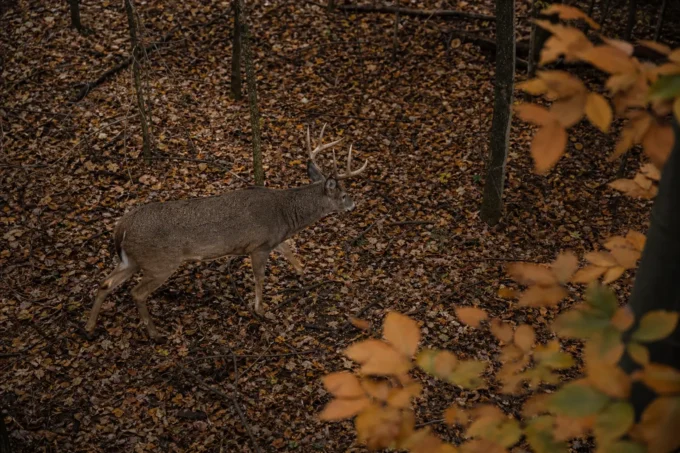
There was a buck standing 22 yards to my left.
Not a spike. Not a basket six. A real deer. Heavy eight-point, neck swollen up like he’d been at the gym all October, walking slow through the fallen leaves like he didn’t have a care in the world. He was coming from the trail I’d walked in on four hours earlier.
I did not move. I did not breathe. I watched this buck — this deer I’d been chasing trail camera pictures of since August — walk directly under my stand and stop. He looked up. Right at me. For about three seconds that stretched into three years.
Then he put his head down and kept walking.
I was too frozen to even think about drawing. By the time my brain caught up with what my eyes were seeing, he was 40 yards out and angling into the thick stuff. I watched his rack disappear into the brush like a taunt.
The Accidental Pattern
Here’s where it gets stupid. That wasn’t the only time it happened.
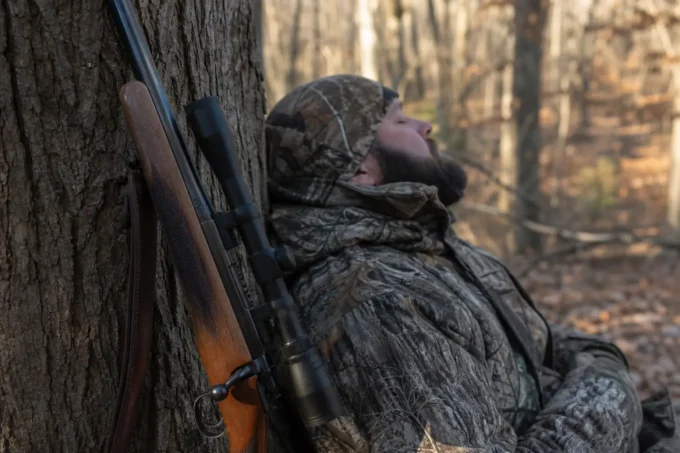
Two seasons later, different piece of public land, this time during the Missouri rifle season. I’d hiked three miles in before daylight, set up on a ridge overlooking a saddle that had more tracks than a Walmart parking lot. Sat from 6 AM till 2 PM. Nothing. Not even a squirrel. By mid-afternoon the sun had warmed my face up just right and the sit had turned into one of those pleasant, drowsy, I’m-just-gonna-rest-my-forehead-on-this-tree situations.
I woke up to the sound of hooves in dry leaves. Two does and a young six-point were feeding 60 yards down the saddle, working their way toward the oak flat. I had time. I got the rifle up slow, found the doe in the scope, settled the crosshair behind her shoulder. She dropped in her tracks.
I had just shot a deer approximately 90 seconds after waking up from a nap. My heart rate was lower than it is when I’m ordering coffee.
Okay, What the Hell Is Going On
I’m not saying naps in the stand are a hunting strategy. That would be insane. What I’m saying is that I started paying attention to what was actually happening when I fell asleep, and it turned out to be a lesson I’d been too stubborn to learn any other way.
The deer weren’t showing up because I was asleep. They were showing up because I had stopped doing all the dumb stuff I normally did when I was awake.
When I’m awake in a stand, I fidget. I check my phone. I shift my weight. I turn my head at every sound like a cat watching a laser pointer. I stand up, sit down, stand up again. I adjust my harness. I drink coffee. I eat a granola bar that crinkles loud enough to be heard in the next county. I range the same tree six times because I’m bored.
When I’m asleep, I do none of that. I become a lump of camo that doesn’t move, doesn’t smell like coffee breath and granola wrapper, doesn’t make a sound except whatever pathetic noises my sinuses are producing.
Deer pattern hunters. Everybody knows this. What I didn’t realize was that they were patterning me so precisely that they knew exactly when I was awake and fidgeting versus when I had passed out from exhaustion. The woods got quiet when I got quiet. And quiet woods are where deer feel safe.
What I Actually Learned (No, Not “Take More Naps”)
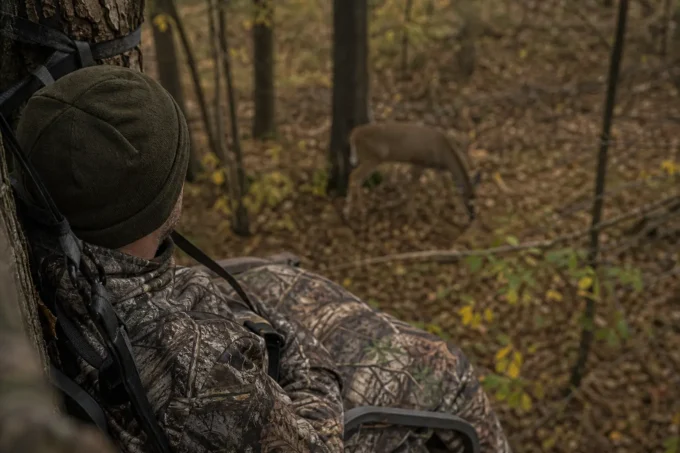
Look, I’m not recommending you fall asleep 16 feet up a tree. That’s stupid. I got lucky I didn’t fall out of my stand. Use your safety harness, clip in, do all the things you’re supposed to do. What I’m saying is I learned more about deer movement from the times I accidentally shut up and stopped moving than I did from years of deliberate, attentive hunting.
Here’s what changed after those accidental naps:
I stopped doing the mid-morning stand shuffle. You know the one — you’ve been sitting since dawn, it’s 9:30, you haven’t seen anything, so you decide to climb down and “still hunt” your way to a different spot. What you’re actually doing is walking around the woods making noise during the time when a lot of mature deer — especially pressured ones — start moving. I’d been climbing down right when the deer were getting up.
I quit checking my phone. Not just because the screen glow is visible — which it is — but because every time I pulled it out, I’d shift my weight, my jacket would rustle, and whatever quiet bubble I’d built around my stand would pop. You can’t tell how much noise you’re making until you stop making noise entirely.
I started treating the all-day sit like a marathon, not a sprint. Pack enough food and water that you don’t have to climb down. Bring a piss bottle. Accept that hours 10 through 1 are going to be boring. Bring on the boredom. The boredom is what makes you still. And being still is what kills deer.
I stopped believing I could outsmart the wind with gadgets. The buck that walked under my stand didn’t wind me because I was asleep, which meant I wasn’t sweating, wasn’t breathing hard, wasn’t radiating heat and scent like a furnace. I can’t prove that’s why. But I know he walked directly under a tree that had a human in it and didn’t spook.
The Real Lesson
There’s a saying my grandpa had — different grandpa than the one with the Winchester, this was the one who raised beef cattle and smoked cigarettes and thought vegetables were a government conspiracy. He used to say: “The deer ain’t hiding from you. They’re hiding from what you’re doing.”
I didn’t understand that for years. I thought it meant scent control, camouflage patterns, walking in from the right direction. And all that matters, sure. But what he actually meant was simpler and harder: just be still. Not “sit still while scrolling Instagram.” Not “be still for 45 minutes and then climb down.” Actually, genuinely, uncomfortably still. For hours.
The deer know you’re there. They probably knew you were there when you walked in at 5 AM. What they don’t know is whether you’re still there at 11 AM. If you’re quiet enough, long enough, they eventually decide you left — even if you didn’t. Even if you’re 20 feet above them with your mouth hanging open, dreaming about breakfast.
I’m not proud that I learned this by passing out in my stand. It’s not a technique I’d put in a how-to book. But it’s the truth. The most productive hours I’ve ever spent in the woods were the ones where I wasn’t trying so hard. Where I was just a quiet thing in a tree, not a hunter with a checklist.
Last season I sat all day on November 9th. Didn’t fall asleep. Didn’t look at my phone. Didn’t climb down at 10 AM to “relocate.” At 1:47 PM a fat eight-point walked the same trail I’d walked in on, stopped 25 yards broadside, and gave me the easiest shot of my life.
I like to think I earned that one. But I know the truth. I just finally learned to shut up and be still. It only took falling asleep in a tree twice to figure it out.