I have hunted pheasants for six years and for five of them I had a dog. For the one year I didn’t, I told myself it didn’t matter. The dog, I mean. I figured a man with a shotgun and a pair of boots could walk the same fields and find the same birds, just slower. That was the first lie I told myself that November.
What a dog actually does is not optional. He runs ahead, cuts back, slams through the switchgrass so his ears flap, and the pheasant that has been holding still since before you opened the truck door decides that thing behind it is about to eat it whole, so it flushes. It bursts straight up with that wing noise like a bedsheet snapping in wind, and for one clean second the bird is right there. Without a dog, that bird never flushes. It just sits there while you walk past it, three feet to your left, laughing at you in whatever birds do for laughing.
I learned that the hard way, which is how I learn most things I actually remember. The first weekend without the dog I walked a mile of prime ditch line near home and kicked exactly one bird out, and that one flushed behind me, which is the pheasant’s favorite trick. You hear it go up, you spin, and the bird is already forty yards out and climbing, and you blow a shell of birdshot at a tail that’s already gone. I came back to the truck with wet boots and a bruised shoulder and no birds, and I sat there and thought about how I’d done this exact walk a hundred times with the dog and always scared up half a dozen.
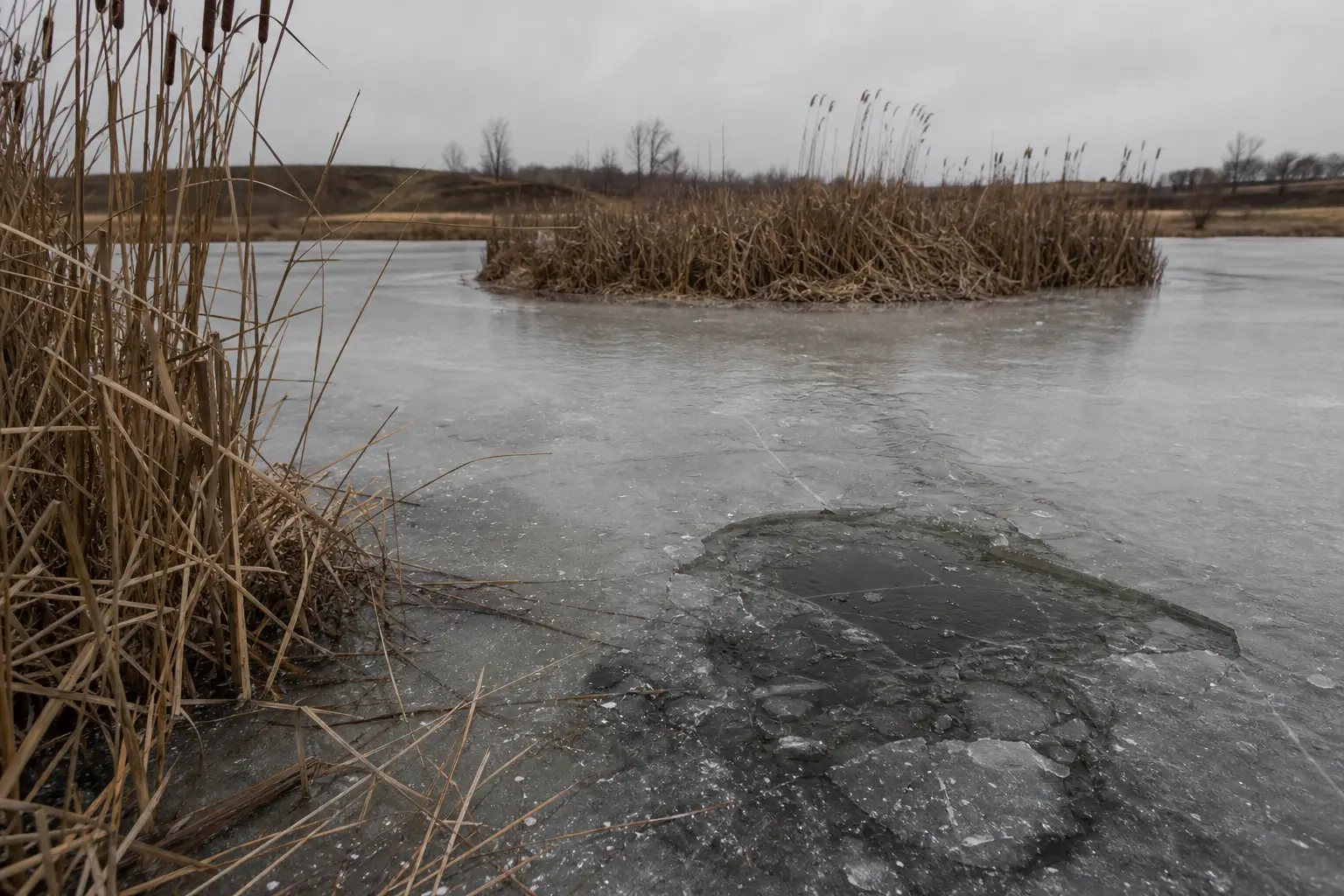
The second weekend I got smart, or I thought I did. I had read somewhere, probably on the internet, probably in some forum thread where a guy bragged about it, that the trick to pheasants without a dog is to hunt the cover nobody else hunts. The nasty stuff. So I went to a patch of public ground on the east end of the county that had a frozen slough running through the middle of it. That slough was the reason everyone else stayed out. The dogs wouldn’t cross it, or their owners wouldn’t let them. The ice was that weak gray kind you get before a real hard freeze, where a fifty pound dog goes through and a grown man definitely goes through.
There was a little island out in the middle of it, maybe forty feet long and twenty across, grown up in cattails and dead canary grass. And on that island, I was now certain, lived every pheasant in the county that had not already been shot.
So I did what any reasonable man would do. I looked at that sketchy ice from the bank for a long time, told myself it was fine, and I walked out. I did it wrong. I walked with my full weight on the first step and the ice sagged under me with a noise like a rifle shot but it held, and then I did the thing you’re supposed to do but I did it too late: I spread my legs and shuffled, flat footed, trying to keep my weight spread wide. About ten feet in I went down to my knees and started crawling, dragging my shotgun across the ice by the sling, because the deeper I got the more certain I was that this was a stupid idea and also the more certain I was that I wasn’t turning back now that I’d committed to it.
Halfway across, the ice moaned under my hands and a crack opened up and ran ahead of me like a live thing, a foot to the left of my right hand. I just froze. I was kneeling on an ice sheet over water I couldn’t feel the bottom of, wearing a thousand dollars worth of boots and a gun, and I thought clearly, for the first time all morning, about what happens to a man who goes through a slough in November alone. You don’t get a second act on that one. The water would pull the heat out of you in minutes, and the cattails would watch it happen.
I backed up. Slow. I crawled backwards exactly the way I’d come, and the ice got thicker under my hands as I went, and when my boots hit solid ground again I just sat on the bank and shook for a little while. My pulse was loud in my ears. The birds out on that island. If they were out there. Never moved. I’d like to think they were asleep, but the truth is they probably watched me scratch and crawl and retreat and didn’t think I was worth the trouble of flying away from.
So I’ll tell you what I learned that season, and I’ll tell it straight because I already paid for the knowledge with a lot of empty game bags and one close call on some bad ice.
The pheasant without a dog is a patience animal, not a speed animal. The bird wants to hold. Its whole survival play is to sit till you pass, then slip out the back door behind you. So you have to break your own rhythm. Walk ten steps, stop dead, count to five, walk ten more. That pause is what kills a pheasant. It can’t stand the not knowing. A dog forces the bird up by fear. You force it up by being unpredictable, and the pause, that little dead stop in the weeds, is the thing that cracks its nerve. The first time I tried it, walking a fence line with a buddy, I stopped for no reason about twenty yards in and a rooster exploded out of the grass three feet behind me, and I killed it before I even registered it was there. My buddy asked what the hell I was doing standing there. I told him I was counting to five, and he looked at me like I’d lost my mind, and then he started doing it too.
Work the edges, not the middle. Ditch lines, fence rows, field corners, the ragged strip where a cut cornfield meets a stand of switchgrass. Pheasants live on those seams. If you walk the wide open middle of a field you are hunting where the bird isn’t. The bird is at the seam, tucked tight, watching you admire the empty space.
Push them toward a stop. Pheasants would rather run than fly, and they will run to the end of the cover and out the other side if you give them a path. So hunt toward a pinch, a fence corner, a ditch, a mowed road, something that stops the running. If you’ve got a second guy, one of you pushes and one of you hangs at the pinch and waits. The bird that slips your boots runs straight into the other guy’s lap. It took me three seasons of empty game bags to get this through my head. I kept walking fields like the birds would politely fly up and wait for me.
Hunt the light. First ten minutes of legal shooting and the last half hour before dark are when pheasants get up and move to feed. Midday, they’re bedded down and they will let you stomp past within arm’s reach. You and a dogless buddy can do more in forty minutes at sunset than in four hours at noon.
And don’t be proud, because I almost died on account of being proud. When the ice moans, listen to it. The island full of birds is not worth a man’s life, and the man who tells you different is lying, usually to himself. I got a few birds that season, walking ditches at dusk and stopping every ten steps like a broken wind up toy. I never did get a bird off that island. I’m alive to be glad about that, and that’s the whole point of the story, if you’ll let a story have a point instead of a trophy.
Last season I hunted with a borrowed dog again, a little English setter that belonged to a friend, and she found more birds in one morning than I’d kicked out in a month on my own. I won’t pretend the dog didn’t matter. I’ll just say this: the year I didn’t have one taught me more about pheasants than every bird that dog ever pointed, because that year I finally had to be the dog, and I wasn’t very good at it, and the birds knew it, and they made sure I knew it too. Now when I walk a field I stop every ten steps whether I’ve got a dog with me or not. Old habit. It’s the only one I’ve got that ever put a rooster in the bag twice in the same afternoon.